AP Syllabus focus: ‘Business cycles are fluctuations in output and employment caused by changes in aggregate demand and supply.’
Business cycles describe the economy’s recurring, though irregular, ups and downs in real activity.
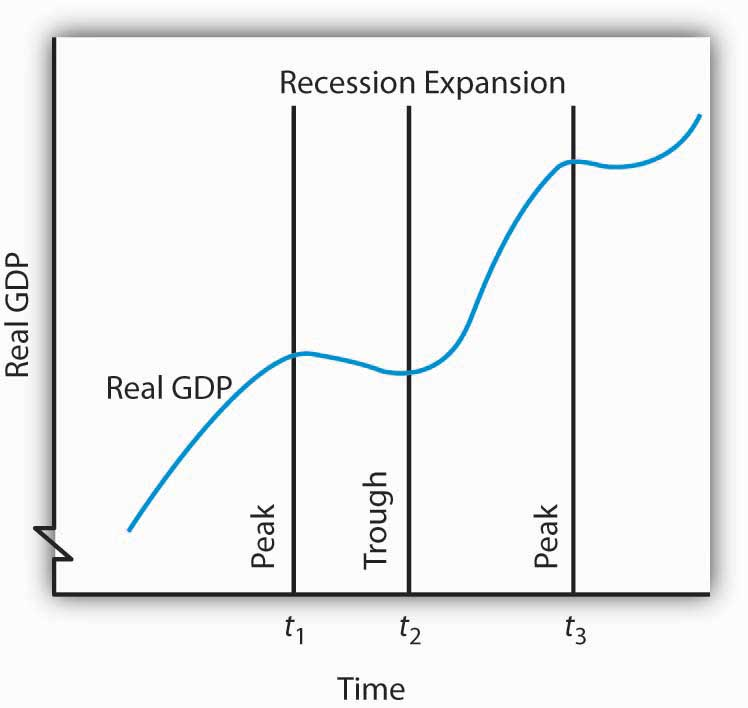
A real-GDP-over-time depiction that overlays cyclical movements on top of a longer-run upward trend. The upward tendency captures long-run economic growth, while the oscillations represent short-run business-cycle fluctuations. This visual helps clarify why economists talk about “cycles” even when the economy grows over the long run. Source
AP Macroeconomics focuses on how shifts in spending and production conditions move output and jobs together over time.
Core Idea: Fluctuations in Output and Employment
Business cycle: short-run fluctuations in real GDP and employment (and therefore unemployment) driven by changes in aggregate demand and aggregate supply.
In a business cycle, the economy does not grow smoothly.
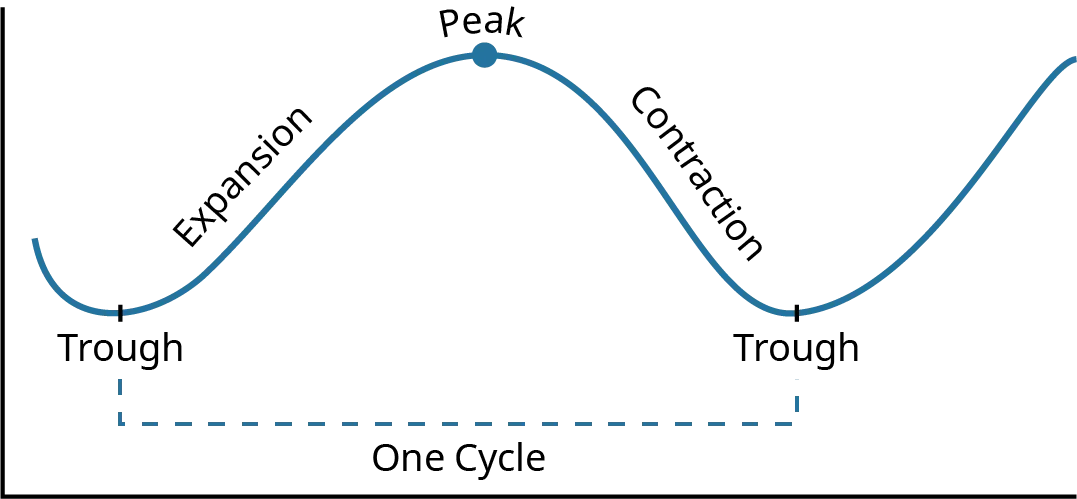
A stylized business-cycle trace that labels expansion, peak, contraction (recession), and trough across time. The figure emphasizes that real economic activity fluctuates rather than following a smooth path, which is the intuition behind “short-run fluctuations in real GDP and employment.” Use it to connect narrative descriptions of booms/busts to the vocabulary you’re expected to apply on AP Macro graphs and questions. Source
Instead, overall production and labor market conditions vary as firms respond to changing sales, costs, and expectations. When real GDP is rising, firms typically hire more workers; when real GDP falls, firms often reduce hours, slow hiring, or lay off workers.
What Typically Moves Together
Real GDP and employment usually move in the same direction.
Unemployment typically moves in the opposite direction of real GDP.
Inflation may rise or fall depending on whether the dominant forces are on the demand side or supply side.
The Drivers: Aggregate Demand and Aggregate Supply
Aggregate Demand (AD)
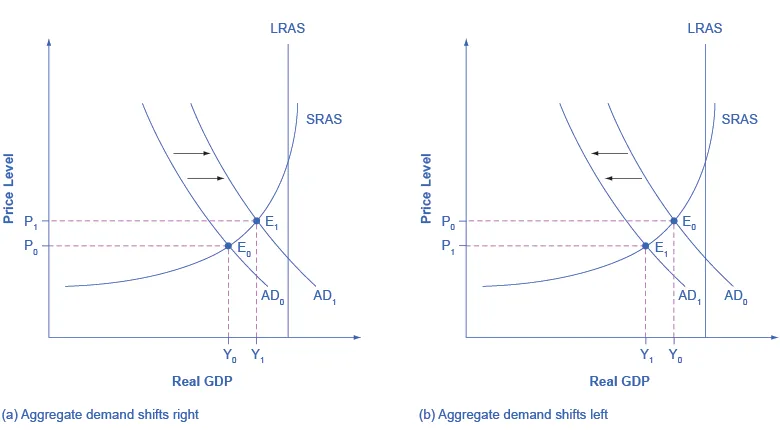
An AD–SRAS–LRAS diagram illustrating how aggregate demand shifts change the short-run equilibrium. A rightward shift of AD raises real GDP and the price level, while a leftward shift lowers real GDP and the price level, holding SRAS fixed. The vertical LRAS line marks potential (full-employment) output, helping distinguish recessionary vs. expansionary gaps. Source
Aggregate demand is total planned spending on a nation’s output at different price levels. When AD changes, firms experience changes in overall demand for their goods and services, influencing production and hiring.
Common reasons AD can change include:
Changes in consumer spending due to income expectations, confidence, or wealth
Changes in business investment spending due to interest rates or expected profitability
Changes in government spending or taxation that alter total spending
Changes in net exports from shifts in foreign income, exchange rates, or trade conditions
Short-Run Aggregate Supply (SRAS)
Short-run aggregate supply reflects how much firms produce at different price levels when some input prices (especially wages) are slow to adjust. When SRAS changes, firms’ costs and production incentives change, affecting output and employment.
Common reasons SRAS can change include:
Changes in input prices (energy, raw materials, wages)
Changes in productivity (technology, organisation, workforce skills)
Disruptions to supply chains or production capacity
How AD and AS Create Business Cycle Fluctuations
Business cycles arise because both spending conditions (AD) and production conditions (SRAS) can change, sometimes quickly. When firms face stronger demand, they increase output and hire more workers; when they face weaker demand, they cut output and reduce labour usage. Similarly, when production becomes easier or cheaper, output and employment can rise; when production becomes harder or more expensive, output and employment can fall.
Two Broad Types of Forces
Demand-side changes (AD shifts): tend to move output and inflation in the same direction in the short run.
Supply-side changes (SRAS shifts): can move output and inflation in opposite directions in the short run.
Shocks and Propagation (Why Cycles Can Be Irregular)
Economic shock: an unexpected event that shifts aggregate demand or aggregate supply, changing output and employment in the short run.
Shocks help explain why business cycles are not perfectly predictable or evenly timed. A shock may be temporary, but it can be amplified through the economy as households and firms adjust spending, hiring, and pricing decisions.
Why Initial Changes Can Spread
Income–spending feedback: reduced output can reduce incomes, which can further reduce spending.
Expectations: pessimistic expectations can delay consumption and investment; optimistic expectations can accelerate them.
Financial conditions: changes in credit availability can strengthen or weaken spending responses.
Key Takeaway for AP Macroeconomics
Business cycles are fundamentally about how changes in aggregate demand and aggregate supply create short-run fluctuations in output and employment. Understanding whether a change is demand-driven or supply-driven is essential for interpreting real-world economic ups and downs.
Practice Questions
(2 marks) Define the term business cycle and identify its two main macroeconomic variables that fluctuate.
1 mark: Correct definition linking business cycles to short-run fluctuations in overall economic activity (output).
1 mark: Identifies real GDP (output) and employment/unemployment as key fluctuating variables.
(6 marks) Explain how changes in aggregate demand and short-run aggregate supply can cause fluctuations in output and employment over time.
1 mark: States that AD changes alter total planned spending, affecting firms’ sales.
1 mark: Explains that higher (lower) AD leads firms to raise (cut) production.
1 mark: Links production changes to higher (lower) employment / lower (higher) unemployment.
1 mark: States that SRAS changes reflect changes in firms’ costs/productivity/production conditions.
1 mark: Explains that adverse (favourable) SRAS shifts reduce (increase) output and employment in the short run.
1 mark: Recognises that unexpected shocks to AD or SRAS help make business cycle movements irregular over time.
FAQ
Because the underlying shocks are unpredictable and differ in size and timing.
Key sources of irregularity include changing expectations, financial market volatility, and policy responses that can shorten, lengthen, or mute fluctuations.
Some events have multiple channels. For example, a disruption can reduce production capacity (SRAS left) while also lowering confidence and spending (AD left).
The overall outcome depends on which channel is stronger.
Expectations influence planned spending and hiring.
If households expect layoffs, they may save more, reducing consumption.
If firms expect weak sales, they may cut investment and hiring, reinforcing the slowdown.
Firms often adjust hours, overtime, and inventories before changing headcount. Hiring and firing can be costly, and businesses may “wait and see” if the shock is temporary.
This can make labour market changes lag behind output changes.
Credit availability and borrowing costs affect consumption (e.g., durable goods) and especially investment. Tighter lending standards can reduce spending even without a large initial shock.
This financial amplification can deepen fluctuations in output and employment.