

AP Syllabus focus: ‘Displacement is the change in an object's position.’
Displacement is a foundational kinematics idea that connects how you describe location with how you describe motion. Mastering its sign, units, and interpretation prevents many common algebra-based errors later in physics.
Position and Coordinate Choice
To talk about displacement, you must first describe position, typically along a straight line (the -axis). You choose:
an origin (the point labeled )
a positive direction (for example, “to the right is positive”)
Different choices are allowed, but you must stay consistent within a problem.
Position (): A signed coordinate that specifies an object’s location relative to a chosen origin along a line, measured in meters (m).
A position can be positive, negative, or zero depending on where the object is relative to the origin and the chosen positive direction.
Displacement: Change in Position
Displacement focuses only on how position changes from an initial moment to a later moment.
Displacement (): The change in an object’s position, equal to final position minus initial position, including sign to indicate direction.
Displacement is a one-dimensional vector quantity in the sense that it has a magnitude and a direction; in 1D, direction is communicated by the sign.
The displacement equation (1D)
Compute displacement by subtracting the initial position from the final position, keeping careful track of signs.
= displacement (m)
= final position (m)
= initial position (m)
The subtraction order matters: swapping and changes the sign and therefore reverses the direction.
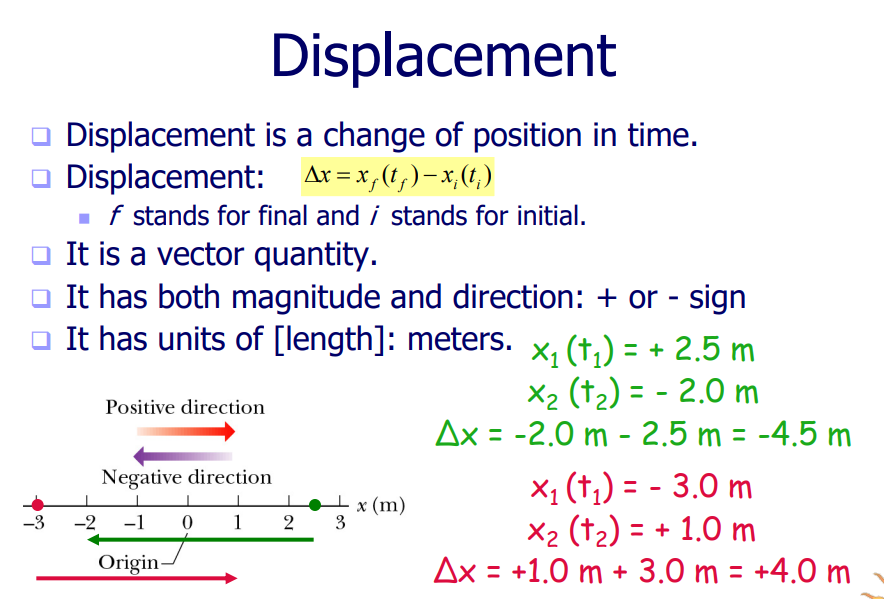
A displacement summary slide pairing the equation with a labeled 1D axis showing origin and positive/negative directions. The worked numerical examples illustrate how subtracting positions with signs can produce either a positive or negative displacement, matching the physical direction of motion on the axis. Source
Interpreting the sign and magnitude
The sign of tells you the direction of the change in position relative to your coordinate system:
: the object’s final position is in the positive direction from its initial position
: the object’s final position is in the negative direction from its initial position
: the final and initial positions are the same (the object ended where it started)
The magnitude of displacement, written , is how far apart the initial and final positions are along the axis, ignoring direction. On its own, does not tell you which way the object’s position changed.
What Displacement Does (and Does Not) Tell You
Displacement captures “start-to-finish change,” not the details of what happened in between.
Depends only on initial and final position
Displacement is determined completely by and . This means:
Two motions that start and end at the same positions have the same displacement.
Any extra back-and-forth motion in between does not change .
This “endpoint-only” feature is why displacement is such an efficient description of motion: it compresses a potentially complicated trip into a single signed change in position.
Not the same as “how much ground was covered”
Displacement does not measure the total amount of motion along the path taken. In everyday language, people often say “moved 5 meters” without specifying whether they mean:
net change in position (displacement), or
total path length (a different idea)
In AP Physics 1, be precise: displacement must be tied to initial and final positions and must include direction (sign) when working in one dimension.
Communicating Displacement Clearly
Units and notation
Use:
SI unit: meter (m)
symbols: , , and
sign convention: state the positive direction if it is not obvious
Acceptable ways to report displacement in 1D include:
a signed value (for example, ), where the sign implies direction
a magnitude with a written direction (for example, “ to the left”), but only if the direction is defined relative to the axis
Common pitfalls to avoid
Confusing position with displacement: is a location; is a change in location.
Dropping the sign: a missing negative sign changes the physical direction of the displacement.
Reversing subtraction: always compute “final minus initial.”
Mixing coordinate systems mid-problem: positions must be measured from the same origin and axis direction for the subtraction to represent the true change in position.
Interpreting incorrectly: zero displacement means the object ended where it started, not that it never moved.
Practice Questions
Question 1 (1–3 marks) An object moves along the -axis from to .
(a) Determine the displacement, .
(b) State the direction of the displacement.
(a) Uses (1 mark)
(a) Calculates (1 mark)
(b) States direction is in the positive direction / to the right (1 mark)
Question 2 (4–6 marks) A cart is at position on a straight track (positive direction is to the right). After some motion, its displacement is .
(a) Calculate the final position .
(b) Explain what the negative sign in means in terms of the cart’s change in position.
(c) If another cart has the same and ends at the same , state what you can conclude about the two carts’ displacements.
(a) Rearranges to (1 mark)
(a) Substitutes: (1 mark)
(a) Calculates with unit (1 mark)
(b) Negative sign indicates the final position is in the negative direction relative to the initial position (1 mark)
(c) States both displacements are identical (same because same and ) (1 mark)
FAQ
If you shift the origin but keep the same axis direction and use the new coordinates consistently, $x_i$ and $x_f$ both change by the same amount, so $\Delta x = x_f - x_i$ stays the same.
If you also reverse the axis direction, the numerical sign convention changes, so report displacement using that new convention.
Displacement compares only start and finish. If an object returns to its starting position, then $x_f = x_i$ and $\Delta x = 0$, even if it travelled a long way in between.
This is not a contradiction; it reflects that displacement measures net change in position, not total travel.
A positive $\Delta x$ means the final position is to the right of the initial position (given the usual convention).
The object could still have moved left during the trip; displacement ignores the intermediate details and reports only the overall change from start to finish.
First define the axis: choose an origin and a positive direction that matches the description (for example, “east is positive”).
Then translate locations into signed positions ($x_i$, $x_f$) and compute $\Delta x$. Finally, communicate direction via the sign or with words consistent with your axis choice.
Follow the measurement precision implied by $x_i$ and $x_f$. In subtraction, the limiting factor is typically the least precise decimal place.
If positions are given as integers in metres, reporting $\Delta x$ to the nearest metre is usually appropriate unless stated otherwise.
