

AP Syllabus focus: ‘Average velocity equals an object's displacement divided by the time interval during which that displacement occurs.’
Average velocity connects where an object starts and ends to how long the change takes. In one-dimensional motion, it is a signed (directional) quantity that describes overall motion across an interval.
Core idea: average velocity over a time interval
Average velocity is defined using an interval with a clear start time and end time. Because velocity is a vector in one dimension, its sign depends on your chosen positive direction.
Displacement and time interval
Displacement () is the change in position: final position minus initial position.
Displacement depends only on the initial and final positions, not on what happens in between (including reversals of direction).
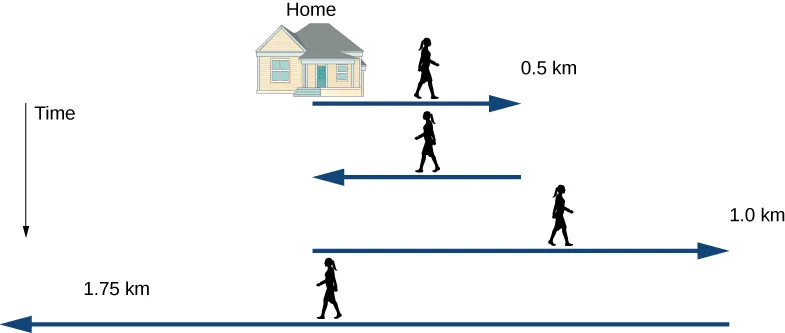
A motion timeline showing multiple legs of a trip with arrows indicating direction and labeled segment lengths. Even with reversals, the net displacement is determined only by the start and finish locations, while distance would add all segment lengths. This makes the sign convention (right/left as positive/negative) concrete. Source
The time interval is similarly based only on the start and end times.
Time interval () is the elapsed time: final time minus initial time.
In typical AP Physics 1 contexts, is positive because time moves forward; negative usually indicates you swapped “initial” and “final.”
Average velocity definition and equation
Average velocity () is displacement divided by the time interval for that displacement.
Average velocity is not “the velocity halfway through” and it is not found by averaging speeds at different moments unless motion is special (for example, symmetric constant-acceleration cases).
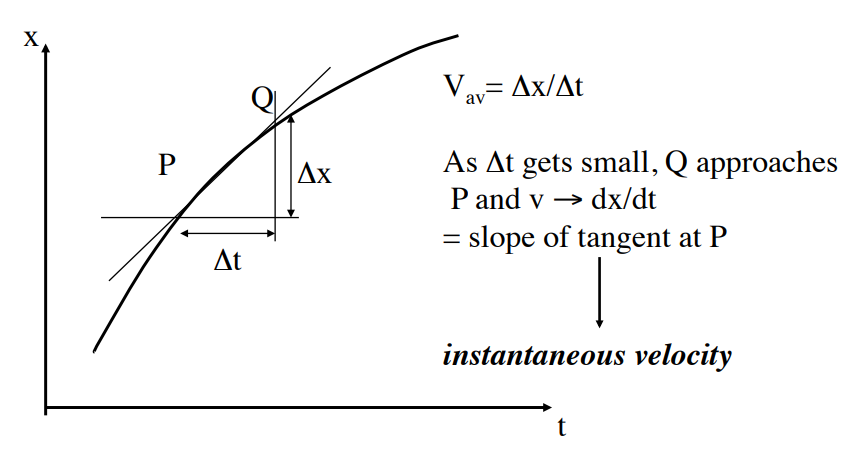
A position–time curve with two marked points (often labeled and ), where and are drawn to show the interval used to compute average velocity. The straight line through the two points represents the secant, whose slope equals for that interval. This visually distinguishes an interval-based average from a single-moment (instantaneous) value. Source
= average velocity (m/s)
= displacement (m)
= time interval (s)
The unit is equivalent to .
Sign conventions and interpretation in 1D
To interpret the sign of , first choose a coordinate axis (for example, “right is positive”).
If , then : net motion in the positive direction.
If , then : net motion in the negative direction.
If , then : the object ends where it started, even if it moved in between.
Magnitude matters too: gives the rate of positional change per time, ignoring direction.
How to compute average velocity from typical information
You can find average velocity from any representation that provides initial and final position and the elapsed time.
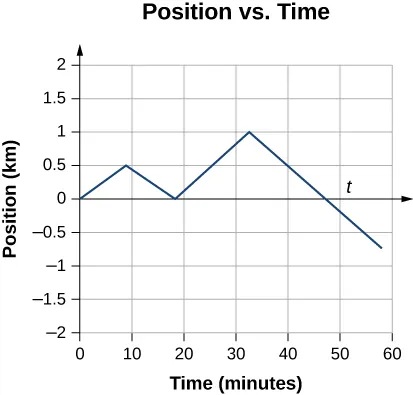
A position–time graph where average velocity over a chosen interval corresponds to the slope of the straight line connecting the interval’s endpoints. Because the slope is , it visually encodes both magnitude (steepness) and sign (upward vs. downward trend) of . Source
From two position-and-time data points
Use the endpoints of the interval only.
Identify and .
Compute .
Compute .
Divide: .
Over multiple segments of motion
If motion is described in stages, average velocity over the entire interval still uses the overall displacement and total elapsed time.
Add displacements to get (include signs).
Add times to get .
Compute .
Do not average segment velocities directly unless the segments have equal durations; otherwise you will weight the intervals incorrectly.
Common pitfalls to avoid
Using distance instead of displacement in the numerator (this changes the meaning).
Dropping the sign of and losing direction information.
Mixing units (for example, minutes with seconds) without converting.
Using intermediate turning points when the question asks for average velocity over a stated start-to-end time interval.
Practice Questions
Q1 (2 marks) A cart moves from at to at . Determine its average velocity.
(1)
and (1)
Q2 (5 marks) A runner’s position along a straight track is recorded: at , ; at , ; at , . (a) Calculate the runner’s average velocity from to . (b) State whether the average velocity from to is positive, negative, or zero, and justify using displacement. (c) Calculate the average velocity from to .
(1)
and (1) (b)
Positive (1)
Justification: so (1) (c)
and (1)
(1)
FAQ
Yes. Average velocity depends on displacement: $v_\text{avg}=\Delta x/\Delta t$.
If the object returns to its starting position, then $\Delta x=0$ and $v_\text{avg}=0$ even though motion occurred.
It means the net displacement over the interval is in the negative direction of your chosen axis.
It does not mean the object “slowed down”; it indicates overall direction from start to finish.
Because velocities at different times may occur over unequal durations. A simple arithmetic mean generally mis-weights the time spent at each velocity.
Average velocity is determined strictly by $\Delta x$ and $\Delta t$ for the interval.
Convert everything before dividing so your units are consistent. Common fixes:
minutes $\rightarrow$ seconds (multiply by 60)
kilometres $\rightarrow$ metres (multiply by 1000)
Then compute $v_\text{avg}$ in $\text{m s}^{-1}$.
Not to find average velocity over the stated interval. You only need the initial and final positions and the elapsed time.
Direction changes affect distance travelled, but average velocity depends on net displacement only.
