

AP Syllabus focus: ‘Over a very small time interval, average velocity and average acceleration are very close to instantaneous values.’
Motion can be described over whole time intervals or at a specific moment. This page focuses on how average quantities connect to instantaneous ones using sufficiently small time intervals and careful interpretation of measured data.
Average vs. Instantaneous Quantities
Average velocity and average acceleration (interval-based)
Average quantities describe what happens over a finite time interval from an initial time to a final time . They depend only on the endpoints of the interval, not on what happened in between.
= displacement over the interval (m)
= time interval (s)
= change in velocity over the interval (m/s)
= time interval (s)
Average velocity is a vector in 1D: its sign depends on the chosen positive direction. Average acceleration is also a vector and can be nonzero even if the object speeds up, slows down, or reverses direction.
Instantaneous velocity and instantaneous acceleration (moment-based)
Instantaneous quantities describe motion at a single moment (conceptually, at one time value). In algebra-based AP Physics 1, you treat an instantaneous quantity as what the average becomes when the interval is made extremely short.
Instantaneous velocity — the velocity of an object at a specific moment in time, approximated by the average velocity over a very small time interval around that moment.
Instantaneous velocity can change continuously during motion, so a single average velocity over a long interval may hide important details (for example, speeding up early and slowing down later).
A key syllabus idea is that over a very small time interval, average velocity and average acceleration are very close to instantaneous values.
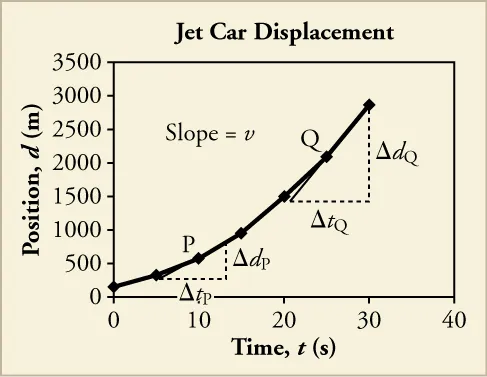
A position–time curve is shown with tangent lines drawn at specific points. The slope of each tangent line represents the instantaneous velocity at that moment, illustrating how “moment-based” velocity is extracted from a graph. This supports the idea that as the time interval shrinks, a secant-slope average velocity approaches the tangent-slope instantaneous velocity. Source
This is the practical bridge between “moment” quantities and measurements you can actually take.
Instantaneous acceleration — the acceleration of an object at a specific moment in time, approximated by the average acceleration over a very small time interval around that moment.
How “Very Small Time Interval” Works in Practice
Approximating instantaneous velocity
To approximate the instantaneous velocity at time , choose two times close to (one just before and one just after, if possible) and compute over that short interval.
The smaller the interval:
the closer the computed average is to the instantaneous value
the more sensitive your result becomes to measurement noise
When using position data from a ticker timer, motion sensor, or video analysis:
keep units consistent (m and s)
use consistent sign conventions (right/left or forward/backward)
report an appropriate number of significant figures based on the measurement precision
Approximating instantaneous acceleration
To approximate instantaneous acceleration at time , use velocity values close to and compute over a short interval. This is often done by:
first determining velocities over small intervals from position data, then
using nearby velocity values to estimate acceleration over an even smaller interval
Because acceleration is based on changes in velocity, it is typically more sensitive to experimental scatter than velocity. Reducing improves the “instantaneous” approximation but can also amplify random error.
Common Interpretation Pitfalls (and How to Avoid Them)
Confusing average speed with average velocity: speed ignores direction; velocity includes sign.
Assuming average equals instantaneous: they only match reliably when is very small or when velocity/acceleration is constant.
Using a long interval near a turnaround: if the object reverses direction within the interval, may be near zero even though instantaneous speeds were large.
Mixing intervals: ensure the used for or matches the same endpoints.
Practice Questions
(2 marks) A cart’s position changes from at to at . State what physical quantity over this interval approximates, and why.
Identifies it approximates the instantaneous velocity at about (1)
Justifies using “very small time interval so average instantaneous” (1)
(5 marks) A student wants the instantaneous acceleration at . Velocity data are and .
(a) Calculate an estimate of the instantaneous acceleration at . (2 marks)
(b) Give two reasons this estimate may differ from the true instantaneous acceleration. (2 marks)
(c) State one practical change to improve the approximation. (1 mark)
(a) Uses with and (1)
(a) (1)
(b) Any two: not small enough; acceleration changing during interval; measurement uncertainty in ; timing resolution limits (2)
(c) Any one: use smaller (closer velocity points); increase measurement precision/frame rate; repeat and average trials (1)
FAQ
Small enough that the quantity does not change much across the interval, but large enough that measurement uncertainty does not dominate. In practice, you compare results using a couple of different $\Delta t$ values and look for consistency.
Smaller intervals reduce the physics approximation error but can increase relative experimental error because $\Delta x$ or $\Delta v$ becomes tiny compared with instrument resolution and random noise.
Often yes. A “centred” interval around $t$ can reduce bias when the quantity is changing, because it samples behaviour on both sides of the moment of interest.
Yes. Negative velocity only indicates direction. “Speeding up” means the magnitude $|v|$ is increasing; this can happen with either positive or negative velocity.
Use the midpoint time of the interval (halfway between the two timestamps). This best represents where the estimate applies when the interval is small.
