TutorChase logo
Login
AP Physics 1: Algebra Notes

1.2.4 Average Acceleration

AP Syllabus focus: ‘Average acceleration equals the change in velocity divided by the time interval during which that change occurs.’

Average acceleration connects how an object’s velocity changes to how long that change takes. In AP Physics 1 Algebra, it is used to describe motion over a chosen time interval using clear sign conventions and units.

Core Idea: Average Acceleration Over a Time Interval

What average acceleration describes

Average acceleration compares the change in velocity to the elapsed time for that change. It does not require the acceleration to be steady during the interval; it is a single value that represents the overall velocity change per unit time.

Average acceleration: The change in velocity divided by the time interval during which that change occurs.

Average acceleration is a vector quantity in one dimension, meaning it can be positive or negative depending on your chosen positive direction.

The algebraic relationship

The defining relationship is:
Pasted image

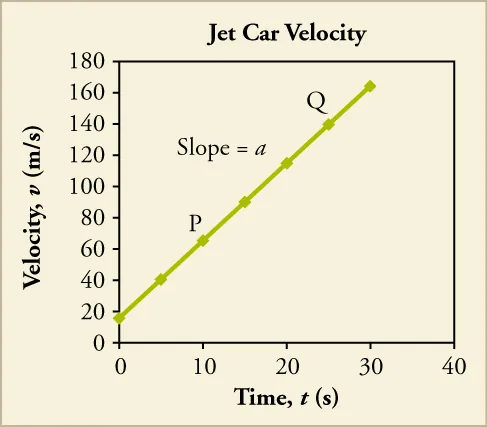
Velocity–time graph for a jet car with two labeled points (P and Q) used to compute slope. The slope of the line represents acceleration, so the average acceleration over an interval is aavg=Δv/Δta_{\text{avg}}=\Delta v/\Delta t read from the rise-over-run between the two points. Source

aavg=ΔvΔta_{\text{avg}}=\dfrac{\Delta v}{\Delta t}

aavga_{\text{avg}} = average acceleration in m/s2\text{m/s}^2

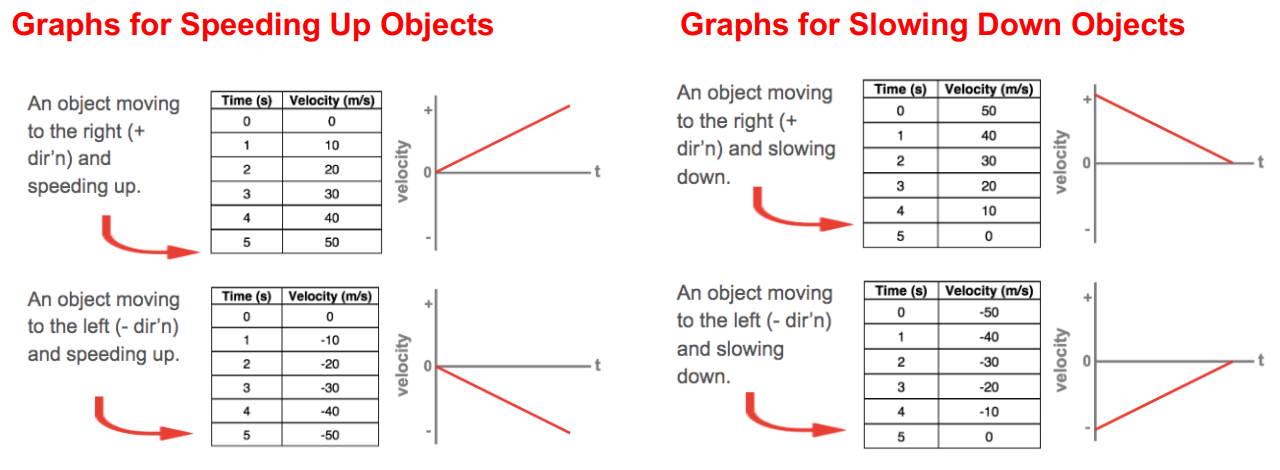
$</p><p>\Delta v=v_f-v_i</p><p></p><p>\Delta v=changeinvelocityin = change in velocity in \text{m/s}</p><p></p><p></p><p></p><p>\Delta t=t_f-t_i</p><p></p><p>\Delta t=timeintervalin = time interval in \text{s}</p><p></p><p></p><p></p><p>v_f</p><p></p><p>v_f=finalvelocityattheendoftheintervalin = final velocity at the end of the interval in \text{m/s}</p><p></p><p></p><p></p><p>v_i</p><p></p><p>v_i=initialvelocityatthestartoftheintervalin = initial velocity at the start of the interval in \text{m/s}</p></div><p>Useconsistentunits(typically<strong>meters</strong>,<strong>seconds</strong>)andkeeptrackofthesignsofvelocities.</p><h2class="editorheading"id="directionsignsandinterpretation1d"><strong>Direction,Signs,andInterpretation(1D)</strong></h2><h3class="editorheading"><strong>Choosingapositivedirection</strong></h3><p>Inonedimension,directionishandledbya<strong>signconvention</strong>:</p><ul><li><p>Pickapositivedirection(forexample,rightwardorupward).</p></li><li><p>Velocitiesinthepositivedirectionare<strong>positive</strong>;intheoppositedirectionare<strong>negative</strong>.</p></li><li><p>Averageaccelerationinheritsitssignfrom</p></div><p>Use consistent units (typically <strong>meters</strong>, <strong>seconds</strong>) and keep track of the signs of velocities.</p><h2 class="editor-heading" id="direction-signs-and-interpretation-1-d"><strong>Direction, Signs, and Interpretation (1D)</strong></h2><h3 class="editor-heading"><strong>Choosing a positive direction</strong></h3><p>In one dimension, direction is handled by a <strong>sign convention</strong>:</p><ul><li><p>Pick a positive direction (for example, rightward or upward).</p></li><li><p>Velocities in the positive direction are <strong>positive</strong>; in the opposite direction are <strong>negative</strong>.</p></li><li><p>Average acceleration inherits its sign from \Delta v(since (since \Delta tispositiveiftimemovesforward).</p></li></ul><h3class="editorheading"><strong>Whatthesigntellsyou</strong></h3><p>Thesignof is positive if time moves forward).</p></li></ul><h3 class="editor-heading"><strong>What the sign tells you</strong></h3><p>The sign of a_{\text{avg}}tellsyouthedirectionofthevelocitychange:</p><ul><li><p> tells you the direction of the velocity change:</p><ul><li><p>a_{\text{avg}} > 0:velocitybecomesmorepositive(couldmeanspeedingupin+directionorslowingdownindirection).</p></li><li><p>: velocity becomes more positive (could mean speeding up in + direction or slowing down in − direction).</p></li><li><p>a_{\text{avg}} < 0:velocitybecomesmorenegative(couldmeanslowingdownin+directionorspeedingupindirection).</p></li><li><p>: velocity becomes more negative (could mean slowing down in + direction or speeding up in − direction).</p></li><li><p>a_{\text{avg}} = 0:nonetchangeinvelocityovertheinterval(velocitycouldbeconstant).</p></li></ul><p>Avoidthecommonmistakeofassumingnegativeaccelerationautomaticallymeansslowingdown.</p><imgsrc="https://tutorchaseproduction.s3.euwest2.amazonaws.com/e9ea75dad068446e9ccdb53414e984e6file.png"alt="Pastedimage"style="width:820px;height:301px;cursor:pointer;"width="820"height="301"draggable="true"><p><em>Asetofrepresentative: no net change in velocity over the interval (velocity could be constant).</p></li></ul><p>Avoid the common mistake of assuming “negative acceleration” automatically means “slowing down.”</p><img src="https://tutorchase-production.s3.eu-west-2.amazonaws.com/e9ea75da-d068-446e-9ccd-b53414e984e6-file.png" alt="Pasted image" style="width: 820px; height: 301px; cursor: pointer;" width="820" height="301" draggable="true"><p><em>A set of representative vtgraphsshowingthatspeedingupcorrespondstothevelocitymovingawayfromzero,whileslowingdowncorrespondstothevelocitymovingtowardzero.Thefourcasesclarifythatthesignofaccelerationdependsontheslopeof graphs showing that speeding up corresponds to the velocity moving away from zero, while slowing down corresponds to the velocity moving toward zero. The four cases clarify that the sign of acceleration depends on the slope of v(t),notonwhethertheobjectisslowingdownineverydaylanguage.</em><atarget="blank"rel="noopenernoreferrernofollow"href="https://www.physicsclassroom.com/getattachment/PhysicsVideoTutorial/Kinematics/VelocityTimeGraphsChangingSpeed/LectureNotes/VelocityTimeGraphs2.pdf?lang=enUS"><em>Source</em></a></p><p>Slowingdownhappenswhen<strong>velocityandaccelerationhaveoppositesigns</strong>.</p><h2class="editorheading"id="selectingtheintervalandreadinginformation"><strong>SelectingtheIntervalandReadingInformation</strong></h2><h3class="editorheading"><strong>Theintervalmatters</strong></h3><p>Averageaccelerationdependsonthechosenstartandendtimes:</p><ul><li><p>Overalongerinterval,, not on whether the object is “slowing down” in everyday language. </em><a target="_blank" rel="noopener noreferrer nofollow" href="https://www.physicsclassroom.com/getattachment/Physics-Video-Tutorial/Kinematics/Velocity-Time-Graphs-Changing-Speed/Lecture-Notes/VelocityTimeGraphs2.pdf?lang=en-US"><em>Source</em></a></p><p>Slowing down happens when <strong>velocity and acceleration have opposite signs</strong>.</p><h2 class="editor-heading" id="selecting-the-interval-and-reading-information"><strong>Selecting the Interval and Reading Information</strong></h2><h3 class="editor-heading"><strong>The interval matters</strong></h3><p>Average acceleration depends on the chosen start and end times:</p><ul><li><p>Over a longer interval, a_{\text{avg}}reflectstheoverallchange.</p></li><li><p>Overashorterinterval,itcanbedifferentifthemotionvaries.</p></li></ul><p>Tocomputeitcorrectly,youmustidentify:</p><ul><li><p>The<strong>initialvelocity</strong>atthestartoftheinterval</p></li><li><p>The<strong>finalvelocity</strong>attheendoftheinterval</p></li><li><p>The<strong>timeinterval</strong>betweenthosetwomoments</p></li></ul><h3class="editorheading"><strong>PracticalnotesforAPproblems</strong></h3><p>Whenvelocitiesaregivenwithdirections(orsigns),treatthemas<strong>signedvalues</strong>:</p><ul><li><p> reflects the overall change.</p></li><li><p>Over a shorter interval, it can be different if the motion varies.</p></li></ul><p>To compute it correctly, you must identify:</p><ul><li><p>The <strong>initial velocity</strong> at the start of the interval</p></li><li><p>The <strong>final velocity</strong> at the end of the interval</p></li><li><p>The <strong>time interval</strong> between those two moments</p></li></ul><h3 class="editor-heading"><strong>Practical notes for AP problems</strong></h3><p>When velocities are given with directions (or signs), treat them as <strong>signed values</strong>:</p><ul><li><p>“3\ \text{m/s}eastand east” and “-3\ \text{m/s}canrepresentthesamevelocityifeastisdefinedaspositive.</p></li><li><p>Ifanobjectreversesdirectionduringtheinterval,” can represent the same velocity if east is defined as positive.</p></li><li><p>If an object reverses direction during the interval, v_iand and v_fmayhaveoppositesigns,making may have opposite signs, making \Delta vlargeinmagnitude.</p></li></ul><p>Unitscheck:</p><ul><li><p>Velocity: large in magnitude.</p></li></ul><p>Units check:</p><ul><li><p>Velocity: \text{m/s}</p></li><li><p>Time:</p></li><li><p>Time: \text{s}</p></li><li><p>Acceleration:</p></li><li><p>Acceleration: \text{m/s}^2(readasmeterspersecondpersecond)</p></li></ul><h2class="editorheading"id="commonerrorstoavoid"><strong>CommonErrorstoAvoid</strong></h2><ul><li><p>Usingspeedinsteadofvelocity(speedhasnosign;averageaccelerationneeds<strong>velocity</strong>).</p></li><li><p>Mixingdirectionswithoutaconsistentsignconvention.</p></li><li><p>Forgettingthat (read as “meters per second per second”)</p></li></ul><h2 class="editor-heading" id="common-errors-to-avoid"><strong>Common Errors to Avoid</strong></h2><ul><li><p>Using speed instead of velocity (speed has no sign; average acceleration needs <strong>velocity</strong>).</p></li><li><p>Mixing directions without a consistent sign convention.</p></li><li><p>Forgetting that \Delta v = v_f - v_i$ (order matters).

  • Using milliseconds or minutes without converting to seconds.

  • Treating average acceleration as describing what happens at every moment; it only summarizes the interval’s net effect.

  • FAQ

    Yes, but convert to $\text{m/s}$ first using $1\ \text{km/h} \approx 0.278\ \text{m/s}$.

    Then apply $a_{\text{avg}}=\Delta v/\Delta t$.

    Then $\Delta t=0$, and average acceleration is undefined.

    You must have two distinct times.

    Uncertainty in $v_i$ and $v_f$ carries into $\Delta v$.

    A larger relative uncertainty in $\Delta v$ gives a larger relative uncertainty in $a_{\text{avg}}$.

    Not necessarily. Different choices of start/end times can produce different $\Delta v$ and thus different $a_{\text{avg}}$.

    It depends on the interval.

    They are equivalent unit notations.

    $\text{m},\text{s}^{-2}$ is common in scientific writing and emphasises “per second squared.”

    Practice Questions

    Q1 (1–3 marks) A car’s velocity changes from 4.0 m/s-4.0\ \text{m/s} to +2.0 m/s+2.0\ \text{m/s} in 3.0 s3.0\ \text{s}. Calculate the average acceleration.

    • Uses Δv=vfvi\Delta v = v_f - v_i with correct substitution (1)

    • Calculates Δv=2.0(4.0)=6.0 m/s\Delta v = 2.0 - (-4.0) = 6.0\ \text{m/s} (1)

    • aavg=Δv/Δt=6.0/3.0=2.0 m/s2a_{\text{avg}}=\Delta v/\Delta t = 6.0/3.0 = 2.0\ \text{m/s}^2 with correct unit (1)

    Q2 (4–6 marks) A cyclist travels along a straight road (take forward as positive). At t=0t=0, vi=+6.0 m/sv_i=+6.0\ \text{m/s}. At t=4.0 st=4.0\ \text{s}, v=+2.0 m/sv=+2.0\ \text{m/s}. At t=7.0 st=7.0\ \text{s}, vf=1.0 m/sv_f=-1.0\ \text{m/s}.
    (a) Determine the average acceleration from 00 to 4.0 s4.0\ \text{s}.
    (b) Determine the average acceleration from 4.04.0 to 7.0 s7.0\ \text{s}.
    (c) Determine the average acceleration from 00 to 7.0 s7.0\ \text{s}.

    (a) Δv=2.06.0=4.0 m/s\Delta v = 2.0 - 6.0 = -4.0\ \text{m/s} (1), Δt=4.0 s\Delta t = 4.0\ \text{s} (1), aavg=4.0/4.0=1.0 m/s2a_{\text{avg}}=-4.0/4.0=-1.0\ \text{m/s}^2 (1)
    (b) Δv=1.02.0=3.0 m/s\Delta v = -1.0 - 2.0 = -3.0\ \text{m/s} (1), Δt=3.0 s\Delta t = 3.0\ \text{s}, aavg=3.0/3.0=1.0 m/s2a_{\text{avg}}=-3.0/3.0=-1.0\ \text{m/s}^2 (1)
    (c) Δv=1.06.0=7.0 m/s\Delta v = -1.0 - 6.0 = -7.0\ \text{m/s} (1), Δt=7.0 s\Delta t = 7.0\ \text{s}, aavg=7.0/7.0=1.0 m/s2a_{\text{avg}}=-7.0/7.0=-1.0\ \text{m/s}^2 (1)

    Hire a tutor

    Please fill out the form and we'll find a tutor for you.

    1/2
    Your details
    Alternatively contact us via
    WhatsApp, Phone Call, or Email