

AP Syllabus focus: ‘An object is accelerating when the magnitude or direction of its velocity changes.’
Acceleration is often misunderstood as “going fast.” In physics, acceleration is about how velocity changes over time. You can accelerate while speeding up, slowing down, or even while briefly stopped.
Core meaning of “accelerate”
Velocity includes both speed (magnitude) and direction, so any change in either counts as acceleration.
Acceleration — the rate at which an object’s velocity changes with time; it can result from a change in speed, a change in direction, or both.
Saying an object “is accelerating” does not require its velocity to be large; it requires that velocity is changing.
Acceleration from changing speed (magnitude of velocity)
In one dimension, changing speed means the numerical value of velocity (including sign) changes over time.
Speeding up
If an object’s speed increases, it is accelerating. In 1D, this often happens when velocity and acceleration have the same sign:
Moving in the + direction and increases speed.
Moving in the − direction and increases speed (it becomes “more negative”).
Slowing down
If an object’s speed decreases, it is still accelerating (because velocity is changing). In 1D, this often happens when velocity and acceleration have opposite signs:
Moving in the + direction with reduces speed.
Moving in the − direction with reduces speed.
The common phrase “deceleration” usually means “slowing down,” but in AP Physics, you should communicate using the sign and direction of acceleration instead of relying on the word.
Acceleration from changing direction
Even if speed stays the same, changing direction means velocity changes, so the object accelerates.
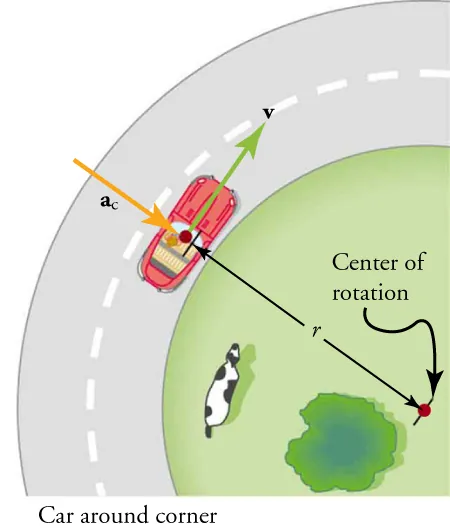
A car rounding a curve with velocity tangent to the path while the centripetal acceleration points inward toward the center of rotation. The speed can stay constant, yet the velocity still changes because its direction changes. This diagram emphasizes that acceleration is a vector and can be perpendicular to velocity during uniform circular motion. Source
In one dimension, a direction change is a sign change in velocity (from + to − or − to +). At a reversal point:
The object can be momentarily at .
It may still have nonzero acceleration at that instant, because acceleration depends on how velocity is changing, not on the current value of velocity.
How to identify whether an object is accelerating
You determine acceleration by checking whether velocity changes during a time interval.
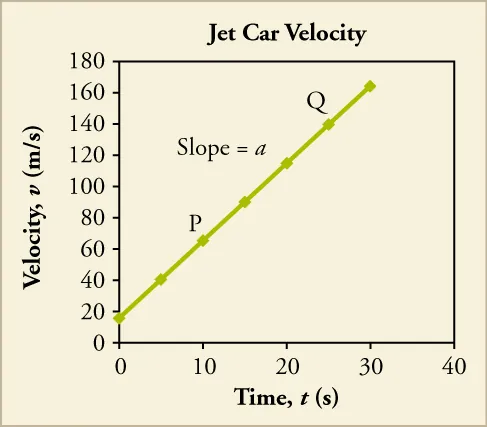
A velocity–time graph for a jet car speeding up, where the straight-line slope is explicitly labeled as acceleration. Because the slope is constant and positive, the acceleration is constant and . This visual also helps connect “velocity changes over time” to the algebraic idea of rate of change. Source
A constant velocity means zero acceleration.
= average acceleration, in
= change in velocity , in
= time interval, in
This relationship reinforces the syllabus idea: if over a time interval, then and the object is accelerating in that interval.
Direction and sign conventions in 1D
In one-dimensional motion, you choose a positive direction (often right or up). Then:
Positive acceleration means acceleration points in the + direction.
Negative acceleration means acceleration points in the − direction.
A frequent mistake is to assume negative acceleration always means slowing down.
It does not. Negative acceleration means “pointing in the negative direction.” Whether the object speeds up or slows down depends on the sign of velocity at the same time.
Common “is it accelerating?” checkpoints
Use these quick tests:
If velocity is constant (same value, same sign), then no acceleration.
If velocity’s magnitude changes, then accelerating.
If velocity’s sign changes, then accelerating (direction change).
If the object is “moving but slowing,” it is still accelerating.
If the object is “not moving at one instant,” it may still be accelerating if it is about to start moving or reverse direction.
Practice Questions
(2 marks) A cart moves to the right (take right as positive) but its speed is decreasing. State the sign of its acceleration and briefly explain why.
Correct sign: (1)
Explanation links slowing down while moving right to acceleration opposite the velocity direction / opposite sign to velocity (1)
(5 marks) An object moves along a straight line. Its velocity changes from to over . (a) Calculate the average acceleration. (2 marks) (b) Does the object accelerate during this interval? Justify using the definition of acceleration. (2 marks) (c) The object must have at some instant in this interval. Can its acceleration at that instant be nonzero? State yes/no with a reason. (1 mark)
Uses with (1)
(1) (b)
States yes, it accelerates (1)
Justification: velocity changes in magnitude and/or direction (from negative to positive), so acceleration is nonzero (1) (c)
Yes; acceleration depends on change of velocity, not on the value of velocity at an instant (1)
FAQ
No. Velocity describes how fast and in what direction you move. Acceleration describes how quickly velocity changes with time.
Because $v=0$ is a snapshot, but acceleration concerns how velocity is changing. At a turning point, velocity can be zero while still changing direction.
It means the acceleration vector points in the negative direction of your chosen axis. It may correspond to speeding up or slowing down depending on the sign of $v$.
You primarily feel acceleration: changes in speed or direction require forces that push on you, creating noticeable sensations.
Acceleration still means changing velocity, and velocity includes direction. So changing direction alone (even at constant speed) implies acceleration.
