

AP Syllabus focus: ‘A system’s properties are determined by interactions between the objects within it.’
Studying forces and motion starts with deciding what you are analysing. In AP Physics 1, that means defining a system, identifying the objects inside it, and describing how their interactions determine measurable system properties.
What “system” means in physics
A system is a selected collection of objects treated together for analysis. The core idea in this subtopic is that the system’s behaviour and measurable properties come from the interactions between the objects within it.
System: A chosen set of one or more objects considered together as the subject of analysis.
The same physical situation can be described using different systems, depending on what you want to predict or explain. Choosing a good system is a modelling decision, not a single “correct” choice.
System boundaries and what counts as “inside”
When you define a system, you set an imagined boundary that separates what you include from everything else.
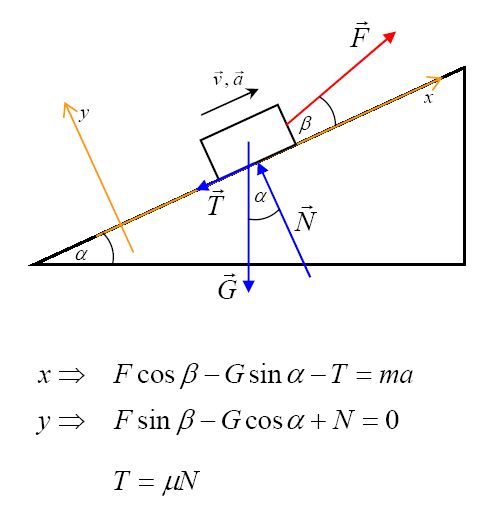
An inclined-plane force diagram illustrating how choosing the system (the block) determines which interactions appear as forces: weight, normal force, and friction. The labeled forces emphasize that the diagram is about interactions between the block and other objects (Earth and the surface) across a chosen boundary. This is the visual starting point for connecting “what’s in the system” to measurable outcomes like acceleration and momentum change. Source
The boundary is not necessarily a physical surface; it is part of your model.
System boundary: An imaginary surface that separates the objects included in the system from everything outside the system.
A clear boundary prevents common mistakes such as mixing forces or energy changes that belong to different objects.
Interactions inside a system determine system properties
An interaction is a mutual influence between two objects (for AP Physics 1, typically via contact or gravity). The syllabus emphasis here is that the system’s properties depend on these internal interactions, not just on a list of objects.
Examples of how internal interactions shape properties:
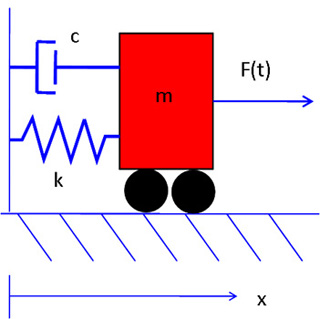
A cart–spring–damper model showing how interactions inside the chosen system (spring constant and damping ) influence the cart’s motion. The applied force represents an external interaction crossing the system boundary, while the spring/damper forces are internal if those elements are included in the system. Diagrams like this help you decide what counts as “inside” versus “outside” before writing equations. Source
Two carts connected by a spring: the spring force couples their motions, so the system’s motion can involve compression/extension effects.
A book and the Earth: the gravitational interaction links the book’s weight to the Earth-book pair, even if you often model only the book.
A pair of colliding objects: contact forces act between the objects, and the collision outcome depends on that interaction.
Properties you may assign to a system
Once the system is defined, you can describe system properties such as:
Total mass (sum of the masses of objects inside)
Total momentum (vector sum of object momenta inside)
Internal energy associated with relative motion and internal interactions (described qualitatively at this level)
These properties are meaningful only after you have specified which objects are included and which interactions are considered internal.
How to describe a system effectively (AP skill)
A strong system description is specific, testable, and tied to the question being asked.
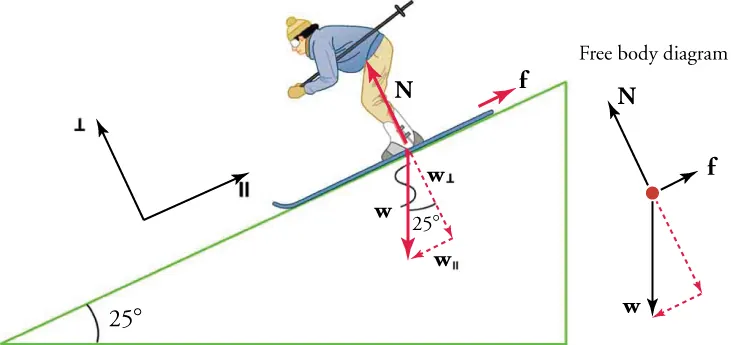
A textbook-style inclined-plane figure with a free-body diagram used to set up Newton’s second law along axes aligned to the surface. It models how you first identify the system of interest, then represent each interaction as a force vector before writing component equations. This supports the AP habit of making the system definition explicit before doing any algebra. Source
Use this checklist:
State the goal (what you want to predict: motion, force relationships, qualitative behaviour).
Name the objects included (e.g., “block + table” rather than “the setup”).
Identify the internal interactions (e.g., contact forces between block and table; gravitational attraction between Earth and block).
Clarify what is outside the system (objects not included), so you do not accidentally attribute their effects to internal behaviour.
Common pitfalls to avoid:
Treating an interaction as one-sided (an interaction always involves two objects, even if one is not in your system).
Describing only an object’s properties (mass, velocity) without noting the interactions that determine the system’s behaviour.
Changing the system mid-solution without stating it, which changes what “system properties” refer to.
Why the choice of system matters
Different system choices highlight different interactions and therefore different properties. In AP Physics 1, many errors come from an unclear system definition rather than bad algebra. If you can clearly state “what is in the system” and “which objects interact within it,” you have set up the rest of dynamics correctly and consistently.
Practice Questions
(2 marks) Define a “system” in physics and state, in one sentence, what determines a system’s properties according to the syllabus.
1 mark: Correct definition: a chosen set of one or more objects treated together for analysis.
1 mark: States that system properties are determined by interactions between the objects within the system.
(5 marks) Two blocks, A and B, are in contact on a horizontal surface. A student wants to analyse their motion when pushed. Describe two different valid choices of system and, for each choice, clearly identify (i) the objects in the system, and (ii) one internal interaction that helps determine a system property.
1 mark: System choice 1 clearly stated (e.g., “A only” or “A + B”).
1 mark: Objects for system choice 1 correctly identified.
1 mark: Internal interaction for system choice 1 correctly identified (must be between objects within that system).
1 mark: System choice 2 clearly stated and different from the first.
1 mark: Objects and one internal interaction for system choice 2 correctly identified.
FAQ
Choose the system that makes the interactions you care about internal and keeps the description aligned to the quantity you want to predict.
No. A system is made of objects (or parts of objects). Forces and motion describe interactions and behaviour of those objects.
Gravity becomes an internal interaction of the Earth–object system, which can change how you describe where certain effects “come from” in words.
Listing objects says what is included; describing interactions explains how those objects influence each other and why system properties take the values they do.
Be concrete: name each object or group (e.g., “block A and block B” rather than “the setup”) and mention at least one interaction between included objects.

