

AP Syllabus focus: ‘If internal details are not important, a system can be treated as a single object.’
When many interacting parts move together, you can simplify analysis by replacing them with one “equivalent” object. This model keeps the essential external interactions while ignoring internal complexity you do not need.
When to Model a System as One Object
A system can be anything you choose to analyse: a cart plus blocks, two skaters pushing off, or a train and its cars. Treating that system as one object is appropriate when:
You only care about the overall motion (speeding up, slowing down, direction change).
The parts do not significantly move relative to each other, or their internal motions are irrelevant to the question.
You need the net effect of external interactions, not the details of internal forces.
This approach is especially useful for translating a messy “many-object” situation into one set of force and motion relationships.
Key Idea: Keep External Effects, Ignore Internal Details
What “ignoring internal details” means
Inside a system, objects can pull, push, or collide with one another. When you model the system as one object, you do not track those internal interactions individually.
Internal forces: Forces that objects within the system exert on other objects within the same system.
Internal forces may be large, but they mainly reshuffle momentum/energy among parts; they do not need to appear in the single-object force balance.
What you must still include
Even in a single-object model, you must still represent all influences from outside the system.
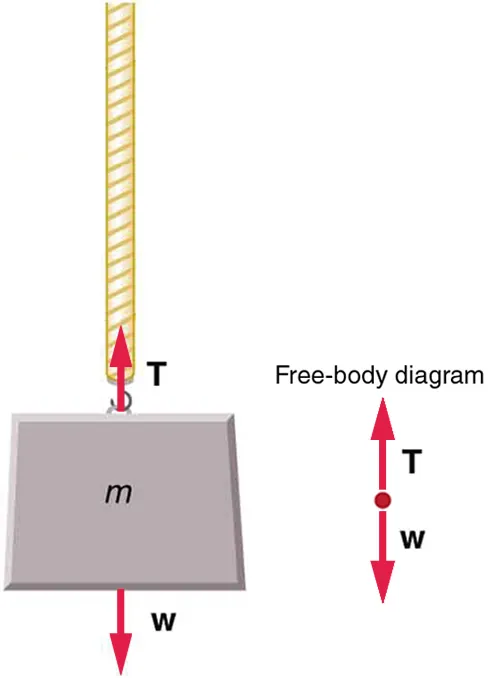
A mass suspended by a rope is shown alongside its free-body diagram, where the rope’s tension acts upward and the weight acts downward. This is a canonical example of representing an object (or whole system) as a single point acted on only by external forces. Source
External forces: Forces exerted on the system by objects in the environment (outside the chosen system boundary).
A good check is: if the agent causing the force is not in your system, the force is external and should be included.
How the Single-Object Model Works (AP Physics 1 Algebra Level)
Step 1: Choose the system boundary strategically
Pick a boundary that makes the problem simpler:
Include objects that interact strongly with each other (to eliminate their internal forces from your equations).
Exclude objects whose forces you want to treat as external (so they appear explicitly).
Common modelling choices:
“Two blocks + rope” as one system (tension becomes internal).
“Cart + rider” as one system (contact forces between them become internal).
Step 2: Replace the system with one object with total mass
You treat the system as if it were a single object whose mass is the sum of the parts, . This does not mean the system is physically rigid; it means you are tracking only the system’s overall translation.
Single-object model: A representation in which a multi-object system is treated as one object with total mass, responding only to the net external force.
Step 3: Apply the net external force relation to the system
For the system’s overall motion, use the net external force and the system’s acceleration.
= Net external force on the system, in newtons (N)
= Total mass of the system, in kilograms (kg)
= Acceleration of the system (its overall translational acceleration), in m/s
This equation is the core payoff of the model: multiple objects reduce to one force balance.
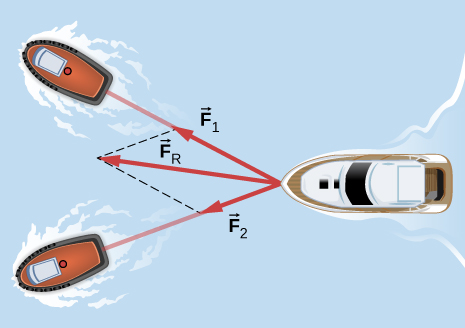
An overhead free-body diagram shows a system pulled by two external forces, and , applied at a point representing the object/system. It highlights how the system’s acceleration is determined by the vector sum of external forces rather than by internal details within the system. Source
What Changes (and What Doesn’t) When You Use This Model
Forces you should not include separately
If you included both interacting objects in the system, then forces they exert on each other (like contact forces or tension between them) are internal and should not appear as separate external forces in the system equation.
Forces you must still include
Typical external forces on a multi-object system can include:
Weight from Earth on each part (often combines to total weight )
Normal forces from a floor or wall (from outside the system)
Applied pushes/pulls from an external agent
Friction from an external surface (if the surface is not in the system)
Motion described by the model
The model predicts the acceleration of the system as a whole. It does not directly tell you:
How forces are distributed among components
Whether parts compress, stretch, or slip internally
The acceleration of individual parts relative to each other
Those details require switching back to a multi-object analysis, but only if the question demands it.
Practice Questions
(1–3 marks) A student treats two connected blocks on a frictionless table as a single system. State one advantage of modelling the two-block system as one object.
1 mark: States a valid advantage, e.g. internal forces (such as tension between blocks) are ignored/cancel and only external forces need to be considered; fewer equations required.
(4–6 marks) Two objects of masses and are in contact and pushed horizontally by an external force . The surface is frictionless. The student models both objects as a single system. (a) Write an expression for the total mass of the system. (1 mark) (b) Identify which forces are external to the system and which are internal. (2 marks) (c) Using the single-object model, write an expression for the acceleration of the system. (2 marks)
(a) 1 mark: .
(b) 1 mark: External force is (and vertical forces from Earth/surface may be noted as external).
(b) 1 mark: Contact force between the two objects is internal (does not appear in ).
(c) 1 mark: Uses with horizontal net force .
(c) 1 mark: .
FAQ
Choose the boundary to eliminate forces you do not want to track. Include objects that exert complicated forces on each other (so those become internal), and exclude objects whose influence you want to appear explicitly as external forces.
Yes, if you only need the overall translation. The single-object model can still predict the system’s overall acceleration even if parts shift internally, but it will not describe that internal motion.
Double-counting internal forces as external. If both objects are inside the system, any forces they exert on each other must not appear in $\sum F_{\text{ext}}$.
No. “Single object” is a modelling choice about what you track (overall motion), not a claim that distances between parts are fixed.
It predicts $a=0$ for the system as a whole. The system’s overall velocity remains constant, even though internal forces can still cause internal rearrangements within the system.
