

AP Syllabus focus: ‘Systems can interact with the environment and may transfer energy or mass.’
Understanding what counts as the “system” versus the “environment” helps you track which interactions matter. In AP Physics 1, you use system boundaries to decide what can cross them and how transfers change motion and energy.
Identifying Systems and Environments
What is a system?
A system is the collection of object(s) you choose to analyse together. Everything not included is the environment. Your choice depends on what question you want to answer and which interactions you want to treat as internal.
System — the object or set of objects chosen for analysis, treated as a single unit for tracking forces, energy, momentum, and/or mass.
A system is not “right” or “wrong”; it is useful or not useful. For example, two carts that collide can be treated as one system if you want to focus on how external forces affect the pair.
System boundary
The boundary is an imaginary surface separating the system from the environment.
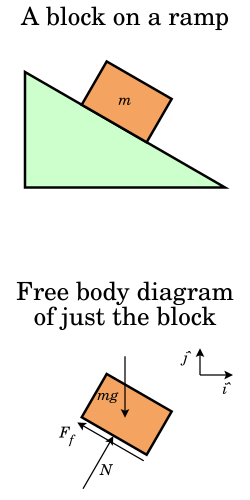
A free-body diagram (FBD) isolates the chosen object (the system) and represents only forces exerted on it by the environment as labeled vectors. This visual convention makes it explicit which interactions cross the system boundary and therefore count as external forces in Newton’s second-law modeling. Source
The boundary determines what is considered internal (within the boundary) and external (across the boundary).
Boundary — the conceptual dividing line that separates the system from the environment and determines what transfers (energy or mass) are allowed to cross.
A force exerted by an object outside the boundary on an object inside the boundary is an external interaction; forces between objects both inside the boundary are internal interactions.
Transfers Between System and Environment
Energy transfers
A system can gain or lose energy due to interactions with the environment. In AP Physics 1 mechanics, the most common energy transfer mechanism is work done by external forces (including applied forces and friction when the surface is in the environment).
Energy ideas are most powerful when you explicitly state:
what the system is,
what is in the environment,
what interactions cross the boundary,
whether those interactions transfer energy into or out of the system.
Energy transfer — energy crossing the system boundary due to an interaction with the environment (commonly via external work in mechanics).
Whether friction is “external” depends on your boundary:
If the system is just a sliding block, kinetic friction from the floor is an external force that can transfer energy out of the block (often to thermal energy in the environment).
If the system includes the block + floor together, the friction forces are internal, and energy is redistributed within the system rather than transferred across the boundary (though it may change form internally).
Mass transfers
Some systems can exchange mass with the environment (for example, fuel leaving a container, sand falling from a cart, or material being added). Mass transfer changes the system’s total mass and can change how you model motion, because the “system” you are tracking is no longer made of the same matter over time.
Mass transfer language for AP Physics 1 should stay conceptual and algebra-based:
Specify whether mass is entering or leaving the boundary.
State how that changes the amount of matter you consider part of the system at later times.
Re-check which forces are external after the system changes.
= final mass of the system, in kg
= initial mass of the system, in kg
= total mass entering the system, in kg
= total mass leaving the system, in kg
In many AP Physics 1 problems, mass transfer is mentioned to test whether you can keep the boundary clear and update the system definition consistently.
Open, Closed, and Isolated Models
Classifying by what crosses the boundary
You can describe systems by what they exchange with the environment:
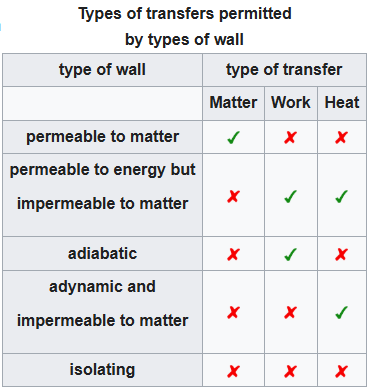
This wall-permeability summary organizes system models by what is allowed to cross the boundary (matter, work, and heat). It supports the open/closed/isolated classification by tying each label to concrete, checkable transfer pathways rather than memorized definitions. Source
Open system: can exchange energy and mass with the environment.
Closed system: can exchange energy but not mass.
Isolated system: exchanges neither energy nor mass (an idealisation).
These labels are modelling choices.
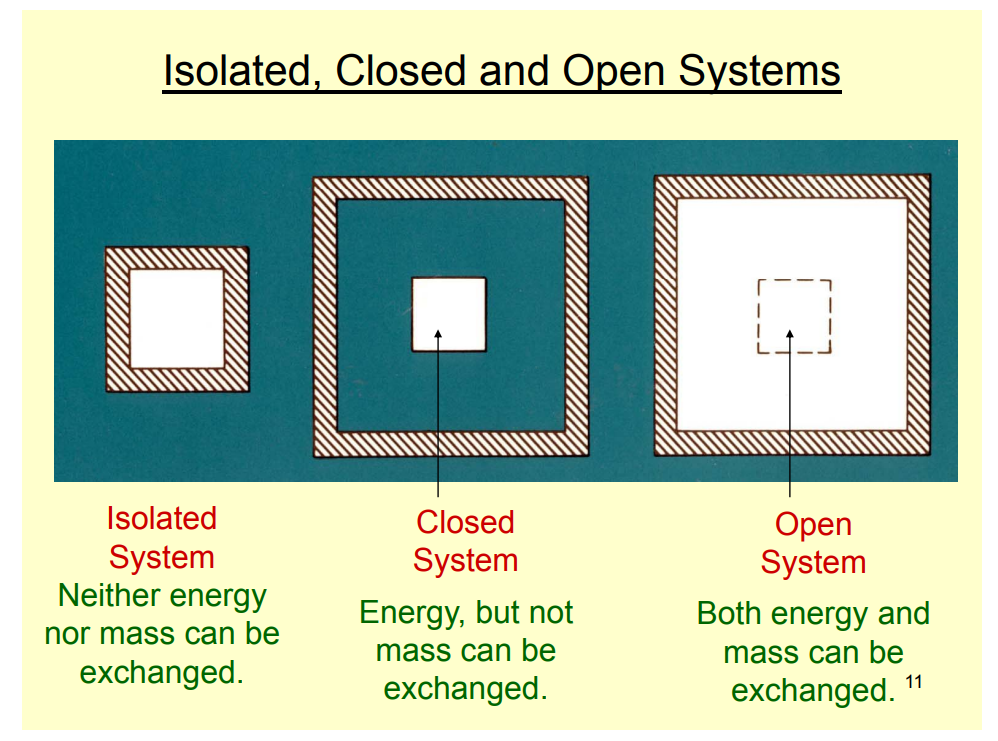
A three-case schematic compares open, closed, and isolated systems by showing which transfers are permitted across the boundary. The side-by-side layout helps students quickly connect each label to the presence or absence of energy and mass exchange. Source
Real objects are rarely perfectly isolated; you decide whether transfers are small enough to neglect for the time interval of interest.
Why this matters for forces and motion
Once you choose the system and boundary, you can organise interactions:
Internal forces come in action–reaction pairs within the system and do not represent a net “outside push” on the system.
Only external interactions can represent a net influence from the environment across the boundary.
This is why defining the system first is a key step: it determines which forces you include when connecting motion changes to environment interactions, and it clarifies whether energy or mass is allowed to cross the boundary.
Practice Questions
[2 marks] A student chooses the system to be a book resting on a table. Identify (i) the environment and (ii) one energy transfer that could occur if the book is pushed across the table.
(1) Environment identified as the table and Earth/air and anything outside the book (accept equivalent wording).
(1) Energy transfer described across the boundary (e.g. external work done by the push into the system, or energy transferred out due to friction with the table).
[5 marks] Sand leaks from a moving cart at a steady rate while the cart rolls along a level track. A student models the cart alone as the system. (a) State whether this is an open, closed, or isolated system. [1] (b) Explain how the system boundary choice affects whether the friction force from the track is internal or external. [2] (c) Write an algebraic expression for the cart system’s mass after time if its initial mass is and a total mass has left. [2]
(1) Open system (mass leaves; energy transfer may also occur).
(1) Friction is external if the track is in the environment and the cart alone is the system.
(1) If the system is redefined to include cart + track, friction becomes internal (or statement that boundary determines internal/external classification).
(1) Correct form: (accept consistent equivalent).
(1) Clear identification that is mass that has left by time .
FAQ
Pick the objects whose motion/energy you are asked about, then choose the boundary to make the important interactions either clearly external (easy to track) or clearly internal (easy to ignore as “within the system”).
If you are stuck, try two system choices and see which gives fewer external forces to analyse.
Yes. “Internal” and “external” depend on the boundary.
Example: friction between a block and a surface is external if only the block is the system, but internal if block + surface is the system.
They are typically used interchangeably in introductory mechanics. In AP Physics 1 wording, “environment” emphasises “everything outside the system boundary” that can interact with the system.
Not automatically. Mass leaving can carry energy, but whether you treat that as an energy transfer depends on your model and what quantities you track.
State explicitly whether energy is considered to cross the boundary with the escaping mass.
Use a consistent template:
Define system and boundary.
List what crosses the boundary (energy by external work, mass in/out).
State direction: “from environment to system” or “from system to environment.”
