

AP Syllabus focus: ‘For symmetric mass distributions, the center of mass lies on lines of symmetry or can be calculated from mass-weighted positions.’
The center of mass (COM) is the single location that represents how a system’s mass is distributed. In AP Physics 1, you find it from symmetry or by averaging positions weighted by mass.
What “center of mass” means
Center of mass: The weighted-average position of all the mass in a system; the point where the system can be treated as if its mass were concentrated for translational motion.
The COM is a geometric idea tied to mass distribution, not necessarily a point inside the object (for example, it can lie in empty space for a ring).
Finding COM using symmetry (fast method)
For symmetric mass distributions, the COM lies on lines of symmetry.
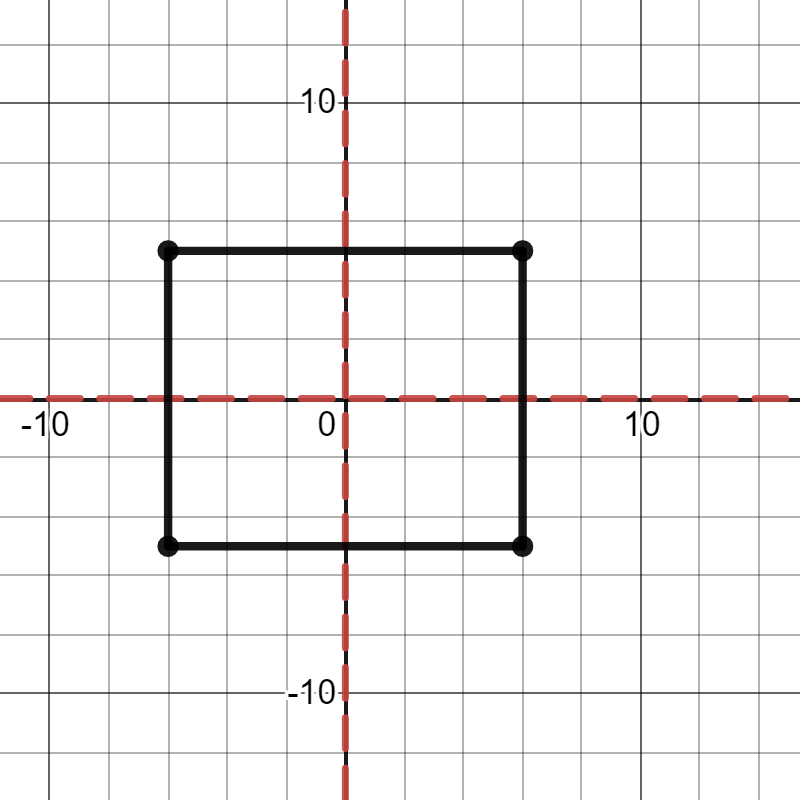
A uniform rectangle has two mirror symmetry lines (horizontal and vertical). Because the mass distribution is identical on either side of each symmetry line, the center of mass must lie on both lines simultaneously—at their intersection (the geometric center). Source
Use these rules:
If an object has one line of symmetry, the COM lies somewhere on that line.
If it has two or more symmetry lines, the COM is at their intersection.
For uniform objects, “symmetric mass distribution” usually means uniform density and symmetric shape.
Common results (uniform objects):
Uniform rod: COM at the midpoint.
Rectangle or disk: COM at the geometric center.
Two identical masses placed symmetrically: COM halfway between them.
Finding COM by mass-weighted position (general method)
When symmetry is not enough, calculate the COM from mass-weighted positions. Use coordinates; in AP Physics 1 this is typically done in 1D or as separate x- and y-calculations.
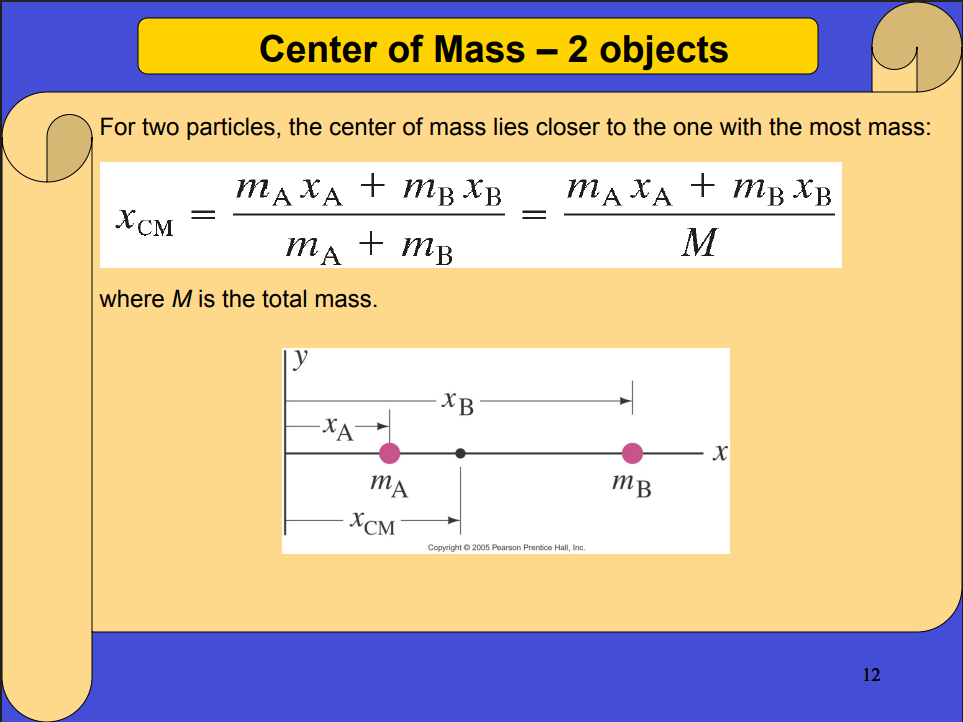
Two point masses on the x-axis illustrate the weighted-average definition of center of mass. The diagram labels , , and to show that lies between the masses and moves closer to the larger mass. This is the geometric meaning of the formula . Source
= x-coordinate of the center of mass (m)
= mass of the th object or piece (kg)
= x-position of the th object or piece (m)
= total mass of the system (kg)
You can apply the same structure to other directions:
for vertical placement
Treat each direction independently, using the same origin and sign convention.
How to set up the calculation correctly
Choose an origin (0 point) and a positive direction before substituting values.
Use consistent units (meters, kilograms).
Include negative positions if masses lie on the negative side of your axis.
If a system is made of a few discrete objects, each object is one “ at .”
If an object is continuous but simple, you can often treat it as several uniform pieces:
Split into parts with known COM locations.
Use each part’s mass and COM position in the sum.
Interpreting the result
The COM lies closer to the more massive parts.
If one mass dominates (), then is very near .
If masses are equal, the COM is the average of their positions.
Common pitfalls (avoid these)
Using geometric center when the object is not uniform or not symmetric.
Forgetting to divide by total mass.
Mixing coordinates from different origins or directions.
Treating the COM as “where forces act”; COM is a location from mass distribution, not automatically a contact point.
Practice Questions
(2 marks) Two point masses lie on the x-axis: at and at . Find .
Uses (1)
(1)
(5 marks) A system has three point masses: at , at , and at . Determine .
Total mass (1)
(2: method (1), value (1))
(2: method (1), value (1))
FAQ
Suspend the lamina from one point and draw a vertical line down from the suspension point (plumb line).
Repeat from a second suspension point. The intersection of the lines is the COM.
Geometric symmetry alone is not enough. You must use mass-weighting with actual masses of regions.
If the density increases toward one side, the COM shifts toward that side even if the outline is symmetric.
Yes. For hollow or concave shapes (e.g., a ring or a boomerang-like outline), the mass-weighted average position can fall in empty space.
Removing mass is equivalent to adding a “negative mass” at that location in the weighted-average formula.
The COM shifts away from where the mass was removed.
COM is an average of signed positions. If you change the origin or flip an axis, every $x_i$ (and therefore $x_{\text{cm}}$) changes consistently.
Mistakes occur when positions are measured from mixed reference points.
