

AP Syllabus focus: ‘The kinetic friction force equals the coefficient of kinetic friction times the normal force and does not depend on contact area.’
Kinetic friction is modeled with a simple proportional relationship that lets you predict sliding forces without microscopic detail. This page focuses on what sets the size of kinetic friction in AP Physics 1 Algebra problems.
Core model: what kinetic friction depends on
Kinetic friction is the frictional force present when two surfaces slide relative to each other. In AP Physics 1 Algebra, its magnitude depends on:
the normal force between the surfaces,
the coefficient of kinetic friction, , for that pair of surfaces
Coefficient of kinetic friction
Coefficient of kinetic friction (): a dimensionless constant that relates the kinetic friction force to the normal force for a given pair of surfaces in sliding contact.
In this course model, is treated as a given property for the situation (often provided in the prompt).
Relationship to the normal force
= kinetic friction force magnitude (N)
= coefficient of kinetic friction (unitless)
= normal force magnitude (N)
This equation states a direct proportionality: if increases, then the kinetic friction magnitude increases in the same ratio (assuming is unchanged).
Contact area: what kinetic friction does NOT depend on (in AP Physics 1)
A key AP Physics 1 statement is that kinetic friction does not depend on contact area. That means:
doubling the apparent touching area does not automatically double
shrinking the apparent touching area does not automatically reduce
In typical exam problems, you should not introduce an “area” term into kinetic friction.
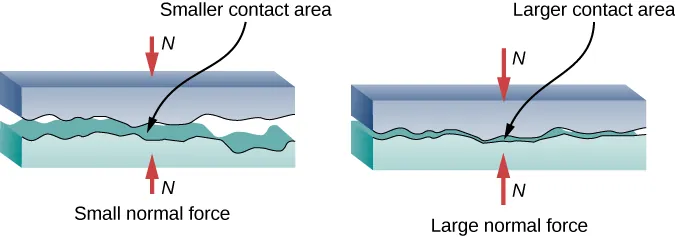
Diagram illustrating that rough surfaces touch only at a small number of microscopic high points, so the real contact area is much smaller than the apparent area. As the normal force increases, more microscopic contact points engage, which helps explain why the macroscopic model makes kinetic friction scale with rather than with the apparent contact area. Source
If the same materials are sliding and the normal force is unchanged, the model predicts the same even if the object is flipped onto a different face.
Practical implications for problem solving
How changes in situation change
Use the model to reason quickly about proportional changes:
If increases (for example, due to a stronger push into a surface), then increases.
If decreases (for example, reduced pressing force), then decreases.
If the prompt changes the surface pairing (different materials), then may change, so changes even if stays the same.
If only the object’s contact area changes, but and are the same, then stays the same in the AP model.
Using the model consistently with directions
Although the equation gives the magnitude, kinetic friction as a force acts:
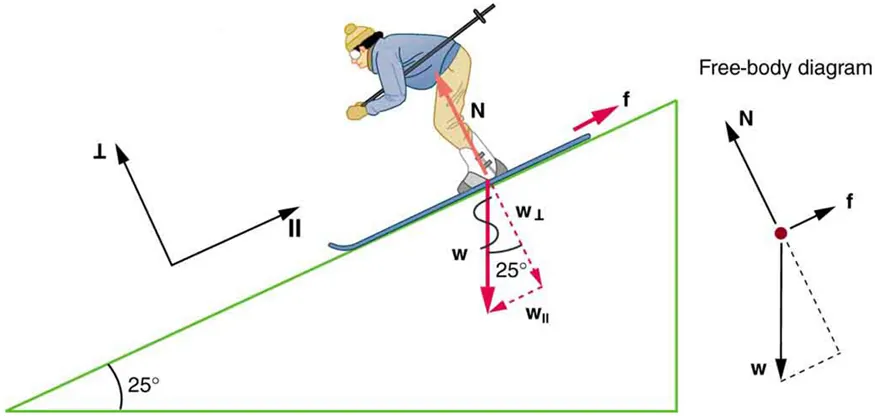
A free-body diagram for an object sliding on an incline, showing perpendicular to the surface and friction parallel to the surface opposing the motion. The diagram also decomposes weight into components, emphasizing that is set by the perpendicular component of gravity, which then sets through . Source
parallel to the surface
opposite the direction of relative sliding motion
For this subsubtopic, the key dependency is magnitude: do not treat kinetic friction as “self-adjusting” to any value during sliding; in the model it is set by .
Common AP-style constraints
To stay aligned with AP Physics 1 Algebra assumptions:
treat as constant for a given interaction
ignore contact area effects
avoid adding extra dependencies (speed, time, “roughness area,” etc.) unless explicitly stated by the problem (rare for AP 1)
Practice Questions
Q1 (3 marks) A block slides on a horizontal surface with coefficient of kinetic friction . Take . Determine the magnitude of the kinetic friction force.
States/uses on a horizontal surface: (1)
Uses (1)
Calculates (1)
Q2 (5 marks) A block slides while being pushed against a vertical wall. The coefficient of kinetic friction is . The person pushes horizontally with force so the normal force on the block from the wall is . The block slides downward at constant speed. (a) Write an expression for the kinetic friction magnitude in terms of and . (2) (b) State whether the kinetic friction depends on the contact area between block and wall in the AP model. (1) (c) Using your answers, explain what change to is required to keep the block sliding downward at constant speed if the block is replaced with one that has double the contact area but the same mass and same materials. (2)
(a) Uses (1)
(a) Substitutes to give (1)
(b) States kinetic friction does not depend on contact area (1)
(c) Concludes should be unchanged (1)
(c) Links reasoning to and area-independence in the model (1)
FAQ
Because increasing apparent area typically decreases pressure, and the microscopic real contact adjusts so the total resistive force stays roughly proportional to $N$ in many everyday cases.
At very high speeds, unusual materials (e.g., rubber), lubricated contacts, or when heating significantly changes the surfaces. In such cases $\mu_k$ may vary during motion.
Measure $N$ and the steady pulling force needed to keep constant speed. Then compute $\mu_k = f_k/N$. Repeating trials improves reliability.
In many real systems it can vary with speed, but AP Physics 1 typically treats $\mu_k$ as constant unless the problem explicitly gives a speed-dependent friction model.
Real traction involves deformation, temperature, tread, and material behaviour; “grip” can involve effects beyond simple kinetic friction, so the basic $f_k=\mu_k N$ model may not capture those details.
