

AP Syllabus focus: ‘Static friction has a maximum value beyond which it can no longer prevent slipping.’
Static friction is a self-adjusting contact force that can hold objects at rest even when other forces try to move them. This page focuses on the limiting case: when static friction reaches its maximum and slipping begins.
What “maximum static friction” means
Static friction increases as needed to prevent relative motion between surfaces, but only up to a limit set by the surfaces and the push between them.
Maximum static friction (): the largest possible static friction force; if the required friction exceeds this value, the surfaces can no longer remain at rest relative to each other and slipping starts.
This maximum is not a “typical” value; it is a boundary. Below that boundary, the actual static friction value is whatever is required for no slipping.
The inequality that controls sticking vs slipping
To decide whether an object can remain at rest, compare the needed friction (from force balancing) to the available maximum.
= actual static friction force (N)
= maximum static friction force (N)
= coefficient of static friction (unitless)
= normal force between surfaces (N)
If the physics of the situation demands a friction force larger than to maintain rest, then static friction cannot supply it, and motion begins (transition to slipping).
How to use the maximum in force analysis (algebra-based)
When you draw a free-body diagram and write Newton’s second law, treat static friction carefully:
If the object is definitely not slipping, do not automatically set .
Instead, write equilibrium in the direction along the surface (often ) and solve for the required .
Then check whether the result satisfies .
If the object is on the verge of slipping (“impending motion”), then static friction is at its limit:
Use .
If the object is slipping, the static friction model is no longer valid; the maximum static friction has been exceeded.
Key interpretation: depends on , so changing how strongly surfaces are pressed together changes the maximum possible static friction.
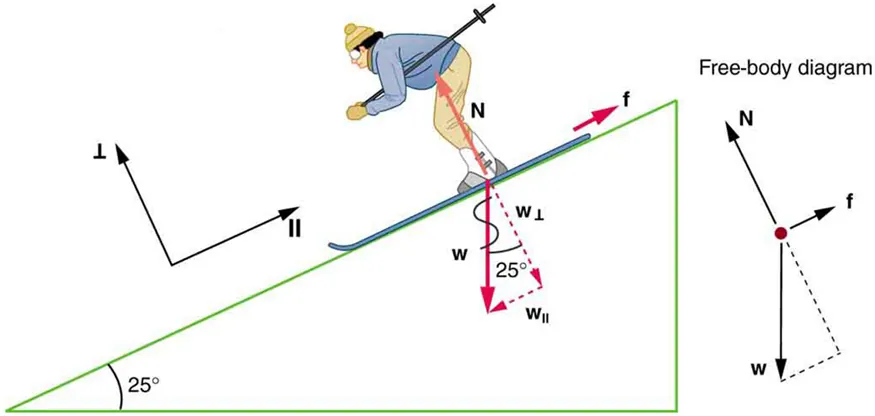
Free-body diagram for motion on an incline, showing perpendicular to the surface and friction along the surface opposing the motion. The weight is resolved into components parallel and perpendicular to the plane, making it clear why (and thus ) changes with incline angle. Source
Physical cues for “about to slip”
Situations that commonly imply impending motion (so you may set ) include:
A force is gradually increased until motion “just begins.”
A ramp’s angle is increased until the object “just starts to slide.”
A system is described as “at the threshold of motion” or “about to move.”
If the object is simply described as “at rest,” you usually must solve first and only apply the maximum as a check.
Direction and sign conventions
Static friction acts along the surface and points opposite the direction the object would move if there were no friction.
You can choose a positive axis along the surface in either direction.
If your solved comes out negative, it usually means your assumed friction direction was opposite; the magnitude is still compared to .
Common mistakes to avoid
Treating static friction as a constant: it is variable up to .
Using whenever you see “static”: that is only true at the maximum.
Forgetting that is not always (for example, when additional vertical forces change the contact push); since , an incorrect gives an incorrect maximum.
Mixing up “maximum static friction” with the actual friction present: the actual value may be far smaller than the maximum when forces are small.
Practice Questions
Q1 (3 marks) A 5.0 kg crate rests on a horizontal floor. The coefficient of static friction is . Determine the maximum static friction force.
Uses (1)
Finds N (1)
N (1)
Q2 (5 marks) A block is pushed horizontally with force across a floor. The block remains at rest. Given mass , , and : (a) Write an expression for the maximum value of before the block starts to move. (2) (b) Explain, using an inequality, how you would check whether a given will keep the block at rest. (3)
Identifies (1)
(1) (b)
States actual static friction adjusts so that while at rest (1)
Uses condition (1)
For a horizontal push at rest, , so require (1)
FAQ
The contact surfaces have microscopic roughness that interlocks and forms adhesive junctions.
As the applied tangential force increases, more junctions deform until they can no longer hold; beyond that limit, they break and slipping begins.
It is an empirical (experimental) model that works well for many dry, rigid surfaces.
It can fail for very smooth materials, very soft materials, lubricated contacts, or unusual conditions where $\mu_s$ is not constant.
Yes, if $N$ changes.
Examples include added downward/upward forces, tilting that redistributes contact forces, or any setup where the “push” between surfaces is not simply $mg$.
It indicates the system is exactly at the threshold of slipping, so static friction has reached its limit.
In symbols, that means $f_s=f_{s,\max}=\mu_s N$ rather than just $f_s \le \mu_s N$.
Not always; some surfaces are direction-dependent (anisotropic), such as treaded materials or grain patterns.
AP-style problems typically assume an isotropic surface where the same $\mu_s$ applies in any direction along the contact plane.
