

AP Syllabus focus: ‘Normal force is perpendicular to the surface, and the coefficient of kinetic friction depends on the materials in contact.’
Normal force and friction are easy to confuse because they often appear together. This page clarifies what sets the normal force’s direction and what physical factors actually affect the kinetic friction coefficient.
Normal Force: Direction and Physical Meaning
When two surfaces touch, each pushes on the other.
The normal force is the contact force component that acts perpendicular to the surface at the point (or region) of contact.
Normal force (). The perpendicular contact force exerted by a surface on an object in contact with it.
Key direction ideas (the “perpendicular rule”):
On a horizontal floor, points straight up.
On an incline, points perpendicular to the incline (not vertical).
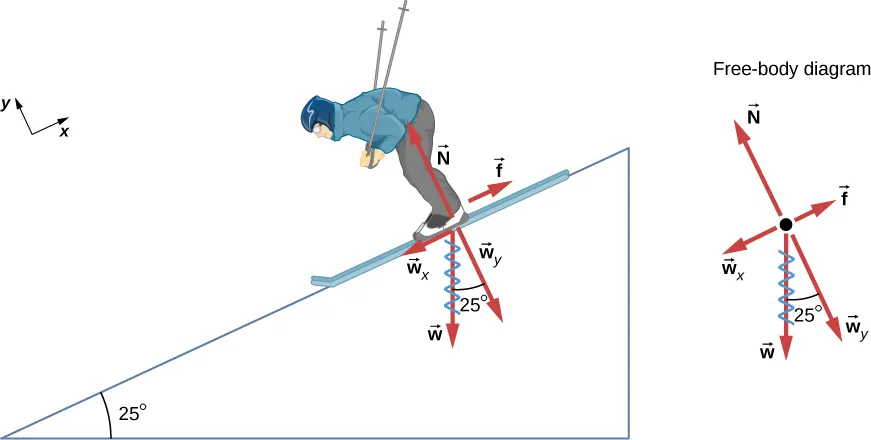
Free-body diagram and force-component breakdown for an object on an incline. The normal force is drawn perpendicular to the surface, while friction lies parallel to the surface; the weight is resolved into components along the chosen axes to show why is not generally equal to . Source
On a curved surface, is perpendicular to the surface at that location (its direction can change along the path).
Normal force is not automatically equal to weight. It adjusts to satisfy Newton’s laws given the object’s acceleration and other forces.
Finding Normal Force in Common Situations (Qualitative)
To determine , start with a free-body diagram and choose axes that make the perpendicular direction clear (often one axis perpendicular to the surface).
Common patterns:
Object resting on a horizontal surface with no vertical acceleration: balances the other vertical forces (often weight).
Object on an incline: relates to the component of weight perpendicular to the incline; any additional forces with perpendicular components change .
Pushing or pulling at an angle: the applied force can increase or decrease depending on whether it has a downward or upward perpendicular component.
Accelerating systems (e.g., elevator-like motion while in contact with a surface): changes so that .
This matters because kinetic friction typically depends on .
Kinetic Friction and Material Properties
Kinetic friction is the frictional force that acts when surfaces slide relative to each other. Its magnitude is modeled by the coefficient of kinetic friction, which is a property of the pair of materials and surface conditions.
Coefficient of kinetic friction (). A dimensionless constant (for a given pair of surfaces and conditions) that relates kinetic friction magnitude to normal force.
The syllabus focus is that the coefficient depends on the materials in contact. In practice, this includes:
The material pair (rubber on concrete vs. wood on wood)
Surface condition (polished, roughened, dusty, wet, lubricated)
Temperature and wear (sometimes changes surface texture or introduces films)
In AP Physics 1 Algebra, you typically treat as a given constant for the situation.
Relationship Between Normal Force and Kinetic Friction
Kinetic friction is proportional to the normal force:
= kinetic friction force magnitude (N)
= coefficient of kinetic friction (unitless)
= normal force magnitude (N)
Because depends on , anything that changes the normal force (tilting the surface, pushing down, reducing contact force) changes the kinetic friction magnitude even if stays the same.
Direction of Kinetic Friction (Tied to Motion)
Even though gives a magnitude, the direction comes from the relative motion:
Kinetic friction acts parallel to the surface
It points opposite the direction of slipping (relative motion between surfaces)
Practical checklist:
Identify the surface of contact.
Set one axis parallel to the surface.
Assign kinetic friction opposite the actual (or impending) sliding direction along that axis.
Common Misconceptions to Avoid
“Normal means normal direction, so it must be vertical.” Normal means perpendicular to the surface; vertical is only for horizontal surfaces.
“Normal force always equals weight.” Only in specific cases (e.g., level surface, no vertical acceleration, no other vertical forces).
“A larger contact area gives larger friction.” In the basic AP model with , contact area is not part of the equation; material pair and control .
“ is universal for a material.” is for a pair of surfaces and depends strongly on conditions.
What You Should Be Able to Do
State that normal force is perpendicular to the surface and draw it correctly on a free-body diagram.
Recognise that depends on the materials in contact (and surface condition).
Use with a correctly identified to connect friction magnitude to contact forces.
Assign friction direction correctly based on relative motion along the surface.
Practice Questions
Q1 (2 marks) A block slides to the right across a rough horizontal table. Draw arrows on a free-body diagram to show the directions of (i) the normal force and (ii) the kinetic friction force on the block.
1 mark: Normal force shown perpendicular to the table, upwards.
1 mark: Kinetic friction shown parallel to the table, to the left (opposite the sliding direction).
Q2 (5 marks) A crate is pulled along a horizontal floor at constant speed by a rope that makes an angle of above the horizontal. The tension is . The coefficient of kinetic friction between crate and floor is . (a) Explain how the rope angle affects the normal force compared with pulling horizontally. (2 marks) (b) Write an expression for the kinetic friction force in terms of and identify which physical factor(s) determine . (2 marks) (c) State the direction of the kinetic friction force. (1 mark)
1 mark: Identifies that the rope has an upward component, reducing the contact force.
1 mark: Concludes is smaller than if the same tension acted horizontally (all else equal). (b)
1 mark: Gives .
1 mark: States depends on the materials in contact (surface condition acceptable as elaboration). (c)
1 mark: Friction acts opposite the direction of motion; here it acts to the left.
FAQ
Only if the only forces with components perpendicular to the incline are the normal force and weight.
If an applied force (like a push, pull, or tension) has a perpendicular component, then $N$ changes accordingly.
“Materials in contact” is shorthand for the interacting surface layers.
Films and contaminants (water, oil, dust) can act like different materials, changing adhesion and microscopic interlocking, so the effective $\mu_k$ can change.
It is approximately constant over a limited range of speeds and loads in the AP model.
At high speeds, high pressures, or with heating, real surfaces can change and $\mu_k$ may vary measurably.
It arises mainly from electromagnetic interactions between atoms at the surfaces.
As surfaces are pressed together, electron clouds repel strongly, producing a macroscopic perpendicular contact force.
A common method uses a sled pulled at steady speed.
Measure the steady pulling force $F$ (so $F \approx f_k$).
Measure or calculate $N$.
Compute $\mu_k = \dfrac{f_k}{N} = \dfrac{F}{N}$.
