

AP Syllabus focus: ‘Static friction can act when surfaces are not moving relative to each other and takes whatever value prevents slipping.’
Static friction is the contact interaction that keeps surfaces from sliding when they would otherwise begin to move. In AP Physics 1, it is treated as a responsive force that matches the needs of equilibrium up to a limit.
What “static friction before sliding starts” means
Static friction acts when two surfaces are in contact and there is no relative sliding at the interface. Even if the object is at rest, other forces (a push, a component of gravity, tension) may try to cause slipping; static friction can appear to oppose that tendency.
Key idea: it adjusts as needed
The defining feature is that the static friction force is not automatically a fixed value.

Force–friction graph showing that static friction increases to match the required opposing force up to a peak (the maximum static friction), after which the friction drops to the kinetic-friction level once sliding begins. This picture helps explain why is not a single preset number during the no-slip regime. Source
Instead, it “self-adjusts” to be whatever magnitude is required to prevent relative motion (slipping) between the surfaces, as long as it is physically possible for the surfaces to supply that much friction.
This is why you cannot assume “friction equals something” without first considering whether the object is actually slipping.
Forces and directions for static friction
Static friction acts parallel to the surface and points opposite the direction the surfaces would slide if static friction were absent (often called the impending or tendency of motion).
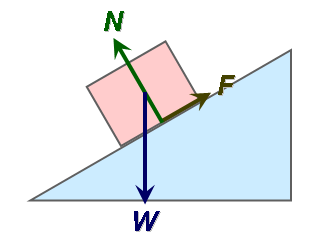
Free-body diagram of a block on a rough inclined plane, with friction drawn parallel to the surface and the normal force perpendicular to it. The diagram emphasizes that friction’s direction is chosen to oppose the block’s would-be motion along the incline, while weight acts vertically downward. Source
That direction is determined by analyzing the other forces along the surface.
For an object on a surface, typical forces include:
Weight (gravity) straight down
Normal force perpendicular to the surface
Applied forces (push/pull/tension) that may have components parallel to the surface
Static friction along the surface, preventing slipping
Direction is about “would slip,” not “is moving”
Because the object may be stationary, you infer the direction of static friction by asking:
If friction were zero, which way would the object start to move relative to the surface?
Static friction then points opposite that would-be motion.
Using static friction in a free-body diagram
A free-body diagram (FBD) for the object should include static friction only if there is contact and a reason the object might slip. When drawing and solving:
Choose an axis parallel to the surface to isolate the “slip/no-slip” direction.
Include a static friction force along that axis.
Use equilibrium along the surface if the object does not accelerate relative to the surface.
You generally solve for from Newton’s second law, rather than inserting a preset formula.
Static friction (): The contact force parallel to the interface that prevents relative sliding between surfaces by taking whatever value is needed (up to a limit) to maintain no slipping.
A common misunderstanding is to treat static friction as always “large” or always equal to some coefficient times the normal force; for “before sliding starts,” the essential point is that it is whatever value prevents slipping.
Equilibrium condition “before sliding starts”
If the object is not slipping relative to the surface, its acceleration along the surface is zero. Then the net force component parallel to the surface must be zero, and static friction fills the gap between the other parallel forces.
= Net force component parallel to the surface (N)
= Mass of the object (kg)
= Acceleration component parallel to the surface (m/s)
= Zero when there is no slipping and no acceleration along the surface (m/s)
Practically, this means:
If a single applied force tries to slide the object, static friction often matches it in magnitude (opposite direction) so the net parallel force is zero.
If multiple forces have parallel components, static friction balances the net tendency of those components.
What you can and cannot conclude
You can conclude all of the following in the “before sliding starts” regime:
Static friction can be zero (e.g., no force tends to cause sliding).
Static friction can be nonzero even while the object remains at rest.
The magnitude of static friction is determined by the equilibrium requirement and the other forces present, not by contact area or “being at rest” by itself.
You cannot conclude the object will remain at rest indefinitely without checking whether the required static friction is achievable; in AP Physics 1 this “achievable limit” is addressed separately, but the setup here is always: assume no slipping, solve for the needed , then interpret.
Practice Questions
A book rests on a horizontal table. You push it gently to the right, but it does not move. Describe the direction of the static friction force on the book and how its magnitude compares to your horizontal push.
Direction: static friction acts to the left, opposing the tendency to slip right (1).
Magnitude: static friction matches the push so the net horizontal force is zero while it remains at rest (1).
A crate is held at rest on a rough incline by a rope pulling up the slope. The component of the crate’s weight down the slope is , and the rope tension up the slope is .
(a) State whether static friction acts up or down the slope. (1)
(b) Determine the magnitude of the static friction force. (2)
(c) Write the equilibrium equation along the slope using signed forces. (2)
(a) Up the slope, opposing the net tendency to move down (1).
(b) Net tendency down without friction is , so (2).
(c) Correct signed equation, e.g. taking up-slope positive: or (2).
FAQ
No. It can be present whenever there is a tendency for relative motion at the contact, even if the object remains perfectly still.
Yes. If no other force component tries to produce sliding, there is no need for static friction, so $f_s=0$.
Temporarily imagine friction removed and determine which way the object would start to slip relative to the surface. Static friction points opposite that tendency.
Before slipping, it responds to the required value for equilibrium: pushing harder generally requires a larger $f_s$ to keep $a_{\parallel}=0$, until a limiting condition is reached.
No. Normal force is perpendicular to the surface; static friction is parallel. Their magnitudes are set by different equilibrium conditions and can be very different.
