

AP Syllabus focus: ‘Kinetic friction occurs when surfaces move relative to each other and acts opposite that motion.’
Kinetic friction is one of the most common real-world forces in AP Physics 1 problems. The key skill is identifying when it applies and assigning its direction correctly from the relative motion of surfaces.
What kinetic friction is (and when it applies)
When two solid surfaces slide against each other, the interaction between their surfaces produces a resistive contact force called kinetic friction.
Kinetic friction: A contact force that exists when two surfaces are sliding relative to each other; it acts parallel to the surfaces and opposes the relative sliding motion.
Kinetic friction is an external force on the object you are analysing, exerted by the other surface (part of the “environment” in a free-body diagram). It only appears in your model if the surfaces are actually slipping at the contact.
Relative motion is the deciding factor
To decide the direction of kinetic friction, you must think in terms of relative motion at the point of contact: how the object’s surface moves compared with the other surface.
Relative motion (at a contact): The motion of one surface as measured from the other surface; it is what determines the direction of kinetic friction.
Kinetic friction always points opposite this relative sliding. It does not “oppose the applied force” in general; it opposes the slipping direction.
Direction: “opposite the motion” means opposite the slipping
A reliable direction checklist
Choose the object (or system) you will draw a free-body diagram for.
Identify the specific contact surface that can produce friction.
Determine the direction of the object’s motion relative to that surface.
Draw kinetic friction along the surface, pointing opposite the relative motion.
Common direction situations
Block sliding right on a floor: kinetic friction on the block points left.
Block sliding down an incline: kinetic friction on the block points up the incline.
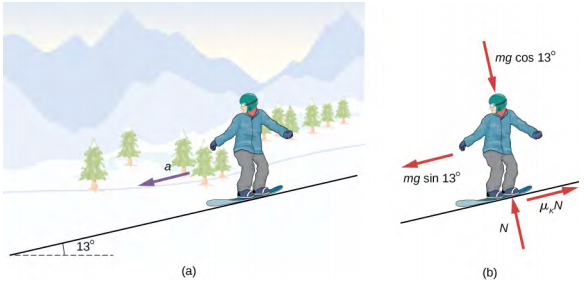
Free-body diagram(s) for an object on an incline with kinetic friction. The diagram makes the geometry explicit by showing the normal force perpendicular to the surface and the friction force parallel to the surface, pointing opposite the direction of sliding along the plane. Source
Block being pulled left but still sliding right (coasting): kinetic friction still points left, because it opposes the rightward slipping.
Surface moving (belt/conveyor): compare velocities.
If the belt moves right faster than the block, then the block slips left relative to the belt, so kinetic friction on the block points right.
Free-body diagram (FBD) implications
Kinetic friction is drawn as a single force vector:
Parallel to the contact surface
Applied to the object (not split across both objects)
Directed opposite the relative slipping
In an FBD, do not pair kinetic friction with an equal-and-opposite arrow on the same diagram. The Newton’s third law partner force acts on the other surface, so it appears only on that other object’s FBD.
Sign conventions and components
If you choose an axis along the surface (often the most convenient choice), kinetic friction will appear as a positive or negative term depending on whether it points along +axis or −axis. The physics decision is the direction; the sign follows from your coordinate choice.
Subtleties students often miss
“Opposes motion” does not mean “prevents motion”
Kinetic friction does not necessarily make an object stop immediately; it simply acts in the direction that reduces the relative slipping over time (it tends to reduce the speed of sliding, but other forces can still cause acceleration).
Kinetic friction depends on what is sliding relative to what
If two objects move together with no slipping, then the “kinetic friction” model is not the appropriate one for that contact. In AP-style reasoning, always justify kinetic friction by stating that the surfaces are sliding relative to each other.
Kinetic friction is not a force you can choose arbitrarily
In problem setups, the direction is determined by observed or implied slipping. If you assume the wrong direction, your algebra may produce a negative value for acceleration or another quantity, signalling that your assumed direction (or motion) was inconsistent.
Practice Questions
A book is sliding to the right across a rough horizontal table. On a free-body diagram for the book, state the direction of the kinetic friction force. (2 marks)
Identifies kinetic friction acts to the left / opposite the motion (1)
States it is opposite the relative sliding between book and table (1)
A crate is sliding down a rough ramp that slopes upward to the right. A student draws kinetic friction on the crate pointing down the ramp because “friction helps the motion downhill.”
(a) State whether the student’s friction direction is correct. (1 mark)
(b) State the correct direction of kinetic friction on the crate and justify it using relative motion. (3 marks)
(c) Explain briefly how this friction direction would appear in the sign of the force term if you choose the +axis down the ramp. (1 mark) (Total 5 marks)
(a) Incorrect (1)
(b) Friction points up the ramp (1); justification: it opposes the relative sliding of crate’s surface down the ramp (1); explicitly references relative motion at the contact (1)
(c) With + down the ramp, friction is a negative force term (e.g., ) (1)
FAQ
Even “smooth” solids have microscopic roughness and adhesive interactions.
At the contact, tiny high-pressure junctions form and break during sliding, producing a resistive force along the surface.
No. Slowing down means acceleration opposite velocity, which could be caused by any net force.
Kinetic friction contributes only if there is sliding at a contact; other forces (tension components, air resistance) may dominate.
Compare velocities of the two surfaces at the contact.
Compute or infer which way the object slips relative to the surface.
Kinetic friction on the object points opposite that slipping direction.
For ideal rolling without slipping, the point of contact does not slide relative to the ground.
In that case, the contact is not modelled with kinetic friction; kinetic friction would require slipping (e.g., skidding).
Not in AP Physics 1 terminology. Air resistance is typically treated as drag, a force due to fluid interaction.
Kinetic friction refers specifically to solid-on-solid sliding contact forces.
