

AP Syllabus focus: 'Atoms in a gas collide with other atoms and with the container, exerting forces during those collisions.'
A gas may seem smooth on the macroscopic scale, but microscopically it is a huge collection of rapidly moving atoms whose repeated collisions explain its mechanical behavior.
Atomic view of a gas
A gas is modeled as many tiny particles moving constantly in random directions. Most of the time each atom travels freely through empty space, but that motion is repeatedly interrupted by collisions.
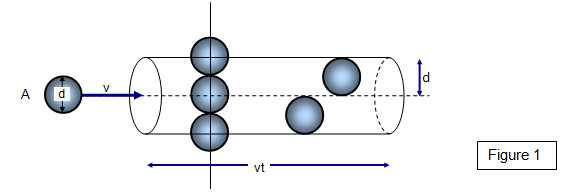
A “collision cylinder” visualization shows the effective volume swept out by a moving molecule that would lead to a collision with another molecule. This picture makes the ‘free flight’ between collisions concrete and motivates why collision frequency depends on number density and molecular size. Source
Those collisions are the key microscopic events that connect particle motion to the observable behavior of gases.
Collision: A brief interaction in which two atoms, or an atom and a wall, exert forces on each other and change motion.
In this model, collisions are not rare events. They happen continually throughout the gas and at the boundaries of the container.
Collisions between atoms
When two gas atoms approach very closely, the electric forces associated with their electron clouds and nuclei become significant. In AP Physics 2, this is treated simply as a short collision rather than as a long-lasting interaction.
During an atom-atom collision:
each atom exerts a force on the other
the forces act for a very short time
the atoms may change speed, direction, or both
after the collision, the atoms separate and continue moving until later collisions occur
Because a gas contains enormous numbers of atoms, this process happens constantly. Any single collision is brief, but the total effect of many collisions helps determine the overall behavior of the gas.
A useful way to think about this is that a gas is not a static collection of particles. It is a dynamic system in which motion is repeatedly redirected by countless tiny interactions.
Collisions with the container
Atoms also collide with the walls of the container. When an atom strikes a wall, it does not pass through it. Instead, the wall exerts a force on the atom that changes its motion, usually reversing the component of velocity perpendicular to the wall.
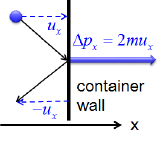
A molecule approaches the container wall with an -component of velocity and rebounds with the same speed in the opposite direction. The diagram highlights the resulting momentum change , which corresponds to an impulse delivered to the wall during the brief collision. Source
At the same time, the atom exerts an equal and opposite force on the wall.
This mutual interaction is an example of Newton’s third law: forces in an interaction always come in pairs. The wall pushes on the atom, and the atom pushes on the wall during the same collision interval.
These wall collisions matter because they are the microscopic origin of the force a gas exerts on its container.
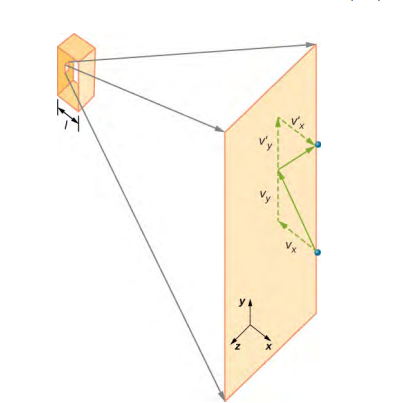
A gas in a container is depicted along with a close-up of a molecule’s elastic collision with a rigid wall. The figure emphasizes that only the velocity (and momentum) component perpendicular to the wall reverses, illustrating how repeated microscopic momentum changes add up to a sustained pressure on the container. Source
The force is not produced by a single atom staying in contact with the wall. It comes from a huge number of separate, short-lived impacts.
Why a force must be present during a collision
A force is required whenever an object’s motion changes. In a collision, an atom may speed up, slow down, or turn. That change cannot happen without an interaction.
Between collisions, the simple gas model assumes that atoms move without significant forces from other atoms. The main forces appear only when atoms come very close together or when they strike the container boundary. This is why collisions are treated as short, intense interactions separated by intervals of nearly force-free motion.
The short duration of a collision is important. Gas atoms do not need to press continuously on a wall in order to affect it. Repeated brief impacts are enough to create a sustained macroscopic effect.
Random motion and repeated impacts
The motion of gas atoms is disordered rather than coordinated. Different atoms move in different directions and at different speeds. As they bounce off one another and off the container, the pattern of motion keeps changing.
Because of this randomness:
collisions happen throughout the gas, not just at the walls
different parts of the container are struck by many different atoms
the force from one collision is tiny, but the combined effect of many collisions can be significant
the average behavior of the gas can be steady even though individual atomic motions are constantly changing
This microscopic randomness is why a gas can look smooth and uniform on the large scale even though it is made of separate particles undergoing continual collisions.
Common misunderstandings
It is important to avoid a few common misconceptions about atomic collisions in gases.
Atoms are not continuously pressing on the container walls. In the basic model, they move freely between short collision events.
A collision does not require visible contact like colliding billiard balls. Atoms interact through electric forces when they get very close.
Only wall collisions do not matter. Atom-atom collisions are also essential because they continually alter the motion of particles within the gas.
A gas is not motionless when the container is at rest. Even in a stationary container, atoms are moving rapidly and colliding all the time.
What to emphasize for AP Physics 2
For this subsubtopic, the key idea is microscopic: gases are made of atoms in constant motion, and those atoms exert forces when they collide with other atoms or with the container.
When describing the process, focus on this sequence:
atoms move through the gas
they encounter other atoms or the container wall
a short collision occurs
forces act during that collision
the atoms’ motion changes
many such collisions produce the observable behavior of the gas
Practice Questions
A gas atom moves toward the wall of a container, strikes it, and rebounds. Explain why the wall experiences a force and state when that force acts.
1 mark: States that the atom exerts a force on the wall while the wall exerts an equal and opposite force on the atom.
1 mark: States that the force acts only during the collision, not while the atom is traveling freely between collisions.
A student says, “Gas atoms are spread throughout the container, so they must be pushing continuously on everything around them.”
Using the atomic model of a gas, evaluate this statement. Your response should describe collisions between atoms, collisions with the container, and when forces act.
1 mark: States that gas atoms move randomly through the container.
1 mark: States that atoms collide with other atoms in the gas.
1 mark: States that atoms also collide with the walls of the container.
1 mark: Explains that forces act during the brief collision interval when atoms interact closely.
1 mark: Explains that atoms are not pushing continuously between collisions; instead, macroscopic effects come from many repeated short collisions.
FAQ
Atoms are extremely small, and the region over which their interaction becomes strong is also extremely small. That means an atom moving at ordinary gas speeds passes through the interaction region very quickly.
The force can still be significant because it acts intensely over a tiny time interval. So a collision is brief, but it can still noticeably change an atom’s motion.
An atom is neutral overall, but it contains positive nuclei and negative electrons. When two atoms come very close, these internal charges interact.
At very short distances, the interaction becomes strong enough to prevent atoms from occupying the same space easily. In the gas model, that short-range interaction is treated as the force during a collision.
A collision depends on the atoms’ paths and how closely they approach each other. If their trajectories bring them within a small effective distance, they interact strongly and collide.
This idea is often described using a collision cross section, which is a measure of how likely a collision is for a given type of particle. A larger effective size means collisions are more likely.
In ordinary gases, most collisions are effectively between two particles at a time. That is because the gas is dilute enough that three or more atoms almost never arrive at the same small region simultaneously.
This makes the microscopic analysis much simpler. The gas behavior can usually be understood as a huge number of separate pairwise collisions plus collisions with the container walls.
In the simplest gas model used in introductory physics, collisions are treated as events after which atoms separate and continue moving. That model works well for many basic situations.
In real gases, atoms can sometimes stick together briefly or form longer-lasting bonds under special conditions, especially at lower temperatures or higher densities. When that happens, the gas no longer behaves like the simplest particle model.
