

AP Syllabus focus: 'Gas pressure on a surface equals the total perpendicular force exerted by gas atoms divided by the surface area.'
Gas pressure on a surface comes from countless atomic collisions. The central idea is that pressure depends on how much perpendicular force gas atoms collectively exert on each unit of surface area.
Gas Pressure as a Surface Effect
Pressure on a wall, piston, or container lid is a macroscopic effect produced by microscopic collisions. Gas atoms move in many directions and repeatedly strike the surface.
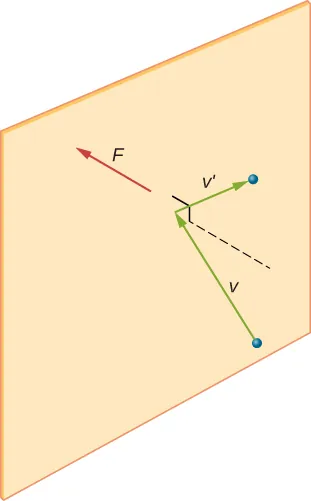
A molecule strikes a container wall and rebounds, reversing the momentum component perpendicular to the wall while leaving tangential components unchanged. This momentum change during collisions produces an average force on the wall, which appears macroscopically as gas pressure. Source
During each collision, the atom and the surface push on each other. The surface experiences a force from the atom, and the combined effect of enormous numbers of collisions produces a steady pressure.
When physicists talk about gas pressure on a surface, they are focusing on how strongly the gas pushes against that particular boundary. The important idea is not the force from one atom, but the total force from all collisions over the surface.
Pressure: The perpendicular force exerted on a surface per unit area.

A perpendicular force acts on a surface patch of area , illustrating the definition . The figure emphasizes that only the component normal to the surface contributes to pressure, and that pressure represents how concentrated the push is over the contact area. Source
Because pressure describes force spread over area, a large total force does not always mean a large pressure. The same force spread over a bigger area produces less pressure, while the same force concentrated on a smaller area produces more pressure.
= pressure on the surface, Pa
= total perpendicular force on the surface, N
= surface area,
In AP Physics 2, pressure is measured in pascals, where . This unit emphasizes that pressure is not just force; it is force per unit area.
Why the Force Must Be Perpendicular
The meaning of perpendicular force
Only the component of force perpendicular to the surface contributes to pressure. If an atom’s motion is partly sideways along the wall, that sideways part does not determine the pressure on the wall. Pressure depends on how strongly the gas pushes into the surface, not along it.
This is why the force in the equation is written as . The surface can only be compressed or pushed inward by the component normal to it. Tangential interactions may matter for other effects, but they are not what AP Physics 2 uses to define pressure on a surface.
Why collisions matter
Each atomic collision with the wall lasts a very short time, but during that interval the atom exerts a force on the surface. A single collision produces a tiny, brief force. Because a gas contains an enormous number of atoms, collisions happen constantly across the area of the surface. The result is a measurable and often nearly steady pressure.
At any instant, the force from collisions can fluctuate slightly. In ordinary situations, though, there are so many collisions that the average force over time is stable enough to treat the pressure as constant.
Area and the Size of the Force
For a given pressure, a larger surface experiences a larger total force because more area is available for collisions. For a smaller surface at the same pressure, the total force is smaller.
This relationship is often important when thinking about pistons, container walls, and flat surfaces in contact with gases:
Same pressure, larger area: larger total perpendicular force
Same pressure, smaller area: smaller total perpendicular force
Same force, larger area: lower pressure
Same force, smaller area: higher pressure
A common mistake is to confuse force and pressure. They are related, but they are not interchangeable. Pressure tells how concentrated the pushing effect is on the surface, while force tells the total push exerted on that surface.
Microscopic Picture of Pressure
From many atoms to one measurable quantity
A gas does not push as a single solid object. Instead, many atoms strike the surface separately. Each atom transfers momentum during a collision, and the wall feels the combined effect of all those interactions. The pressure on the surface is therefore a collective result of many microscopic events.
If more atoms strike a given area in a given time, or if the collisions with the wall are stronger, the perpendicular force on that area becomes larger. Since pressure is force divided by area, the pressure on the surface also becomes larger.
Pressure on real surfaces
The surface does not need to be horizontal.
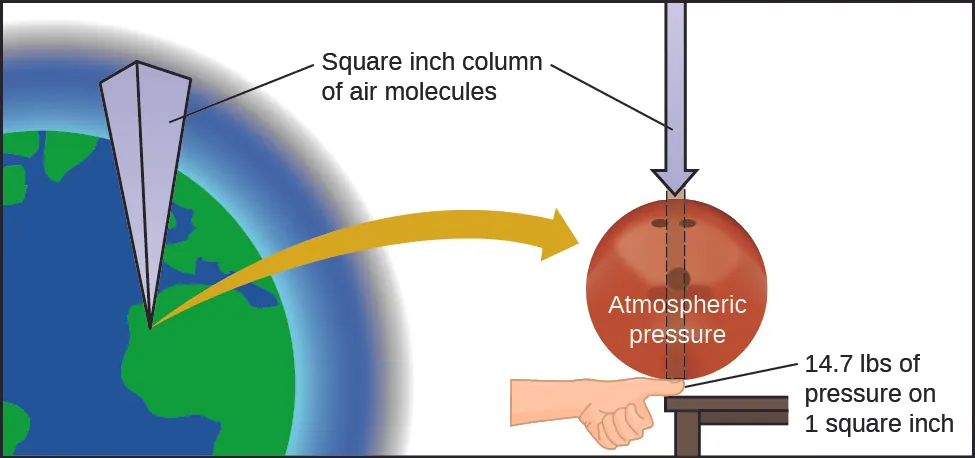
Atmospheric pressure is depicted as a force distributed over a specified area, reinforcing that pressure is an area-normal (perpendicular) interaction. The same idea applies to any oriented boundary: the relevant force component is always normal to the surface patch being considered. Source
Gas pressure acts on vertical walls, slanted surfaces, lids, and pistons in the same general way. For any surface, pressure depends on the total force component perpendicular to that surface divided by the area of that surface.
This means the orientation of the surface changes which direction counts as perpendicular, but it does not change the definition of pressure.
Pressure and Resultant Force on Surfaces
Pressure describes how strongly the gas pushes per unit area, but the actual force on a particular surface has a direction. That force is always perpendicular to the surface at the location being considered. On a flat surface, the net force from uniform pressure points in one clear direction. On a curved surface, different small regions have different perpendicular directions, so the overall force must be found by combining the contributions from many small areas.
This is one reason pressure is especially useful: it lets physicists describe gas-surface interactions locally, then relate that to the total force on the object.
How to Interpret Pressure Statements
When a problem states that a gas exerts a certain pressure on a surface, read that as information about the average perpendicular force per unit area. If you know the area, you can determine the total perpendicular force. If you know the force and the area, you can determine the pressure.
Be careful with units:
area must be in
force must be in newtons
pressure will then be in pascals
Also be careful to use the surface area actually in contact with the gas. Pressure applies to the specific boundary being considered, not to any unrelated area in the system.
In conceptual questions, it is often useful to explain pressure in words before using the equation. A strong AP Physics 2 response usually states that gas atoms collide with the surface, those collisions exert a perpendicular force, and the pressure is the total perpendicular force divided by area.
Practice Questions
A gas exerts a perpendicular force of on a flat wall of area . Calculate the pressure exerted on the wall.
1 mark for using
1 mark for
A sealed container has a movable piston of area . The gas inside exerts a pressure of on the piston.
(a) Calculate the magnitude of the force exerted by the gas on the piston.
(b) Another flat wall of the container has area . Assuming the gas exerts the same pressure on that wall, determine the magnitude of the force on this wall.
(c) A student says, “The larger wall has more force on it, so the pressure on that wall must be larger.” Explain why this statement is incorrect.
(a) 1 mark for using
(a) 1 mark for
(b) 1 mark for
(c) 1 mark for stating that pressure is force per unit area
(c) 1 mark for explaining that a larger area can have a larger total force while the pressure remains the same
FAQ
Many pressure sensors use a thin surface such as a diaphragm or membrane.
When gas pushes on that surface, the pressure creates a perpendicular force over its area. The surface bends slightly, and the device converts that bending into an electrical signal or a needle position. The stronger the pressure on the surface, the larger the deflection.
A gas does not need to pull for a suction cup to work.
The key is that the pressure outside the cup is greater than the pressure inside it. The outside air pushes on the cup’s outer surface more strongly than the air inside pushes back. That pressure difference produces a net force that holds the cup against the wall.
Pressure is still defined locally as perpendicular force per unit area.
For a curved surface, each tiny patch has its own perpendicular direction. The gas pushes normally on each patch, but those directions are not all the same. To find the overall force on the full curved surface, the separate force contributions must be added as vectors.
Usually, not in any important AP Physics 2 sense.
If the roughness is very small compared with the size of the surface or sensor, the gas still produces an average perpendicular force per unit area that is essentially the same. The microscopic force directions vary over the tiny bumps, but the measured macroscopic pressure is an average over many collisions and many small surface features.
Pressure on a surface uses a direction perpendicular to that surface.
At a sharp corner, there is no single unique perpendicular direction exactly at the point where the surfaces meet. That makes the idea of one well-defined local pressure direction less clear there. In real objects, edges are never perfectly sharp at the atomic scale, so this issue is usually handled by considering nearby flat surface regions instead.

