

AP Syllabus focus: 'Pressure exists throughout a gas itself, not only at the boundary between the gas and its container.'
Gas pressure is often introduced through collisions with container walls, but the key thermodynamic idea is deeper: pressure is a property of the gas at locations throughout its volume, not just at its edges.
Pressure as a Property of the Gas
When discussing a gas, it is tempting to think that pressure only matters where the gas touches a solid surface. That view is incomplete. The wall does make pressure easier to measure, because gas atoms collide with it and exert a force, but the wall does not create the pressure.
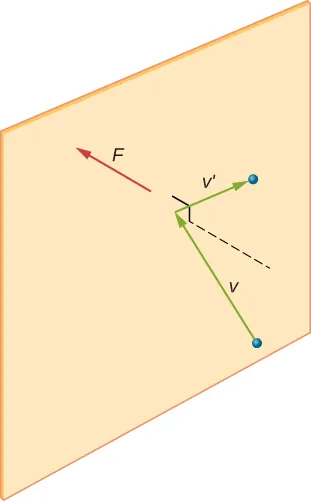
A kinetic-theory diagram showing a gas molecule colliding elastically with a container wall and reversing its momentum component perpendicular to the wall. The momentum change implies an impulse on the wall, producing an average force and therefore pressure, . It supports the idea that pressure is a macroscopic consequence of many microscopic momentum transfers. Source
The pressure already exists within the gas.
Pressure describes the collective effect of many microscopic collisions and momentum transfers occurring everywhere in the gas.
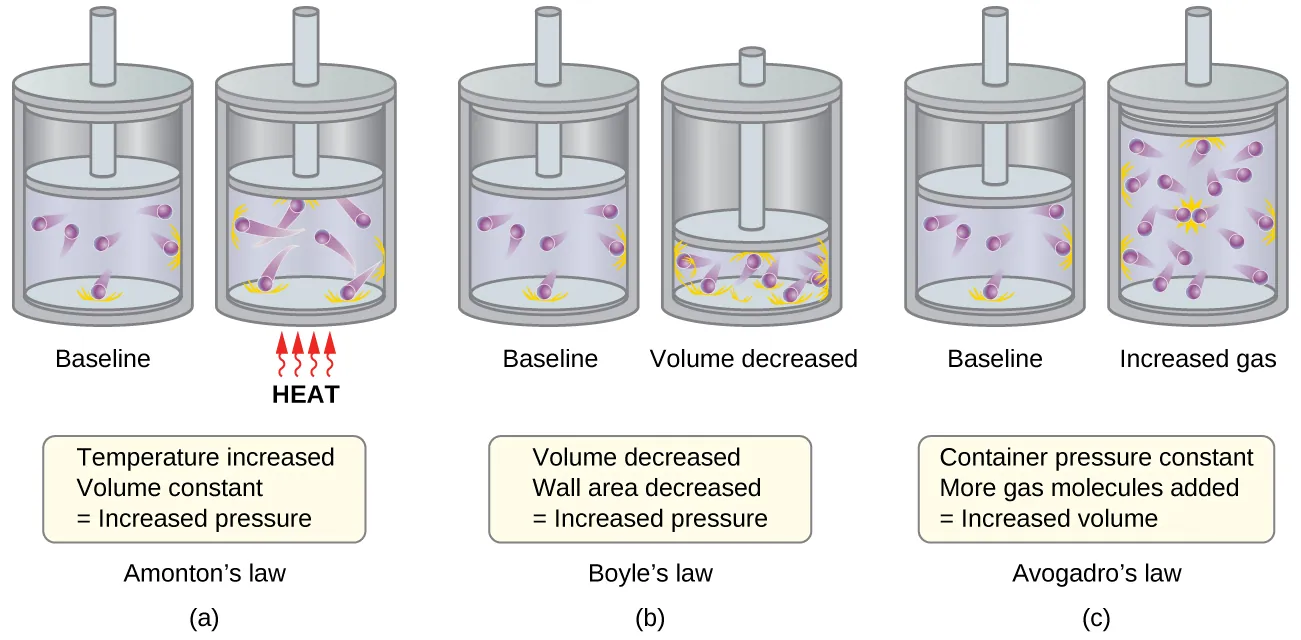
A set of piston-and-cylinder sketches showing how changing temperature, volume, or number of molecules changes the frequency and force of molecular collisions, and therefore the measured pressure. The drawings make the “many collisions add up” idea visually explicit and connect the microscopic model to macroscopic gas-law behavior. This supports treating pressure as a bulk property that can be discussed for the gas state, not just a single wall contact. Source
Because atoms are moving throughout the volume, interacting with one another and with any surface placed in their path, pressure must be understood as an interior property of the gas.
Pressure: A physical quantity that describes the push exerted by a gas on a surface at a location, arising from the combined effect of many microscopic particle collisions.
A useful way to think about this is to imagine selecting a tiny region somewhere in the middle of the gas. That region is surrounded by more gas on all sides. The surrounding gas exerts pushes on it continuously. This means the gas in the interior is not isolated from pressure effects; it is immersed in them.
Why Pressure Exists Away from the Walls
Even if there is no solid object in the middle of a gas, the gas still has pressure there. To see this, imagine drawing an imaginary surface inside the gas. Atoms moving from one side of that imagined surface cross it, collide near it, and transfer momentum across it. The gas on one side influences the gas on the other side.
This idea is important because pressure does not require a visible boundary. A real wall is just one possible surface. A pressure sensor placed in the middle of a gas would register pressure because gas atoms would strike the sensor from all directions. The same reasoning applies to a tiny paddle, membrane, or probe inserted anywhere inside the gas.
So, the interior of a gas is not pressure-free space between particles. Instead, it is a region where microscopic motion produces a macroscopic effect that can be assigned to each location. Pressure is therefore a bulk property of the gas, not merely a boundary effect.
This also explains why pressure can be discussed at a point inside a gas in diagrams and models. In practice, the pressure at a point means the pressure over a very small region surrounding that point.
Pressure Through the Gas, Not Only at the Boundary
The statement that pressure exists throughout a gas means more than “the gas can push on the walls.” It means that one part of the gas can push on neighboring parts of the gas. Pressure is part of how forces are transmitted through the gas itself.
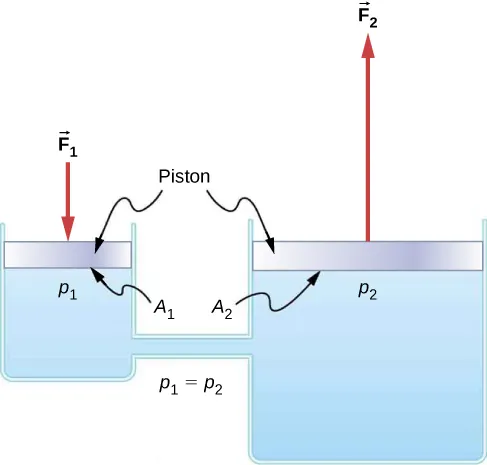
A hydraulic-system schematic illustrating Pascal’s principle: a pressure change applied at one piston is transmitted throughout the enclosed fluid to a second piston. The equal transmitted pressure () acting on a larger area produces a larger output force, highlighting that pressure is a state variable defined throughout the fluid. This provides a concrete picture of how pressure communicates forces through the interior, not just at container walls. Source
If a small parcel of gas is considered, the gas around it exerts forces on its boundaries. In a gas at rest, these pushes balance so the parcel does not accelerate overall. If the pushes did not balance, the parcel would speed up or change shape. This shows that pressure is relevant throughout the gas volume, because the gas’s internal behavior depends on it.
A helpful distinction is this:
Pressure at the wall is the gas pushing on the container
Pressure inside the gas is the gas pushing on neighboring regions of gas, or on any small surface placed there
The wall is simply where the gas meets a solid boundary. The physical origin of the pressure is still the motion and collisions of atoms within the gas.
Pressure Is Defined Everywhere, Not Necessarily Identical Everywhere
Saying that pressure exists throughout a gas does not automatically mean the pressure must be the same at every location. The central idea is that pressure is defined throughout the gas.
In many introductory situations, especially for a gas at rest in a container, the pressure may be treated as approximately uniform. However, the more fundamental point is that pressure is meaningful in the interior whether it is uniform or not. If conditions change from place to place, then the pressure can also vary from place to place.
What AP Physics 2 emphasizes here is the existence of pressure in the gas itself. The gas does not become “real” only when it reaches the wall. Interior regions of the gas also experience and transmit force effects associated with pressure.
This matters conceptually because it connects microscopic motion to macroscopic behavior. Gas particles do not only deliver impulses to the container. They also interact in ways that allow pressure to describe the state of the gas throughout its volume.
Common Misconceptions
A few common errors are worth correcting:
“There is no pressure in the middle of a gas because there is no wall there.”
False. Pressure exists throughout the gas and can be discussed at interior locations.“Pressure is only what a wall feels.”
False. A wall measures pressure, but pressure belongs to the gas itself.“Empty space between atoms means no pressure.”
False. Pressure comes from the overall effect of many moving atoms, not from matter continuously filling every microscopic point.“If pressure is throughout the gas, every point must always have exactly the same pressure.”
False. Pressure may vary with location; the key idea is that it exists throughout the gas.“Only solid objects experience pressure.”
False. Different regions of the gas exert pressure on one another as well.
Practice Questions
A tiny pressure probe is placed at the center of a sealed container of gas. The probe does not touch the walls. Will it read zero pressure or nonzero pressure? Explain your answer. [2 marks]
[1] States that the probe reads nonzero pressure.
[1] Explains that gas particles in the interior collide with the probe from all directions, so pressure exists throughout the gas, not only at the walls.
A sealed horizontal container holds a gas at rest. An imaginary thin surface is drawn inside the gas, dividing it into a left region and a right region. A student says, “Pressure cannot act at that surface because there is no physical wall there.”
(a) Explain why this statement is incorrect. [2 marks]
(b) Describe how the gas on one side of the imaginary surface can exert an effect on the gas on the other side. [2 marks]
(c) If the pressure in the left region became greater than the pressure in the right region, what would happen near the imaginary surface? [1 mark]
(a)
[1] States that pressure exists throughout the gas volume, not just at the container boundary.
[1] States that pressure can be associated with an interior location or an imaginary surface inside the gas.
(b)
[1] Explains that particles move, collide, and transfer momentum across the region near the imaginary surface.
[1] Explains that neighboring regions of gas exert pushes on each other, so pressure is transmitted through the gas itself.
(c)
[1] States that there would be a net force from left to right, causing gas near the surface to accelerate or move toward the lower-pressure region.
FAQ
A real instrument cannot measure an exact mathematical point.
Instead, a pressure sensor samples a very small area over a short time interval. Its reading represents the average effect of many molecular impacts in that tiny region.
If the sensor is small enough compared with the scale over which the gas changes, the reading is a good approximation to the local pressure.
A gas does not need solid walls on every side to have pressure.
Earth’s gravity holds the atmosphere near the planet, and air molecules move and collide throughout that volume. Those collisions produce pressure at locations within the air, including around your body and inside instruments.
So atmospheric pressure is another example of pressure existing throughout a gas, not only where gas touches a container.
Each molecular impact is extremely tiny.
What you experience as pressure is the combined effect of an enormous number of impacts occurring every moment over an area. The individual pushes are too small and too frequent to notice separately, so the result feels smooth and continuous.
This is why pressure can be treated as a macroscopic quantity even though it comes from microscopic events.
Yes. Pressure changes can develop and move through the gas itself.
For example, if one region of a gas is compressed, neighboring regions can be affected even if the disturbance has not yet reached the container boundary. The gas transmits pressure effects internally through particle interactions and momentum transfer.
This is one reason pressure must be treated as a property of the gas volume, not merely of the wall.
Pressure itself is not a force vector in the usual sense.
Instead, pressure tells how strongly a gas pushes per unit area at a location. The actual force depends on the surface being considered:
the size of the surface
the orientation of the surface
the local pressure
So pressure is a scalar quantity, while the force produced by that pressure on a particular surface has a direction.
