

AP Syllabus focus: 'Collisions between two atoms, or between an atom and a fixed object, can be analyzed using conservation of momentum.'
Gas particles collide constantly, and each brief interaction can be understood with a simple model: if the collision is treated as an isolated event, total momentum before and after remains the same.
Momentum in collision analysis
The key quantity in gas-collision analysis is momentum.
Momentum: The product of an object's mass and velocity; momentum is a vector quantity, so its direction matters.
Because momentum depends on both mass and velocity, a change in either one changes the momentum of an atom.
= momentum, unit
= mass of the atom, unit
= velocity of the atom, unit
In AP Physics 2, collisions are usually treated over a very short time interval. During that brief interval, the strongest forces are the forces that the colliding objects exert on each other. Those forces are internal to the chosen system, so they do not change the system's total momentum. Even if the contact forces are large, they come in equal-and-opposite pairs within the system.
In gas problems, gravity or other long-term forces may exist, but during the tiny collision time their effect on momentum is usually negligible compared with the collision forces themselves. That approximation lets the collision be treated as an isolated interaction.
This is why collision problems focus on the total momentum of the system, not just the momentum of one atom. Momentum is also a vector. In one-dimensional problems, direction is handled with signs. If right is positive, then left is negative. A negative momentum value does not mean “less momentum”; it means the momentum points in the negative direction.
Choosing the system correctly is essential. If the system boundary includes every object taking part in the collision, then the internal interaction forces do not change the total momentum. A poor system choice often causes the most common errors in gas-collision reasoning.
Two-atom collisions
For a collision between two atoms, choose the two atoms together as the system. If external influences are negligible during the short collision, the total momentum of that two-atom system is conserved.
= total momentum before the collision, unit
= total momentum after the collision, unit
For a one-dimensional collision, you can write the total initial momentum as and the total final momentum as .
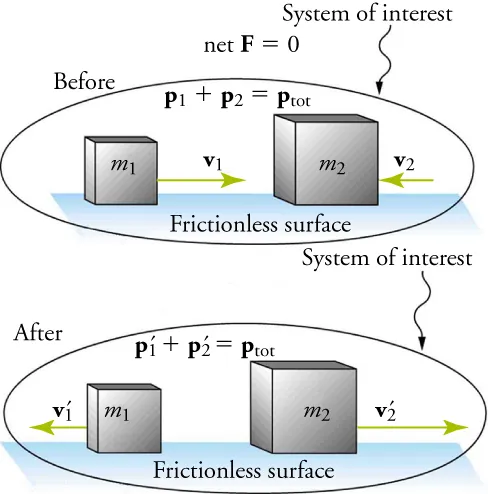
A before/after schematic of a two-object, one-dimensional collision on a frictionless surface, with velocity vectors and the “system of interest” explicitly labeled. The figure supports the conservation statement that the system’s total momentum is unchanged from before to after the collision, even though each object’s velocity can change. Source
Setting these equal gives the main equation used to analyze the collision. The masses may be the same or different, and either atom may be initially at rest or already moving.
Conservation of momentum gives a relationship between the motion before the collision and the motion after it. In some problems, that single relationship is enough to find an unknown final velocity. In other problems, it tells you only which outcomes are possible. Either way, the momentum equation must be satisfied for the chosen system.
The momentum equation does not require the atoms to have the same speed before or after the collision. It applies equally well when both atoms are moving, when one starts at rest, or when they separate in different directions after contact.
A useful idea is that the atoms exert equal and opposite forces on each other during the collision. As a result, the momentum gained by one atom is matched by the momentum lost by the other atom. The total stays constant even though each atom’s individual momentum may change a lot.
In more than one dimension, momentum must be conserved separately in each coordinate direction. That means the -component of total momentum is conserved, and the -component of total momentum is conserved.
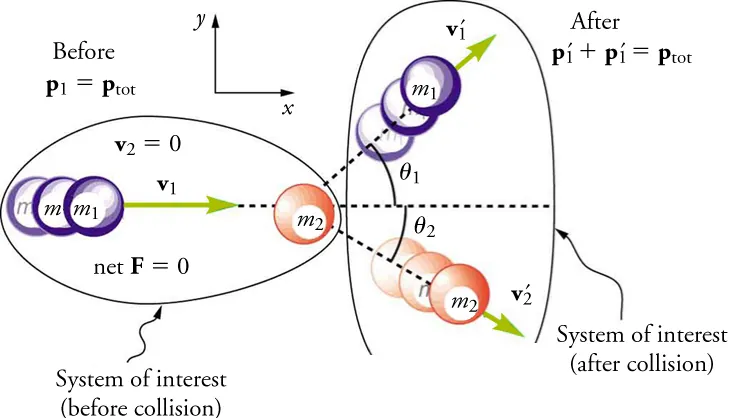
A two-dimensional collision diagram with a chosen coordinate system and post-collision velocity directions at angles. It visually motivates writing conservation of momentum separately for the - and -components when the objects do not collide head-on. Source
This is important when atoms do not collide head-on.
Collisions with a fixed object
A gas atom can also collide with a fixed object, such as a rigid container wall. In practice, “fixed” means the object is so massive compared with the atom that its speed change is too small to notice. The correct conserved system is still the combined system of the atom and the object, even if the object’s motion is negligible.
During the collision, the atom’s momentum changes because the object exerts a force on it. If the atom rebounds, its velocity may reverse direction, so the sign of its momentum changes.
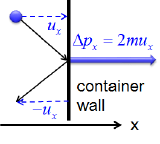
A labeled molecular-collision-with-a-wall diagram showing the initial and final velocity directions and the resulting momentum transfer to the wall. It highlights that reversing the perpendicular component of velocity produces a large change in momentum (an impulse), which is central to understanding gas pressure and wall collisions. Source
That can produce a large momentum change for the atom, even when the atom’s speed before and after is similar.
The object also experiences a momentum change. By conservation of momentum, that change is equal in magnitude and opposite in direction to the atom’s change. For a wall attached to Earth, the momentum is effectively transferred to the enormous wall-Earth system, so the resulting recoil speed is extremely small. This is why ordinary containers do not visibly move when gas atoms strike them.
This point is important on conceptual questions: momentum is not conserved for the atom alone during the collision, because an external force acts on the atom. Momentum is conserved for the larger system that includes both interacting objects.
How to set up AP-style collision reasoning
A strong solution begins by identifying the system. For two-atom collisions, the system is both atoms. For an atom striking a fixed object, the system must include the object as well.
Next, choose a positive direction. Then write the initial and final momentum of each object with correct signs. After that, apply conservation of total momentum in the relevant direction or directions. Finally, interpret the sign of the answer to determine the direction of motion after the collision.
Common mistakes include:
conserving momentum for only one atom instead of the whole system
dropping negative signs when an object moves opposite the chosen positive direction
forgetting that momentum conservation applies to components in angled collisions
assuming a fixed object has zero momentum change just because its speed change is tiny
In AP Physics 2 Algebra, the goal is to connect the physical picture of a collision to the momentum equation. If the system is chosen correctly and directions are handled carefully, collisions in gases can be analyzed with a small set of consistent ideas.
Practice Questions
Two atoms collide head-on in one dimension. Atom A has momentum before the collision. Atom B has momentum before the collision. After the collision, atom A has momentum .
What is the momentum of atom B after the collision?
1 mark for applying conservation of momentum:
1 mark for
A gas atom of mass moves toward a rigid wall with velocity . After the collision, the atom moves away from the wall with velocity .
(a) Determine the change in momentum of the atom. (2 marks)
(b) Determine the change in momentum of the wall-Earth system. (1 mark)
(c) Explain why conservation of momentum should be applied to the combined atom plus wall-Earth system rather than to the atom alone. (2 marks)
(a) 1 mark for stating and
(a) 1 mark for
(b) 1 mark for stating the change in momentum of the wall-Earth system is
(c) 1 mark for recognizing that the wall exerts an external force on the atom, so the atom alone does not conserve momentum during the collision
(c) 1 mark for stating that the interaction forces between atom and wall are internal to the combined system, so total momentum of the combined system is conserved
FAQ
Break the atom’s momentum into components relative to the wall.
The component perpendicular to the wall is the part most directly affected by the collision.
The component parallel to the wall may stay the same if the wall is modeled as smooth and no tangential interaction is included.
Momentum conservation is then applied by tracking the appropriate components for the full atom-plus-wall system.
This is often easier than trying to reason with momentum magnitude alone.
Yes.
Momentum conservation depends on whether the net external impulse on the chosen system is negligible during the collision. It does not require kinetic energy to stay constant.
So two atoms can collide, exchange momentum, and still have a change in kinetic energy distribution, while total momentum remains conserved.
That is why momentum conservation is the first tool used in collision analysis.
Momentum conservation compares the total momentum before and after the collision.
It does not require the exact force at every instant, only that the net external effect during the short collision is negligible for the chosen system.
So even though the collision may involve a very large force over a tiny time, the detailed time history is often unnecessary for finding final momenta.
Then it should no longer be treated as fixed.
Instead, treat the situation as an ordinary two-object collision:
assign an initial momentum to both objects
choose a positive direction
conserve total momentum for the combined system
The same principle applies, but now the second object’s initial and final motion must be included explicitly.
Then the total momentum after the collision must also be zero.
That means the final momenta of the objects must cancel:
equal in magnitude
opposite in direction
This can happen, for example, when two atoms approach with equal and opposite momenta. After colliding, they may both change direction or speed, but the vector sum of their momenta must still be zero.
