

AP Syllabus focus: 'An ideal gas has no internal potential energy; for a monatomic ideal gas, internal energy is the sum of atomic kinetic energies.'
This subtopic explains why the internal energy of an ideal monatomic gas is unusually simple: it comes only from microscopic atomic motion and depends on how much gas is present and its temperature.
Core Idea
The central idea is that internal energy in an ideal monatomic gas is entirely kinetic, not potential. That makes this one of the cleanest thermodynamic models in AP Physics 2.
Internal energy: The microscopic energy stored within a system. For an ideal monatomic gas, it is the total kinetic energy of the atoms.
Each atom moves randomly, and the gas’s internal energy is the sum of those many tiny kinetic energies.
The word internal matters: this energy belongs to the particles inside the system, not to the motion of the whole container.
Why No Internal Potential Energy?
For an ideal gas, the model says that atoms do not store energy in their positions relative to one another. In other words, there is no internal energy associated with interatomic attraction or repulsion. If the gas is ideal, there is no internal potential energy to add to the total.
That means the internal energy of the gas does not come from:
bonds between particles
stretching or compressing interactions between neighboring atoms
any stored interaction energy inside the gas
Instead, it comes only from how fast the atoms are moving.
Why Monatomic Matters
A monatomic ideal gas contains single atoms rather than molecules made of multiple atoms.
Monatomic ideal gas: An ideal gas made of individual atoms, such as helium, neon, or argon.
The word monatomic is important because a single atom does not have internal molecular structure that can rotate or vibrate the way a multi-atom molecule can. In the AP Physics 2 model, that means the only microscopic energy contribution is translational kinetic energy: the kinetic energy of atoms moving through space.
So for a monatomic ideal gas:
no internal potential energy is included
no molecular rotational energy is included
no molecular vibrational energy is included
the entire internal energy is the sum of atomic kinetic energies
This is why the model is so powerful: it connects a macroscopic variable, temperature, to a microscopic picture of moving atoms.
Internal Energy and Temperature
Because the internal energy is the total kinetic energy of the atoms, a higher temperature means a larger internal energy. A lower temperature means a smaller internal energy. For a fixed amount of gas, internal energy changes only when temperature changes.
= internal energy of the gas, J
= amount of gas, mol
= ideal gas constant,
= number of atoms
= Boltzmann constant,
= absolute temperature, K
This equation shows two important things. First, internal energy is proportional to temperature, so doubling doubles if the amount of gas stays the same. Second, internal energy is proportional to the amount of gas, so more atoms mean more total kinetic energy.
The factor comes from motion in three dimensions. Each atom can move in the , , and directions, and each direction contributes to the total translational kinetic energy.
Important Implications
For a closed sample of ideal monatomic gas, the amount of gas stays constant, so internal energy depends only on temperature. That leads to several useful ideas:
If increases, the atoms have greater average kinetic energy, so increases.
If decreases, the atoms have less average kinetic energy, so decreases.
If the number of atoms increases while stays the same, increases because more atoms share the same average kinetic energy.
Pressure and volume can change, but for an ideal monatomic gas they matter for internal energy only through their effect on temperature.
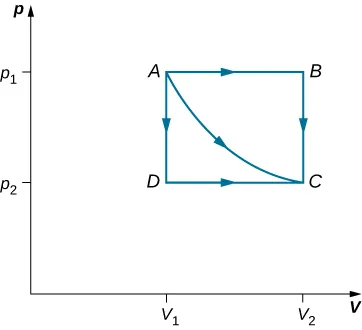
A – diagram showing different quasistatic paths between the same initial and final equilibrium states. It highlights that thermodynamic processes can change pressure and volume in different ways even when connecting the same endpoints, reinforcing that state functions (like for an ideal monatomic gas) depend only on the state—especially —not the path taken. Source
Microscopically, collisions between atoms can redistribute energy from one atom to another, but the gas’s internal energy is still just the total of all atomic kinetic energies. The energy may be shared differently among atoms from moment to moment, yet the total internal energy is determined by the state of the gas.
Common Misunderstandings
A frequent mistake is to think that “no internal potential energy” means “no internal energy.” That is false. An ideal monatomic gas can have substantial internal energy because the atoms are moving.
Another common mistake is to treat internal energy as depending directly on pressure alone or volume alone. For an ideal monatomic gas, the key dependence is on temperature and amount of gas.
It is also important to remember that temperature in these equations must be measured on the absolute scale, in kelvins, because the equation connects temperature to microscopic kinetic energy.
Practice Questions
A sample of helium is modeled as an ideal monatomic gas. Explain why the gas has no internal potential energy in this model and state what its internal energy consists of.
1 mark: States that in the ideal-gas model there is no intermolecular interaction energy, so there is no internal potential energy.
1 mark: States that the internal energy is the sum of the kinetic energies of the atoms.
A rigid, sealed container holds moles of an ideal monatomic gas at temperature . The gas is heated until its temperature becomes .
(a) Write an expression for the initial internal energy .
(b) Determine the final internal energy in terms of .
(c) Describe, in microscopic terms, why the internal energy changes even though the volume remains constant.
(a)
1 mark: Writes
(b)
1 mark: Writes
1 mark: Simplifies to
1 mark: States equivalent result
(c)
1 mark: States that increasing temperature increases the average kinetic energy of the atoms.
1 mark: States that internal energy increases because it is the total kinetic energy of all the atoms.
FAQ
Temperature sets the average translational kinetic energy per atom, so total internal energy depends on the number of atoms and the temperature.
Mass affects speed, not average kinetic energy at a given temperature. Lighter atoms move faster and heavier atoms move slower, but they can still have the same average kinetic energy.
No. Internal energy refers to microscopic energy inside the system, not the motion of the system as a whole.
For example, a container of gas in a moving truck can have kinetic energy because the truck is moving, but that bulk motion is separate from the gas’s internal energy.
Kelvin is an absolute temperature scale, and the internal-energy equation is proportional to absolute temperature.
If Celsius were used directly, a temperature of $0^\circ C$ would incorrectly suggest zero internal energy change from the formula. The equation only works correctly when $T$ is measured from absolute zero, so kelvins must be used.
In the model, internal energy would be zero only at $0\ K$, because all translational kinetic energy would be zero.
In real physics, reaching absolute zero exactly is not achievable. So $U = 0$ is a limiting idea in the idealized model, not a practical experimental state.
A non-monatomic gas can store internal energy in additional microscopic forms, especially rotational and sometimes vibrational motion.
That means the simple monatomic result $U = \dfrac{3}{2}nRT$ no longer fully describes the gas. The factor in front of $nRT$ becomes larger and can depend on which energy modes are active.
