

AP Syllabus focus: 'The first law of thermodynamics restates conservation of energy, accounting for work, heating, and cooling.'
Thermodynamics applies energy conservation to systems that exchange energy with their surroundings. The first law shows how heating, cooling, and work change a system’s internal energy during a physical process.
The first law as energy accounting
When a thermodynamic system changes, physicists track energy crossing the system boundary. The central idea is ordinary conservation of energy: energy is not created or destroyed. Instead, it is transferred or transformed. In thermodynamics, the important question is how those transfers affect the system’s internal energy, written as .
First law of thermodynamics: The change in a system’s internal energy equals the energy transferred by thermal processes plus the work done on the system.
The first law is therefore a bookkeeping rule. It connects microscopic stored energy inside the system to energy entering or leaving during the process. If the system gains energy from its surroundings, must increase unless an equal amount leaves in another way. If the system loses more energy than it gains, decreases.
= change in internal energy of the system, J
= energy transferred by thermal processes, J
= work done on the system by external forces, J
This AP Physics 2 sign convention treats work done on the system as positive.
That is why compression often gives , while expansion often gives . Keeping the sign convention consistent is more important than memorizing a single verbal rule.
Interpreting the three quantities
The term tells how the internal energy changes between an initial state and a final state. A positive value means the microscopic energy of the system increases. A negative value means the system ends with less internal energy than before.
The term represents energy transferred because of a temperature difference. If energy enters the system by heating, then . If energy leaves the system by cooling, then . It is important to treat heating and cooling as energy transfer processes, not as material substances stored inside the system.
The term represents energy transferred by forces acting through a boundary displacement. In gas systems, this usually happens when a piston moves or when the gas changes volume.
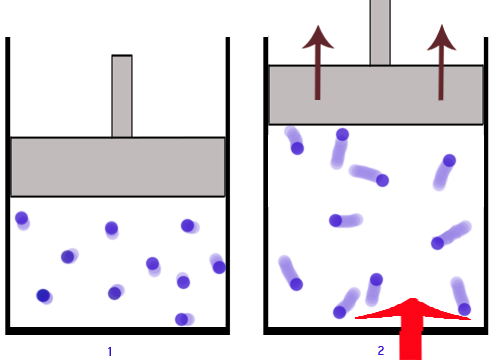
A piston–cylinder sketch showing a gas expanding and pushing a piston, illustrating how boundary motion allows mechanical energy transfer as work. This makes the sign idea concrete: during expansion the gas does work on the surroundings (often corresponding to with your AP Physics 2 “work done on the system” convention). Source
If the surroundings squeeze the gas, they do work on it, so . If the gas pushes outward on the surroundings, the gas does work on them, so .
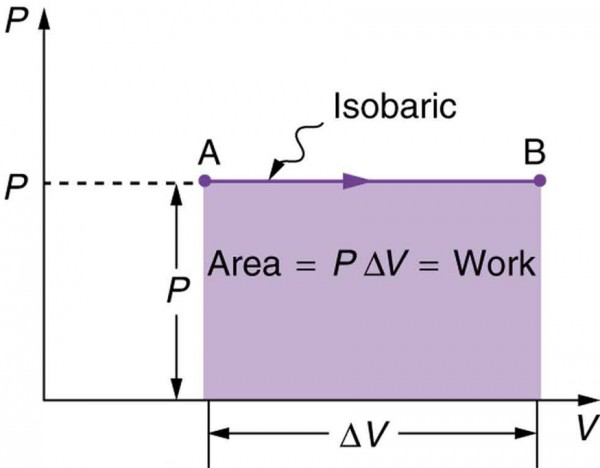
A pressure–volume (PV) diagram with a shaded region highlighting that work equals the area under the curve (or inside a closed loop for a cycle). This connects the graphical meaning of work to the energy-accounting equation by making something students can compute from a process path. Source
What the first law says in physical situations
The first law combines the effects of thermal transfer and work. It does not care whether the process looks simple or complicated; the energy balance must still hold.
If and , the system gains internal energy only by heating.
If and , the system loses internal energy only by cooling.
If and , work alone increases the internal energy.
If and , the system loses internal energy because it does work on the surroundings.
If both and are nonzero, add them algebraically to find .
This explains why a system can be heated and still have its internal energy decrease: if it does even more work on the surroundings, the negative work term can outweigh the positive heating term. It also explains why internal energy can stay constant when energy is transferred. If and have equal magnitude and opposite overall effect, then .
Why this is a statement of conservation of energy
The first law does not introduce a special kind of thermodynamic energy conservation. It is the same universal conservation law written for a chosen system. Any increase in the system’s internal energy must come from energy transferred in by heating or by work. Any decrease in internal energy means that energy has left the system through one or both of those mechanisms.
Because of this, the first law is especially useful for checking whether a description is physically possible. A claim that a gas expands, does work on the surroundings, and also increases its internal energy without any energy input would violate conservation of energy. The missing energy would have to come from somewhere, and the first law reveals that problem immediately.
Common sign and reasoning errors
Most mistakes on this topic come from poor sign choices rather than difficult physics. Always identify the system first, since the signs of and depend on which object or collection of matter you are analyzing.
Helpful questions include:
Is energy crossing the boundary because of a temperature difference?
Is the surroundings doing work on the system, or is the system doing work on the surroundings?
After combining and , should be positive, negative, or zero?
Using those questions keeps the first law tied to the core idea: every thermodynamic change must satisfy conservation of energy.
Practice Questions
A gas releases 90 J to its surroundings by cooling while the surroundings do 25 J of work on the gas. What is the change in the gas’s internal energy?
1 mark: Uses with correct signs, and
1 mark:
A gas in a cylinder is heated, and during the same process the gas expands against a piston.
(a) The gas absorbs 240 J of energy by heating and does 150 J of work on the surroundings. Calculate .
(b) State whether the gas’s internal energy increases or decreases.
(c) In a second process, the surroundings do 60 J of work on the gas while the internal energy decreases by 20 J. Determine and state whether the process is heating or cooling.
1 mark: Identifies that work done by the gas means
1 mark: Uses
1 mark: Calculates
1 mark: States that the internal energy increases
1 mark: Uses or equivalent
1 mark: Finds and states that the process is cooling
FAQ
Different books define $W$ differently.
If $W$ means work done on the system, the AP form is $ \Delta U = Q + W $. If $W$ means work done by the system, the equation becomes $ \Delta U = Q - W $.
Both forms are correct when used consistently. The physical prediction is the same; only the sign convention changes.
Heat and work describe how energy crosses the boundary of a system.
Once the transfer is complete, the energy is counted as part of the system’s internal or macroscopic energy. Physicists therefore say a system has internal energy, but they do not say it “contains heat” or “contains work.”
This distinction helps prevent sign errors and keeps the first law focused on transfer versus storage.
Internal energy depends only on the system’s state. If a process ends with the same state it started with, then the initial and final internal energies are the same.
For a full cycle, the first law becomes $0 = Q + W$. That means the net thermal energy transfer and the net work must balance, using the chosen sign convention.
A cycle can still involve large energy transfers. The key point is that the system returns to its original internal energy.
No. The first law only checks whether the energy accounting is correct.
A process can satisfy $ \Delta U = Q + W $ and still not occur spontaneously. Questions about natural direction, irreversibility, and why some processes happen without outside intervention belong to the second law of thermodynamics.
So the first law tells you whether a process is energetically allowed, not whether nature will automatically choose it.
Choose a boundary that matches what the question asks about and makes the energy transfers easiest to track.
If the question asks about a gas, the gas alone is usually the system.
If a piston or container is included in the system, some energy transfers may be counted differently.
Once the boundary is chosen, keep it fixed throughout the problem.
A clear system boundary is one of the best ways to avoid confusion about the signs of $Q$ and $W$.
