

AP Syllabus focus: 'Work done on a system by constant or average external pressure is associated with a change in the system’s volume.'
When a gas expands or is compressed, the surroundings can transfer energy mechanically by pushing on a moving boundary. Understanding this pressure-volume interaction is essential for describing thermodynamic work.
Pressure-volume work
Pressure-volume work occurs when the surroundings exert pressure on a system and the system’s volume changes. The usual AP Physics 2 picture is a gas in a cylinder with a movable piston, but the same idea applies to any system with a boundary that can move.
Pressure-volume work: Mechanical energy transfer associated with an external pressure acting while a system changes volume.
If the boundary does not move, no pressure-volume work is done. A gas may still have pressure, but pressure alone is not enough. Work requires both a force and a displacement, so the system’s volume must increase or decrease.
External pressure and the boundary
The important pressure for this subtopic is the pressure applied by the surroundings to the system boundary.
External pressure: The pressure exerted by the surroundings on the boundary of a system.
External pressure can come from atmospheric air, a piston, added weights, or any other outside agent pushing on the system. In many problems, it is constant. In others, it may change during the process, in which case an average external pressure may be used.
A helpful physical picture is a piston of area moving a distance .
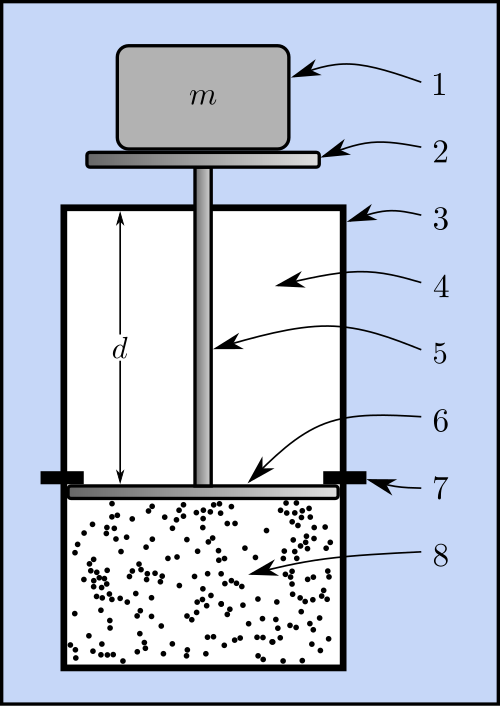
A weighted piston–cylinder diagram showing a gas under a movable piston, with an external load providing the surrounding pressure. It makes the “moving boundary” idea concrete: the surroundings apply to the piston face, and piston motion produces a change in volume. This is the standard physical model behind pressure–volume work in introductory thermodynamics. Source
The surroundings exert a force with magnitude . The volume change has magnitude , so the magnitude of the work is . This is why work by pressure is directly connected to volume change.
Equation for constant external pressure
For a constant external pressure, the work done on the system is given by
= work done on the system by the surroundings, J
= external pressure, Pa
= change in volume, ,
This form uses the AP Physics convention that means work done on the system. Because of that convention, the minus sign is essential.
The units are consistent with energy. Since , multiplying pressure by volume gives .
Expansion and compression
The sign of tells you whether the system expands or compresses, and that determines the sign of the work done on the system.
Expansion: , so is positive. Then is negative.
Compression: , so is negative. Then is positive.
No volume change: , so .
These signs match the physical situation.
During compression, the surroundings push inward and transfer mechanical energy to the system.
During expansion, the system pushes outward against the surroundings, so the work done on the system is negative.
It is often useful to identify the agent doing the pushing. If the surroundings are squeezing the system smaller, the work done on the system should be positive. If the system is pushing the surroundings outward, the work done on the system should be negative.
Constant versus average external pressure
Some processes occur under a truly constant external pressure. For example, a piston may move while the outside force on it stays the same. In that case, the equation above applies directly.
Other processes do not have one unchanging value of external pressure. If the problem gives an average external pressure, you use the same structure with that average value and the total volume change. This gives the total work done on the system over the process.
Using average external pressure is an approximation or a summary description of a changing process. It is appropriate only when the problem explicitly gives that average or clearly intends you to use it.
What the equation emphasizes
This relation shows that pressure-volume work depends on:
how strongly the surroundings push, represented by
how much the boundary moves overall, represented by
A larger external pressure means a larger force on the system boundary. A larger magnitude of volume change means the boundary has moved more. Either one increases the magnitude of the work.
The equation does not say that any increase in pressure automatically means work. A rigid container can hold a very high-pressure gas, but if its volume stays fixed, the pressure-volume work is zero. Likewise, a very small external pressure acting during a large expansion can still produce a relatively small amount of work.
Common reasoning checks
When solving problems about work done by external pressure, check these points carefully:
Identify the system before deciding whether work is done on it or by it.
Use the external pressure, not just any pressure mentioned in the situation.
Decide whether the process is an expansion or a compression.
Find from so the sign is correct.
If the pressure is not constant, use an average external pressure only when the problem supports that choice.
A final conceptual check is useful: if the surroundings squeeze the system, the answer for work done on the system should come out positive. If the system expands against the surroundings, the answer should come out negative.
Practice Questions
A gas in a cylinder is compressed by a constant external pressure of . Its volume changes from to . Calculate the work done on the gas.
Uses with [1]
Calculates [1]
A gas is inside a cylinder with a movable piston. The external pressure on the piston is constant at .
(a) The gas expands from to . Calculate the work done on the gas. [2]
(b) State whether mechanical energy is transferred into the gas or out of the gas during this expansion. Explain briefly. [1]
(c) The gas is then compressed from back to at the same external pressure. Calculate the work done on the gas during the compression. [1]
(d) Find the net work done on the gas for the complete expansion-compression sequence. [1]
(a)
Correct use of with [1]
[1]
(b)
States that mechanical energy is transferred out of the gas, or explains that expansion gives negative work done on the gas [1]
(c)
[1]
(d)
Net work done on the gas is [1]
FAQ
Use an average external pressure when the outside pressure changes during the motion, but the problem asks only for the total work over the whole volume change.
It is most reliable when the average value is given directly.
It can also be used when the pressure change is simple and the problem clearly intends an average.
It is less appropriate for irregular processes unless the problem explicitly says to use it.
Yes. If the system boundary is exposed to air, atmospheric pressure is part of the external pressure acting on it.
For a piston open to the air, the total external pressure can include atmospheric pressure plus any added pressure from weights.
If the outside is a vacuum, atmospheric pressure does not contribute.
Always use the pressure that is actually pushing on the system boundary.
If pressure is in atmospheres and volume change is in liters, the product comes out in $L\cdot atm$ instead of joules.
$1 \ L\cdot atm \approx 101.3 \ J$
Multiply the numerical value in $L\cdot atm$ by $101.3$ to convert to joules.
This is useful when a problem does not start in SI units.
Friction means the surroundings do more than just apply fluid pressure. There is an additional force that resists motion.
During compression, friction can increase the effective external force needed to move the piston inward.
During expansion, friction can make outward motion harder.
In a simplified model, that extra force can be folded into an effective external pressure.
AP-style problems usually ignore friction unless it is mentioned explicitly.
In a rapid process, different parts of the gas may not share the same internal pressure at the same time. Pressure gradients can develop inside the gas.
For work done on the system, the boundary interaction is still determined by the force applied at the boundary. In AP-style problems, you normally use the stated external pressure or average external pressure for the work calculation, even if the gas is not internally balanced during the motion.
