

AP Syllabus focus: 'Special processes include isovolumetric, isothermal, isobaric, and adiabatic processes, depending on volume, temperature, pressure, and thermal transfer.'
Special thermodynamic processes are idealized ways to describe how a gas changes state. Each one is identified by a quantity, or a transfer condition, that remains fixed throughout the change.
Identifying Special Thermodynamic Processes
A thermodynamic process is the path a system follows as it changes from one state to another.
Thermodynamic process: A change in a system from one state to another, described by how variables such as pressure, volume, temperature, or thermal transfer behave.
Special processes are useful because they let physicists classify a changing system by focusing on one controlling feature. In AP Physics 2, the four important special processes are named by what stays constant or by whether thermal energy transfer occurs.
Isovolumetric: volume stays constant
Isobaric: pressure stays constant
Isothermal: temperature stays constant
Adiabatic: no thermal energy is transferred by heating or cooling
These categories are idealized descriptions. Real systems may only approximate them, but they provide a clear way to reason about how a gas behaves during expansion, compression, heating, or cooling.
Isovolumetric Processes
An isovolumetric process is a constant-volume process. The gas is contained so that its volume cannot change. A rigid sealed container is the most common model.
Because the volume is fixed, the gas cannot expand or compress by moving a boundary. That means the defining feature of this process is not what happens to temperature or pressure, but that the container size stays the same throughout the change.
In an isovolumetric process:
the volume remains constant
the pressure may change
the temperature may change
thermal energy may enter or leave the system
Heating a gas in a rigid container is a standard example. As the particles move faster, they strike the walls more forcefully, so the pressure rises even though the container volume does not.
Isobaric Processes
An isobaric process is a constant-pressure process. The pressure of the gas remains unchanged while other properties may vary.
This often happens when a gas is under a movable piston that can rise or fall while the external pressure stays steady. As the gas is heated, it can expand while the pressure remains the same. If the gas is cooled, it can contract at that same pressure.
In an isobaric process:
the pressure remains constant
the volume may change
the temperature may change
thermal energy may enter or leave the system
A common mistake is to assume that constant pressure means “nothing changes.”
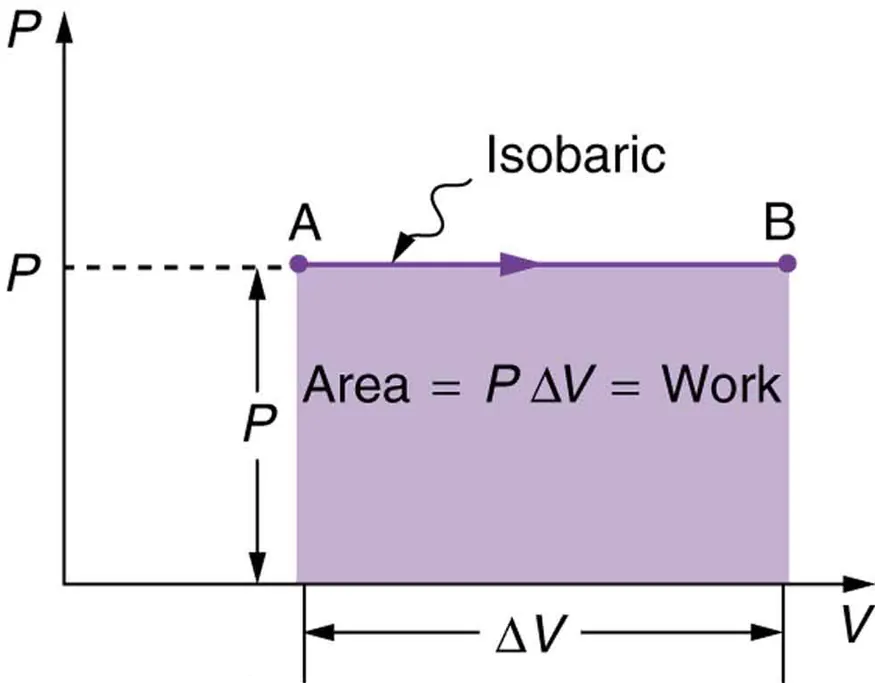
A – diagram of an isobaric process shows a horizontal line from state A to state B, emphasizing that pressure stays constant while volume changes. The shaded rectangle illustrates that the work done by the gas equals the area under the curve, . This visual reinforces why isobaric processes can involve significant expansion or compression even though is unchanged. Source
In fact, isobaric processes often involve very noticeable changes in volume.
Isothermal Processes
An isothermal process is a constant-temperature process. The temperature of the gas stays the same during the entire change.
This does not mean the gas is static or inactive. The gas can still expand or compress. What matters is that the temperature is maintained at a constant value, usually by allowing energy to move between the gas and its surroundings in a controlled way.
In an isothermal process:
the temperature remains constant
the volume may change
the pressure may change
thermal energy transfer may occur in order to keep the temperature fixed
This process is often associated with slow changes, because a slow change gives the system time to stay in temperature balance with its surroundings.
Adiabatic Processes
An adiabatic process is defined by the absence of thermal energy transfer between the system and its surroundings.
Adiabatic process: A thermodynamic process in which no thermal energy is transferred into or out of the system by heating or cooling.
This definition is very important because it shows that adiabatic does not mean constant temperature. In an adiabatic process, the temperature can change even though no thermal energy crosses the boundary of the system.
In an adiabatic process:
there is no thermal energy transfer
the pressure may change
the volume may change
the temperature may change
For example, if a gas expands adiabatically, it can cool as it does work during the expansion. If a gas is compressed adiabatically, it can warm up. The key idea is that the process is identified by the lack of thermal transfer, not by a fixed pressure, volume, or temperature.
Comparing the Four Process Types

Four stacked – diagrams show the characteristic shapes of the special processes: isothermal curves, isobaric horizontal lines, and isochoric vertical lines. The “isentropic” curve represents a reversible adiabatic path (often used as the ideal adiabatic model), which is typically steeper than the isothermal curve for the same starting point. This helps you see that each process is classified by what remains fixed, not by whether other variables change. Source
The four special processes are best distinguished by asking a single question: what is being held fixed?
If the volume is fixed, the process is isovolumetric.
If the pressure is fixed, the process is isobaric.
If the temperature is fixed, the process is isothermal.
If thermal transfer is absent, the process is adiabatic.
It is also important to notice what is not fixed. In most cases, the other variables can still change. Constant temperature does not imply constant pressure. Constant pressure does not imply constant volume. No thermal transfer does not imply constant temperature.
Problem statements usually contain clues about the correct process type. Words such as rigid container, constant pressure, kept at the same temperature, or insulated point directly to one of these four categories. Recognizing that defining condition is the key step in classifying a special thermodynamic process.
Practice Questions
A gas is heated in a rigid sealed container. Identify the special thermodynamic process and state which quantity remains constant.
Identifies the process as isovolumetric. (1 mark)
States that the volume remains constant. (1 mark)
A sample of gas undergoes four separate changes:
A. It is heated in a rigid metal container.
B. It expands under a movable piston that keeps the pressure constant.
C. It is compressed while the temperature is kept constant.
D. It expands in an insulated cylinder so there is no thermal energy transfer.
(a) Name the special thermodynamic process for A, B, C, and D.
(b) Explain one important difference between process C and process D.
A is isovolumetric. (1 mark)
B is isobaric. (1 mark)
C is isothermal. (1 mark)
D is adiabatic. (1 mark)
Explains that process C has constant temperature, while process D has no thermal energy transfer; temperature in an adiabatic process can change. (1 mark)
FAQ
Yes. A process can satisfy more than one condition if the setup allows it.
For example:
a gas in a rigid insulated container is both isovolumetric and adiabatic
a gas can be both isothermal and isobaric if both temperature and pressure are kept constant
In practice, AP problems usually highlight one main category, but it is possible for more than one label to apply.
Thermal energy transfer takes time. If a gas changes state very quickly, there may not be enough time for significant energy to enter or leave by heating or cooling.
That makes the process a good adiabatic approximation, even if the system is not perfectly insulated.
This is why sudden compressions can raise temperature and sudden expansions can lower temperature.
A quasi-static process happens slowly enough that the gas stays close to equilibrium at each moment.
That matters because labels like constant pressure or constant temperature are easiest to apply when the gas has well-defined properties throughout the process.
If a change is too fast or violent, pressure and temperature may not be uniform everywhere in the gas, so the ideal special-process description becomes less exact.
In free expansion, the gas spreads suddenly into empty space without pushing against a steady external pressure.
During that change, the gas is often not in equilibrium, so its pressure may not be well-defined throughout the sample.
Because isobaric means the pressure stays constant during a well-described thermodynamic process, free expansion does not fit that model cleanly.
They mean the same thing: a constant-volume process.
“Isochoric” comes from roots meaning “same space” or “same volume,” while “isovolumetric” states the idea more directly in plain English.
AP Physics 2 may use isovolumetric, but you should recognize both terms as equivalent.
