

AP Syllabus focus: 'A parallel-plate capacitor consists of two separated parallel conducting surfaces that hold equal amounts of charge with opposite signs.'
A parallel-plate capacitor stores charge in a very specific arrangement: two nearby metal surfaces are kept apart so that opposite charges remain separated instead of immediately canceling.
Basic Structure
A parallel-plate capacitor is one of the simplest capacitor models used in AP Physics 2. It is built from two broad conducting surfaces, usually idealized as thin plates, placed so they face each other. The plates are close together, but they are not in contact.
Parallel-plate capacitor: A capacitor made of two separated, parallel conducting surfaces that store equal and opposite charges.
The word parallel describes the geometry: the plates stay the same distance apart across most of their facing area.
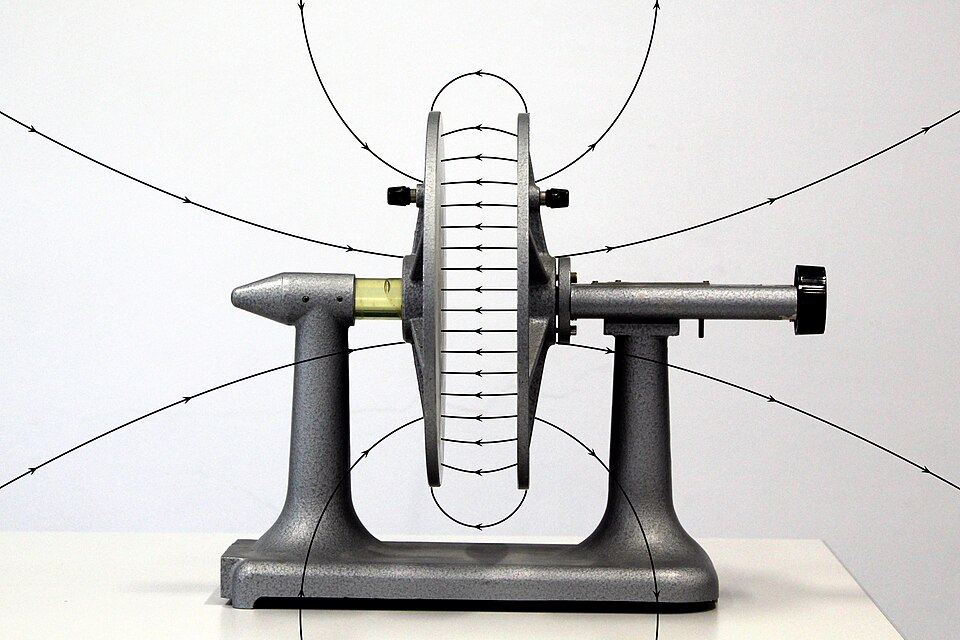
A parallel-plate capacitor with the electric field overlaid as field lines. The lines run from the positively charged plate to the negatively charged plate and are nearly uniform between the plates (with fringing near the edges), matching the idealized AP model of two separated, facing conductors. Source
A conductor is the kind of material needed for the plates because charge carriers in it can move.
Conductor: A material in which electric charge can move relatively easily.
Because the plates are conductors, charge placed on them can redistribute over the surfaces rather than staying trapped at one point. In the ideal model, each plate behaves like a smooth conducting surface that can support a stable net charge. Most textbook diagrams ignore the thickness of the plates and focus on the facing surfaces that define the device.
Why “plate” and “parallel” matter
The word plate does not mean the object must literally look like a kitchen plate. It means the object is treated as a broad, flat surface. The plates are drawn parallel because that geometry creates a simple, controlled arrangement of separated charge. Real devices may use metal foil, films, or coated surfaces, but the AP model focuses on two flat conductors facing one another.
How Charge Separation Happens
If the two plates start neutral, each plate has equal amounts of positive and negative charge overall. A charging process then transfers electrons from one plate to the other. The plate that loses electrons is left with a net positive charge, while the plate that gains electrons develops a net negative charge.
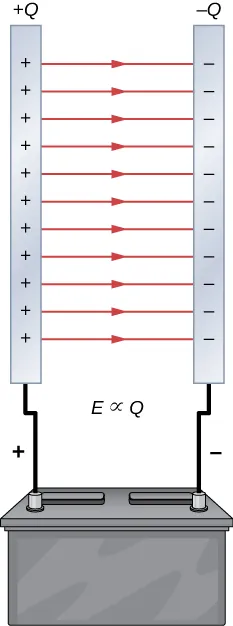
Charge separation in a parallel-plate capacitor after charging: one plate carries and the other carries . The arrows between plates indicate the electric field direction from the positive plate toward the negative plate, reinforcing that the capacitor stores energy in the field created by separated charge. Source
Charge separation: The process of moving charge so that positive and negative charge end up in different regions of a system.
This is the key idea of a capacitor: it does not manufacture charge. Instead, it produces a state in which opposite charges are held apart on different conductors. In ordinary metal plates, the positive charge is usually an electron deficit, and the negative charge is an electron excess.
A useful way to picture the charging process is:
both plates begin neutral
electrons are removed from one plate
those electrons are delivered to the other plate
the first plate becomes positively charged
the second plate becomes negatively charged
Because the same electrons that leave one plate arrive on the other, the amount of charge added to one plate matches the amount removed from the other plate.
What actually moves in the metal plates
In typical metal plates, the positive atomic nuclei are not moving from one plate to the other. Instead, electrons are the mobile charge carriers. A positively charged plate is not filled with extra positive particles brought in from somewhere else; it is a plate that has lost some electrons. A negatively charged plate has gained extra electrons. This helps avoid the common misconception that both signs of charge flow through the metal during charging.
What Equal and Opposite Charges Mean
When one plate has charge , the other plate has charge . The magnitudes are equal, but the signs are opposite. That is what the syllabus means by “equal amounts of charge with opposite signs.”
This equality is not an extra rule added afterward; it follows directly from charge transfer. If a certain amount of negative charge is moved onto one plate, the other plate is missing that same amount of negative charge. As a result, the two-plate capacitor system can still have a total charge of even though each individual plate is charged.
In the ideal parallel-plate capacitor model, one plate is not supposed to have a larger net charge than the other. The defining structure is a balanced separation: one positive plate and one negative plate, with equal magnitude on each.
Thinking of the capacitor as one system
It is often useful to treat the two plates together as a single system. One plate by itself is just a charged conductor. The capacitor is the pair of plates plus the separation between them. The device’s identity comes from the arrangement of the two conductors relative to each other. For this reason, statements about a capacitor usually refer to both plates at once, not just to one plate in isolation.
Why Separation Is Essential
The two conducting surfaces must be separated. If they touched, electrons would have a direct conducting path between them. Charge would then redistribute quickly, and the distinct positive and negative plates would no longer remain in place.
The gap between the plates may be empty space or some material that prevents charge from freely crossing from one plate to the other. The essential point for this subsubtopic is simple: the capacitor stores charge only because opposite charges are kept close together without being allowed to neutralize by direct contact.
This is why a capacitor is a device based on arrangement, not just on the presence of charge. Two charged conductors become a parallel-plate capacitor only when they are positioned as separated, parallel surfaces.
AP Physics 2 Model Features
In AP Physics 2, the parallel-plate capacitor is usually treated with several simplifying assumptions:
each plate is a conductor
the plates are flat and face one another
the plates are parallel
the plates are separated by a small gap or insulating layer
the charges on the plates are equal in magnitude
the signs of the plate charges are opposite
the important physical idea is stored separated charge, not charge creation
The thickness of the plates, the wires used during charging, and the material holding the plates in place are usually ignored unless the problem explicitly mentions them. What matters is the structural picture of two separated, parallel conductors with balanced opposite charges.
Practice Questions
State two features that make a device a parallel-plate capacitor.
1 mark for stating that it has two conducting surfaces or plates.
1 mark for stating that the plates are parallel and separated.
Two isolated metal plates are initially neutral and placed facing each other with a small air gap. Electrons are transferred from Plate A to Plate B. Explain how this process creates a parallel-plate capacitor. In your answer, include the sign of each plate, why the charges have equal magnitude, and why the plates must not touch.
1 mark for stating that Plate A becomes positively charged because it loses electrons.
1 mark for stating that Plate B becomes negatively charged because it gains electrons.
1 mark for explaining that the same electrons removed from Plate A are added to Plate B, so the charges are equal in magnitude and opposite in sign.
1 mark for identifying the device as two conducting plates facing each other as a parallel-plate arrangement.
1 mark for explaining that separation prevents immediate charge flow back between the plates and prevents neutralization.
FAQ
Most of the important behavior comes from having conductive surfaces, so very thick metal is usually unnecessary.
Thin metal layers help reduce mass and cost, and they make it easier to place the two conducting surfaces very close together without making the device bulky.
No. The key requirement is that each plate acts as a good conductor so charge can move and redistribute.
Metals are most common because they conduct well, are easy to manufacture into thin layers, and remain stable in many practical devices.
Yes, if the facing regions are still nearly parallel and the spacing is fairly uniform, the parallel-plate model can still be a useful approximation.
If the plates are badly warped or tilted, the simple model becomes less accurate because the geometry is no longer the same across the device.
A spacer helps keep the plates from touching and shorting together.
It also keeps the gap more uniform and gives the structure mechanical support, which matters because the plates are often very thin and close together.
A spark can occur if the material between the plates stops acting like an insulator and starts conducting.
This can happen when the charge separation becomes so extreme that the air or other separating material breaks down, allowing charge to rush directly from one plate to the other.
