

AP Syllabus focus: 'Capacitance relates the magnitude of charge stored on each plate to the electric potential difference created by separating those charges.'
Capacitance tells how much charge separation a capacitor can maintain for a given voltage. In AP Physics 2, the central idea is the connection between stored charge and electric potential difference.
The core idea
A capacitor stores energy by separating charge. One conducting surface gains positive charge, and the other gains negative charge. The more charge that is separated, the larger the potential difference between the two surfaces becomes.
When physicists describe a capacitor, they focus on how much charge appears on each plate compared with the voltage across the capacitor. This comparison is called capacitance.
Capacitance: The amount of charge stored on each plate per unit electric potential difference across a capacitor.
A capacitor with a larger capacitance can store more charge on each plate without needing as large a potential difference. A capacitor with a smaller capacitance reaches a larger potential difference with less stored charge.
The potential difference is the voltage created by separating charge.
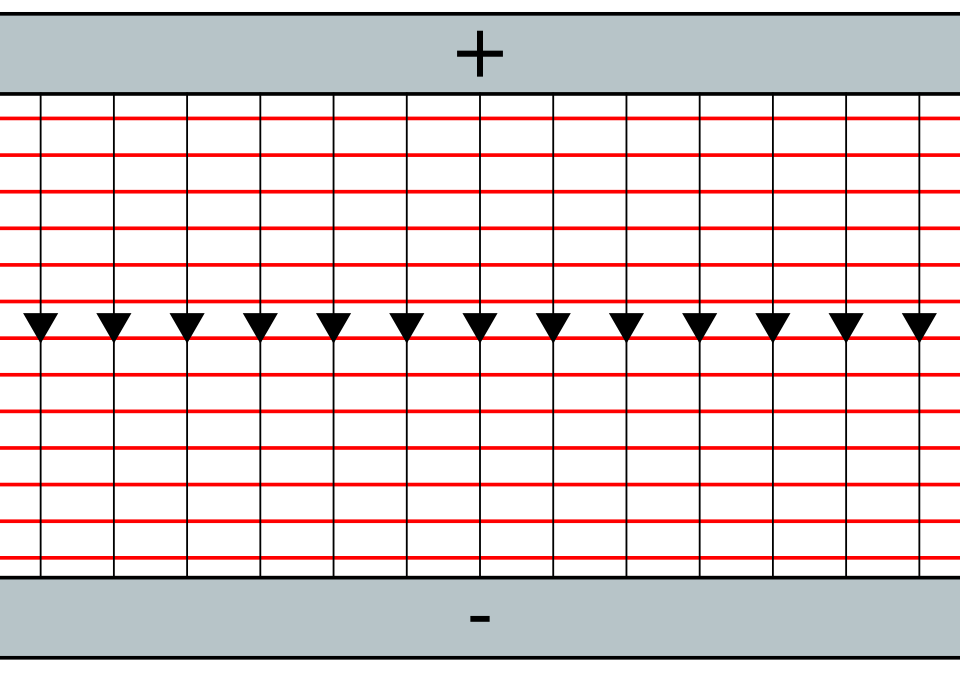
Parallel plates create an approximately uniform electric field between them, drawn here with straight field lines pointing from the positive plate to the negative plate. The evenly spaced equipotential lines emphasize that the electric potential changes steadily across the gap, which is what we mean by the potential difference across the capacitor. Source
It reflects how much electric potential energy changes per unit charge between the two plates.
Electric potential difference: The change in electric potential energy per unit charge between two points; for a capacitor, it is the voltage across the capacitor.
This means capacitance is not just “how much charge is present.” It is specifically about the relationship between charge magnitude and voltage. Two capacitors can have the same potential difference but different stored charges, or the same stored charge but different potential differences.
The capacitance relationship
The essential AP Physics 2 relationship for this topic is the definition of capacitance.
= capacitance, in farads,
= magnitude of charge on one plate, in coulombs,
= electric potential difference across the capacitor, in volts,
This equation shows that capacitance is a ratio. It tells how many coulombs of charge are stored on each plate for every volt of potential difference.
It is important to interpret correctly. The symbol means the magnitude of the charge on either plate, not the net charge of the entire capacitor. If one plate has , the other has , so the whole capacitor can still have zero net charge while storing separated charge.
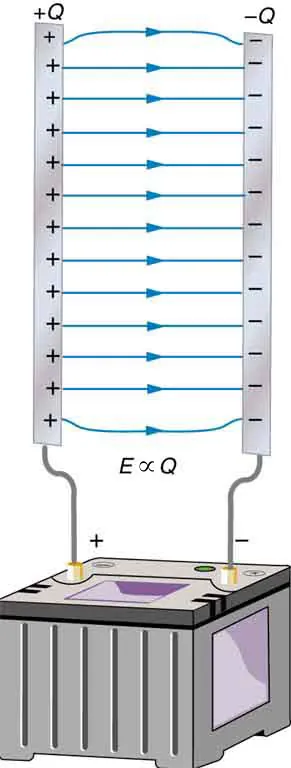
A charged parallel-plate capacitor is depicted with positive charge on one plate and equal-magnitude negative charge on the other. The electric field lines run from the positive plate to the negative plate, illustrating that increasing increases the field strength (and therefore increases the potential difference for a fixed geometry). Source
The equation can also be rearranged as . In that form, it shows directly that for a given capacitor, the stored charge is proportional to the potential difference across it. If the voltage doubles and the capacitance stays the same, the magnitude of charge on each plate also doubles.
Interpreting capacitance
What a larger or smaller capacitance means
A larger value of capacitance means the capacitor is better at storing separated charge for a given voltage. A smaller value means less charge is stored for the same voltage.
Useful interpretations include:
Large capacitance: more charge stored per volt.
Small capacitance: less charge stored per volt.
If increases while stays constant, increases.
If increases while stays constant, increases.
This proportional reasoning is often more important than computation. Many AP questions test whether you understand what happens when one quantity changes while the others are held fixed.
What stays fixed for one capacitor
For a particular capacitor in a fixed situation, the capacitance is treated as a constant property of that capacitor. As charge is added or removed, the potential difference changes in direct proportion.
That is why a graph of charge versus potential difference for an ideal capacitor is a straight line through the origin. The slope of that line is the capacitance. A steeper slope means more charge is stored for each volt, so the capacitor has a larger capacitance.
This idea helps distinguish capacitance from charge and voltage. Charge and potential difference can change during charging or discharging, but capacitance describes how those two quantities are linked.
Units and algebraic reasoning
The SI unit
The SI unit of capacitance is the farad, abbreviated . One farad means one coulomb of charge stored per one volt of potential difference.
In unit form, that means . This is a very large unit in many practical situations, so real capacitors are often much smaller than .
Even if a numerical problem uses unusual unit prefixes, the physical meaning stays the same: capacitance compares stored charge with voltage.
Reasoning without numbers
You should be able to reason from without always substituting values.
For example:
If stays the same and increases, must be smaller.
If stays the same and doubles, doubles.
If stays the same and doubles, doubles.
If both and double, stays unchanged.
This type of algebraic comparison appears frequently in conceptual multiple-choice and short free-response questions.
Common misunderstandings
Several mistakes are common when learning this topic:
Capacitance is not the same as charge. Charge can vary, but capacitance describes the ratio between charge and voltage.
The stored charge is not the net charge of the whole capacitor. It is the magnitude of charge on one plate.
A higher potential difference does not automatically mean a higher capacitance. Capacitance depends on how much charge is stored per volt.
Capacitance is not energy. A capacitor can store electric potential energy, but capacitance itself is the property linking charge and potential difference.
Practice Questions
A capacitor has a capacitance of and a potential difference of across it. What is the magnitude of the charge stored on each plate?
1 mark for using
1 mark for
Capacitor A has capacitance . When a potential difference is applied across it, the magnitude of the charge on each plate is .
(a) A second capacitor, B, has capacitance and is connected across the same potential difference . State the charge on each plate of capacitor B. (1 mark)
(b) Capacitor A remains unchanged, but the potential difference across it is doubled to . Determine the new charge on each plate in terms of . (2 marks)
(c) A student says, “If a capacitor stores no net charge overall, its capacitance must be zero.” Explain why this statement is incorrect. (2 marks)
(a)
1 mark for stating the charge is
(b)
1 mark for recognizing that
1 mark for stating the new charge is
(c)
1 mark for explaining that the two plates carry equal and opposite charges, so the net charge of the whole capacitor can be zero
1 mark for explaining that capacitance depends on the ratio of charge magnitude on one plate to potential difference, not on the net charge of the entire capacitor
FAQ
For an ideal capacitor, the geometry and the material between the conducting surfaces do not change during a problem.
That means the ratio $Q/\Delta V$ stays fixed, so capacitance stays constant even though $Q$ and $\Delta V$ may both change.
In AP Physics 2 problems, this is usually assumed unless the problem clearly says the physical setup changes.
A farad means a capacitor stores $1\ C$ of charge for only $1\ V$ of potential difference.
That is a very large amount of charge compared with many ordinary circuits, so practical capacitors are often labeled in:
microfarads, $\mu F$
nanofarads, $nF$
picofarads, $pF$
This does not change the physics; it only reflects that many real devices have capacitances much smaller than $1\ F$.
A simple method is to place a known amount of charge on a capacitor and measure the resulting potential difference.
Then use the definition: $C=\dfrac{Q}{\Delta V}$
In practice, electronic instruments often automate this process. They may apply a controlled voltage or charge, then determine the other quantity and compute the ratio.
So capacitance is not measured by looking only at voltage or only at charge; both are needed.
The rating tells you how much charge the capacitor can store per volt across its terminals.
For example, a larger rated capacitance means that for the same applied voltage, more charge can accumulate on the plates.
The rating does not by itself tell you:
the current in a circuit
the energy stored
the maximum safe operating voltage
Those are related but separate pieces of information.
If the capacitor is isolated after being disconnected, the total separated charge usually remains approximately fixed because there is no easy path for charge to leave.
If $Q$ stays fixed and the physical capacitor is unchanged, then $C$ stays fixed as well, so the potential difference is determined by $ \Delta V=\dfrac{Q}{C} $.
In real situations, leakage can slowly reduce the charge, but ideal AP problems often ignore that effect.
