

AP Syllabus focus: 'Capacitance depends only on physical properties, including shape and plate separator material. For parallel plates, it is proportional to plate area and inversely proportional to plate distance.'
This subtopic focuses on what sets the capacitance of a capacitor. In AP Physics 2, the key idea is that capacitance is determined by geometry and materials, not by changing charge or voltage.
What sets capacitance?
The most important idea is that capacitance is a property of the capacitor itself. If the capacitor is ideal, its capacitance is fixed by how it is built. That means it depends on the capacitor’s physical properties, not on how much charge is currently stored on it.
Capacitance: A property of a capacitor that describes how much charge it can store for a given potential difference.
Because capacitance is a construction-based property, changing the amount of stored charge does not, by itself, change the capacitance. Likewise, changing the potential difference across an ideal capacitor does not change its capacitance. Instead, the capacitance is determined by features such as:
the shape of the conductors
the size and arrangement of the conductors
the material between them, called the separator material
This is a major distinction in capacitor physics: charge and potential difference can vary during use, but capacitance stays tied to the device’s design.
Shape and geometry
The syllabus states that capacitance depends on shape, which means the geometry of the conductors matters. Geometry affects how charge can spread out and how much potential difference is produced when charge is placed on the conductors.
A capacitor with a different shape can have a different capacitance even if it is made from the same conducting material. What matters is not the metal itself, but the way the conductors are arranged in space.
Important geometric ideas include:
Larger facing surfaces usually allow more charge to be stored for the same potential difference.
Smaller separation between conductors usually increases capacitance.
Different shapes create different electric interactions, so capacitance is not determined by area alone in every design.
For AP Physics 2, the most important specific case is the parallel-plate capacitor, because its trends are simple and directly tested.
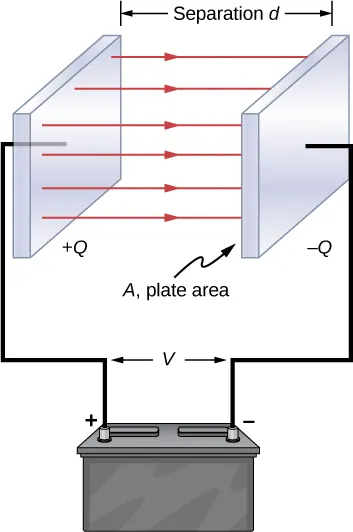
A labeled parallel-plate capacitor showing plate area and separation distance , with electric field lines drawn between the plates. This visual reinforces that changing geometry (larger or smaller ) changes how much charge can be stored per volt, i.e., the capacitance. Source
Parallel-plate capacitors
For a parallel-plate capacitor, the capacitance follows a very useful proportional relationship.
= capacitance, in farads
= overlapping plate area, in square meters
= separation distance between the plates, in meters
This relationship shows two separate physical effects: the effect of plate area and the effect of plate distance.
Plate area
For parallel plates, capacitance is directly proportional to plate area. If the plate area increases, the capacitance increases. If the plate area decreases, the capacitance decreases.
This happens because larger plates provide more surface over which charge can be distributed. With more area available, the capacitor can store more charge before the potential difference rises by the same amount.
A few important points follow from this idea:
Doubling the plate area doubles the capacitance, if all other factors stay the same.
Halving the plate area halves the capacitance, if all other factors stay the same.
The relevant area is the facing area of the plates, since that is the region that contributes most strongly to the capacitor’s behavior.
Plate separation
For parallel plates, capacitance is inversely proportional to the distance between the plates. If the distance increases, the capacitance decreases. If the distance decreases, the capacitance increases.
The physical reason is that when the plates are closer together, a given amount of charge creates a smaller potential difference than it would if the plates were farther apart. That allows the capacitor to store more charge per unit potential difference, which means greater capacitance.
Key consequences include:
Doubling the plate separation cuts the capacitance in half.
Reducing the separation to one-half doubles the capacitance.
Very small plate spacing can produce large capacitance, provided the plates remain separated and the capacitor still behaves as intended.
Separator material
The syllabus also states that capacitance depends on the plate separator material.
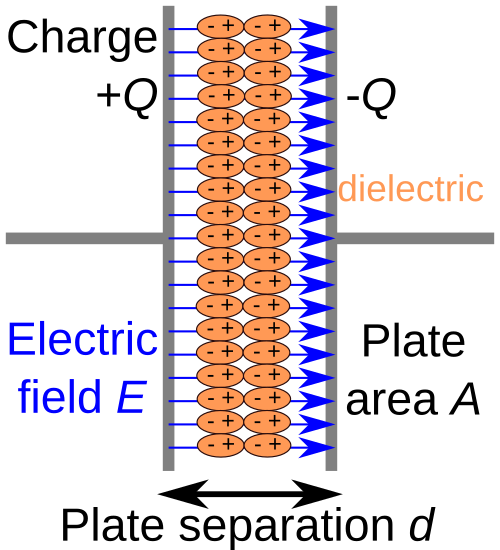
Schematic of a parallel-plate capacitor with a dielectric slab inserted between the plates, showing how the dielectric occupies the gap where the electric field exists. The labeling highlights that the separator material is a design choice inside the capacitor, not just empty space, and it can change the capacitance without changing or . Source
This means the substance between the conducting plates is part of the capacitor’s physical design.
If two capacitors have the same plate geometry but different separator materials, they can have different capacitances.
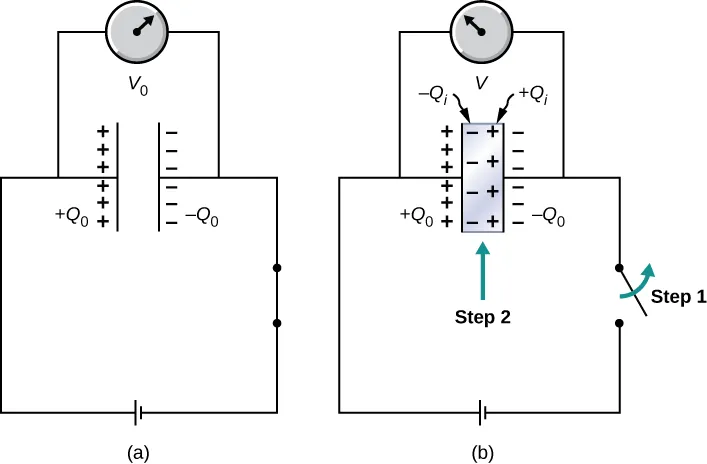
Diagram showing a charged capacitor before and after a dielectric is inserted, including induced surface charges on the dielectric and a lower measured potential difference. It helps students see how changing only the separator material modifies the capacitor’s behavior while the plate geometry stays the same. Source
The separator is not just a spacer. It helps determine how much charge can be stored for a given potential difference.
In many practical capacitors, the separator is an insulating material. Different insulating materials affect the electric behavior between the plates in different ways, so the capacitance changes when the material changes.
For this subtopic, the essential point is simple: same geometry does not always mean same capacitance if the separator material is different.
Reasoning with changes in design
When deciding whether capacitance changes, ask whether the physical construction changes. That is the central test.
A change does affect capacitance if it changes:
the shape of the conductors
the area of parallel plates
the distance between parallel plates
the separator material
A change does not affect capacitance if it only changes:
the amount of stored charge
the applied potential difference
how the capacitor is being used at that moment
This is why capacitance is often described as a device property. In AP Physics 2, you should treat it as something determined by the capacitor’s structure. For parallel-plate capacitors in particular, always connect your reasoning to the two core geometric trends: larger area gives larger capacitance, and greater plate distance gives smaller capacitance.
Practice Questions
A parallel-plate capacitor is redesigned so that the overlapping plate area becomes three times larger. The plate separation and separator material remain unchanged.
How does the capacitance change? Explain your reasoning.
1 mark: States that the capacitance becomes three times larger.
1 mark: Explains that for parallel plates, , so tripling triples .
Two parallel-plate capacitors, X and Y, are initially identical.
Capacitor X is modified so that the distance between its plates is doubled.
Capacitor Y is modified so that the plate area is doubled, and the separator material is replaced with one that gives a greater capacitance.
(a) Compare the new capacitance of X to its original capacitance.
(b) Explain the effect of the area change on the capacitance of Y.
(c) State how the change in separator material affects the capacitance of Y.
(d) A student says, “Y has a larger capacitance only because it can be charged to a larger potential difference.” Evaluate this statement.
1 mark: For (a), states that X has half the original capacitance.
1 mark: For (a), links the result to .
1 mark: For (b), states that doubling the plate area doubles the capacitance contribution from geometry because .
1 mark: For (c), states that the new separator material increases the capacitance.
1 mark: For (d), rejects the student’s statement and explains that capacitance depends on physical construction, not simply on charge or potential difference.
FAQ
A rolled or folded design packs a very large effective plate area into a small volume.
Even if the capacitor does not look like two big flat plates, the same ideas still apply:
large facing area increases capacitance
small separation increases capacitance
separator material still matters
This is why compact capacitors can still store significant charge.
In real devices, there are practical limits.
If the plates are too close:
the separator may fail mechanically
unwanted charge leakage can increase
the electric field may become large enough to damage the separator
So reducing distance increases capacitance, but only up to safe design limits.
That relationship is an ideal model for parallel plates.
Real capacitors can differ because of:
edge effects near the plate boundaries
nonuniform plate spacing
imperfect alignment
variations in the separator material
The proportional trend is still very useful, but real devices may not follow it perfectly.
Yes. The separator material is only one factor.
Capacitance can still change a lot if the capacitors differ in:
shape
plate area
spacing between conducting surfaces
So using the same material does not guarantee equal capacitance.
Not always. The most important area is the part of one plate that faces the other plate.
If part of a plate extends beyond the facing region, that extra area usually contributes much less to the capacitor’s main behavior.
For this reason, problems about plate area usually mean the overlapping area of the two plates.
