

AP Syllabus focus: 'For a parallel-plate capacitor, the proportionality constant is the product of the dielectric constant of the material between the plates and the permittivity of free space.'
For a parallel-plate capacitor, the space between the plates is not just an empty gap. The material there sets an important constant that determines how strongly the capacitor responds to a given plate geometry.
The proportionality constant in the capacitance formula
For a parallel-plate capacitor, capacitance depends on both the geometry of the plates and the material between them. If the plate area and separation are fixed, the remaining factor is the proportionality constant that connects geometry to capacitance. In AP Physics 2 Algebra, that constant is the product of the dielectric constant of the material and the permittivity of free space.
When the space between the plates is a vacuum, the baseline constant is . If a different material fills the gap, the material changes the capacitance by multiplying that baseline value by a dimensionless factor called .
Permittivity of free space: The constant that sets the baseline electric behavior of empty space. In capacitor equations, its unit is farads per meter.
This means is a universal reference value. It does not depend on the specific capacitor you build. Instead, it tells you what the capacitance would be for a given plate area and separation if the region between the plates were empty space.
The full parallel-plate capacitance relationship is:
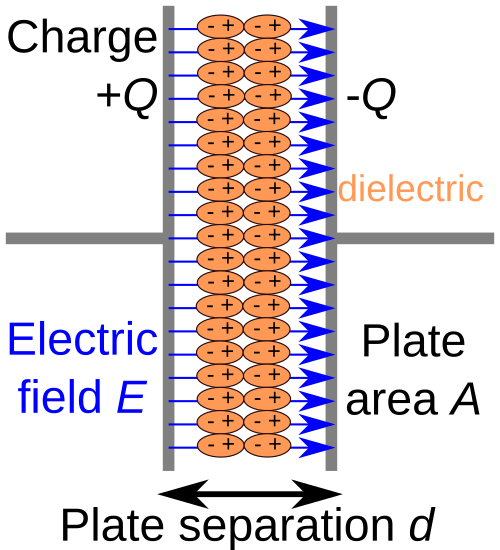
Schematic of a parallel-plate capacitor with a dielectric inserted between the plates, labeling the key geometric quantities ( and ) along with the field direction and plate charges. This directly supports reading as “geometry times material factor.” Source
= capacitance, in farads
= dielectric constant of the material between the plates, no unit
= permittivity of free space, in farads per meter
= plate area, in square meters
= plate separation, in meters
This equation shows exactly where the material enters the model.
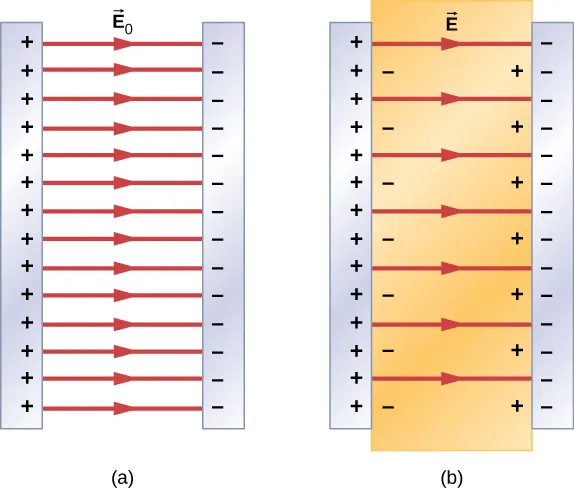
OpenStax diagram comparing the electric field in an empty (vacuum) capacitor versus a dielectric-filled capacitor, including the induced bound charges on the dielectric surfaces. The figure makes clear why the net field inside the dielectric is reduced, which is the microscopic reason a larger increases capacitance for the same and . Source
The plate area and separation describe the capacitor’s shape and size, while the factor describes the material effect. If the space between the plates is vacuum, then , so the equation becomes . If the material has a larger dielectric constant, then the capacitance is larger for the same geometry.
Dielectric constant: A dimensionless factor, written as , that tells how much a material changes the capacitance of a parallel-plate capacitor compared with vacuum.
Interpreting dielectric constant
Because the dielectric constant compares a material to vacuum, it has no unit. It is a ratio, not a separate measured unit like farads or meters. A dielectric constant of 2 means the capacitance is doubled relative to vacuum for the same plate area and separation. A dielectric constant of 5 means the capacitance is five times the vacuum value for that same geometry.
This is why is useful in problems: it tells you how strongly the material changes the capacitor’s behavior without changing the physical dimensions of the capacitor. The material does not replace the geometric factors; it scales the vacuum result.
Why and appear as a product
The syllabus emphasizes that the proportionality constant is the product . That matters because neither part alone is enough in a material-filled capacitor.
gives the vacuum baseline.
tells how the chosen material compares with that baseline.
Together, they give the correct constant for the material between the plates.
In many physics contexts, the product is written as a single symbol, , for the permittivity of the material.
= permittivity of the material, in farads per meter
= dielectric constant, no unit
= permittivity of free space, in farads per meter
Using can make equations shorter, but the physical meaning stays the same. The material’s permittivity is built from a universal reference value and a material-specific multiplier.
Reading the formula in context
In AP Physics 2 Algebra, you should be able to interpret the formula conceptually, not just memorize it.
If increases, capacitance increases because the plates can support more stored charge per volt.
If increases, capacitance decreases because the plates are farther apart.
If increases, capacitance increases because the material changes the proportionality constant.
If the capacitor stays the same size and shape, then comparing materials is really a comparison of their dielectric constants.
So, for this subtopic, the main idea is that the material between the plates affects capacitance through the factor .
Common misconceptions
A few misunderstandings are especially common:
is not the capacitance. It only tells how the material scales the vacuum result.
does not have units. It is a pure number.
is not chosen from the material. It is the same universal constant in every capacitor problem.
The proportionality constant is not just and not just . For a material-filled parallel-plate capacitor, it is their product.
Changing the material does not change the plate area or separation. It changes the material factor in the equation.
Practice Questions
A parallel-plate capacitor is completely filled with a material of dielectric constant . The plate area and plate separation remain unchanged from the vacuum case.
State how the capacitance compares with the vacuum capacitance.
1 mark: Recognizes that is proportional to for fixed and .
1 mark: States that the new capacitance is times the vacuum capacitance.
A parallel-plate capacitor has plate area and separation . The space between the plates is completely filled with a dielectric material of dielectric constant .
(a) Write an equation for the capacitance of the capacitor. (2 marks)
(b) Identify the proportionality constant in that equation. (1 mark)
(c) The capacitor would have capacitance in vacuum. If the dielectric constant is , determine the new capacitance. (2 marks)
(a) 1 mark: Writes .
(a) 1 mark: Uses correct symbols and places as the material-dependent factor.
(b) 1 mark: Identifies the proportionality constant as .
(c) 1 mark: Uses for unchanged geometry.
(c) 1 mark: Calculates .
FAQ
They are closely related ideas.
Dielectric constant compares a material’s permittivity to the permittivity of free space.
Relative permittivity is the more formal name for the same ratio in many physics texts.
For AP Physics 2 Algebra, they are typically treated as the same quantity, written as $\kappa$.
The word “relative” is helpful because it reminds you that the material is being compared to vacuum, not measured as a completely separate unit.
Air has a dielectric constant very close to $1$ under ordinary conditions.
That means using air instead of vacuum changes the capacitance only slightly, so introductory problems usually ignore the difference.
This approximation is useful because it lets students focus on the main relationship: $C=\dfrac{\kappa\epsilon_0A}{d}$
If $\kappa\approx1$, then the equation is essentially the vacuum form.
Yes. In real materials, dielectric constant can change with:
temperature
frequency of an applied electric effect
purity or moisture content
material structure
However, AP Physics 2 Algebra usually treats $\kappa$ as a fixed constant for a given material in a given problem.
That simplification keeps the focus on the capacitor model rather than material science.
Because the two numbers play different roles.
$\epsilon_0$ is a universal constant.
$\kappa$ tells how a specific material compares with vacuum.
Listing both makes it easy to calculate the material permittivity using $\epsilon=\kappa\epsilon_0$.
It also helps students see the structure of the physics: one part comes from nature’s baseline behavior in vacuum, and one part comes from the chosen material.
Then the simple single-value form $C=\dfrac{\kappa\epsilon_0A}{d}$ may not apply directly.
You would need a more detailed model because different regions between the plates would contribute differently. The effective proportionality constant would depend on how the materials are arranged.
For AP Physics 2 Algebra, problems in this area are usually limited to one uniform material between the plates so that one dielectric constant can be used consistently.
