

AP Syllabus focus: 'The temperature of a system is characterized by the average kinetic energy of the atoms in that system.'
Temperature is a macroscopic quantity, but kinetic theory explains it microscopically. In gases, temperature describes the average kinetic energy of moving atoms, not the motion of any single atom.
Microscopic meaning of temperature
A thermometer gives a single temperature for an entire sample, yet the sample contains a huge number of atoms in constant random motion. Kinetic theory connects these two views by interpreting temperature in terms of atomic motion.
Temperature: A measure that characterizes the average kinetic energy of the atoms in a system.
This definition is important because it shifts temperature away from a purely descriptive idea such as “hot” or “cold.” Instead, temperature becomes a quantity tied to measurable motion at the atomic scale.
In a gas, atoms do not all move with the same speed.
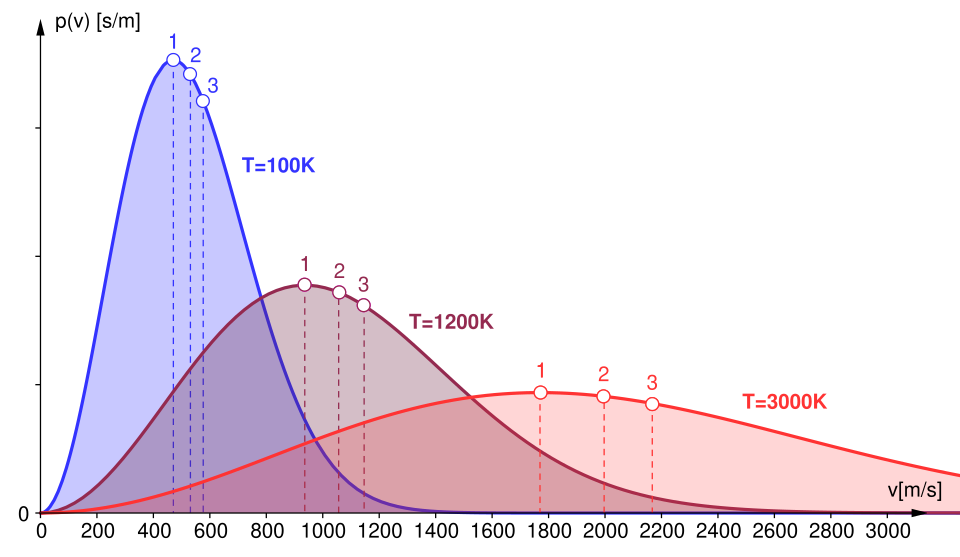
Maxwell–Boltzmann speed distributions for the same gas at different absolute temperatures show that particle speeds are spread over a range, not concentrated at one value. As temperature increases, the peak shifts to higher speeds and the distribution broadens, illustrating why “one temperature” corresponds to an average over many particles rather than any single particle’s motion. Source
At any instant, some atoms are moving relatively slowly, some are moving at moderate speeds, and some are moving very fast. Even so, the system can still be assigned one temperature because the relevant quantity is the average kinetic energy across all the atoms.
Why one atom is not enough
A single atom can speed up or slow down during collisions, so its kinetic energy changes from moment to moment. That means the kinetic energy of one atom does not define the temperature of the whole system. Temperature is a property of the collection of atoms.
When scientists speak about temperature in kinetic theory, they are describing the overall statistical behavior of many atoms. This is why average values are central. The larger the number of atoms considered, the more meaningful the temperature becomes as a description of the system.
Average kinetic energy
For one atom, kinetic energy depends on mass and speed according to . Because speed appears squared, a fast atom contributes much more to the average than a slow atom.
Average kinetic energy: The mean value of the kinetic energies of all the atoms in a system.
The word average means that you conceptually add the kinetic energies of all the atoms and divide by the number of atoms. This averaging smooths out the rapid changes caused by collisions and gives temperature a stable physical meaning.
If the atoms in one sample have a greater average kinetic energy than the atoms in another sample, the first sample has the higher temperature. This is the essential comparison you should make in AP Physics 2 Algebra problems on this topic.
A rise in temperature means that the average kinetic energy of the atoms has increased. A drop in temperature means that the average kinetic energy has decreased. This statement is about the system as a whole, not about every atom changing by the same amount.
The key proportional relationship
For a monatomic ideal gas, the average translational kinetic energy per atom is directly proportional to the absolute temperature.
= average kinetic energy per atom, J
= Boltzmann constant,
= absolute temperature, K
The most important idea in this equation is the direct proportionality between and .
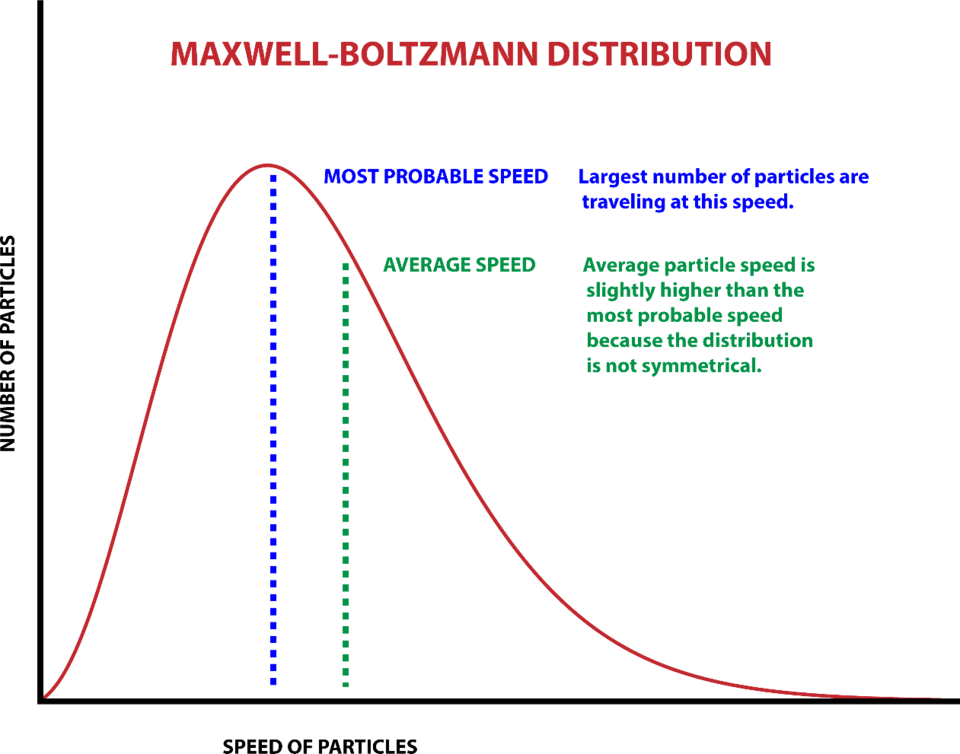
NIST’s Maxwell–Boltzmann distribution graphic emphasizes that even at one temperature, particles occupy a range of speeds, with identifiable “most probable” and “average” values. This directly connects to the kinetic-theory relationship between microscopic energy and absolute temperature, where for an ideal gas. Source
If the Kelvin temperature doubles, the average kinetic energy doubles. If the Kelvin temperature is cut in half, the average kinetic energy is cut in half.
You do not need to memorize every microscopic detail to use this relationship well. Focus on the fact that higher absolute temperature means greater average kinetic energy.
The constant of proportionality is the same for all monatomic ideal gases because the temperature scale is linked to microscopic energy, not to the identity of one particular gas sample.
Why the Kelvin scale matters
The proportional relationship between temperature and average kinetic energy works with the Kelvin scale, not with Celsius. Kelvin is an absolute temperature scale, so its zero point corresponds to the lowest possible thermal state in the classical model.
This matters because proportional reasoning only works correctly on an absolute scale.
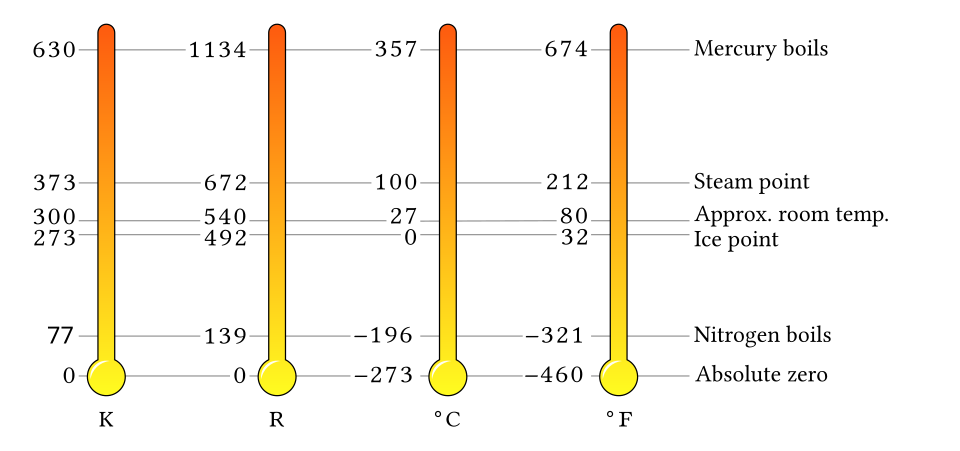
A side-by-side comparison of Kelvin and Celsius (along with Rankine and Fahrenheit) highlights that the zero points are different even though the interval size is the same for Kelvin and Celsius. The placement of absolute zero at visually explains why temperature ratios (like “twice as hot”) are only meaningful on an absolute scale. Source
For example, has twice the average kinetic energy of , but does not have twice the average kinetic energy of .
Using Kelvin also helps avoid a common mistake: treating temperature intervals and temperature ratios as if they mean the same thing. A change of and a factor of 2 in temperature describe very different physical ideas.
Interpreting temperature correctly
Temperature is linked to average kinetic energy, so it should not be confused with several related ideas.
It is not the kinetic energy of one atom.
It does not mean all atoms move at the same speed.
It does not require every collision to transfer the same amount of energy.
It refers to the collective motion of atoms in the system.
A hotter gas therefore has atoms with a larger average kinetic energy, but it still contains a range of atomic speeds. Some atoms in a cooler sample may temporarily move faster than some atoms in a hotter sample. What distinguishes the hotter sample is the higher average.
That is why temperature is a macroscopic shortcut for an enormous amount of microscopic information. Instead of tracking every atom separately, physicists can describe the system with one quantity that reflects the average kinetic-energy level.
Common misunderstandings
Students often say that temperature measures “how fast atoms are moving.” This is only partly correct. A more precise statement is that temperature characterizes the average kinetic energy of the atoms. Since kinetic energy depends on speed, faster average motion corresponds to higher temperature, but the energy-based wording is more accurate.
Another common mistake is to think that temperature tells you everything about microscopic motion. It does not. Temperature gives a compact description of the system’s average atomic kinetic energy, which is why it is so useful in thermodynamics and kinetic theory.
Practice Questions
A sample of monatomic gas is heated from to . How does the average kinetic energy per atom change?
States that average kinetic energy is directly proportional to absolute temperature. (1)
States that the average kinetic energy doubles. (1)
Two rigid containers hold samples of the same monatomic ideal gas. Container A is at , and container B is at .
(a) Which container has the greater average kinetic energy per atom?
(b) By what factor is the average kinetic energy per atom larger?
(c) Explain why container B can have a higher temperature even though not every atom in B must have more kinetic energy than every atom in A.
(d) Explain why Kelvin, rather than Celsius, must be used when comparing average kinetic energies with temperature ratios.
(a)
Identifies container B. (1)
(b)
States the factor is or . (1)
(c)
States that temperature depends on the average kinetic energy, not the kinetic energy of each individual atom. (1)
States that atoms in each container can have a range of kinetic energies or speeds. (1)
(d)
States that Kelvin is an absolute temperature scale, so temperature ratios match average kinetic-energy ratios. (1)
FAQ
Yes. Temperature tells you the average kinetic energy per atom, not the total energy of all the atoms together.
A larger sample can contain many more atoms, so its total thermal energy can be greater even when its temperature is the same as that of a smaller sample.
At the same temperature, atoms have the same average kinetic energy, not the same average speed.
Since $K=\dfrac{1}{2}mv^2$, a smaller mass must usually have a larger speed to have the same kinetic energy. That is why lighter atoms tend to move faster than heavier atoms at equal temperature.
The basic idea is broader than gases: temperature is related to microscopic particle motion in all matter.
However, the simple equation $ \bar{K} = \dfrac{3}{2}k_B T $ specifically describes the average translational kinetic energy of atoms in a monatomic ideal gas. In solids and liquids, interactions and other kinds of motion make the microscopic picture more complicated.
$k_B$ connects the macroscopic temperature scale to the microscopic energy scale of a single atom.
It tells you how much average kinetic energy per atom corresponds to each kelvin of temperature. Because single-atom energies are tiny, $k_B$ is a very small number.
In the classical model used in AP Physics, $0\ K$ corresponds to zero average translational kinetic energy.
Real matter is more subtle because quantum effects can leave particles with residual motion even near absolute zero. For AP Physics 2 Algebra, use the classical interpretation unless a problem specifically says otherwise.


.svg)