

AP Syllabus focus: 'For an ideal gas, root-mean-square speed corresponds to average kinetic energy and is related to gas temperature.'
Root-mean-square speed links microscopic particle motion to a measurable thermal property. For ideal gases, it gives a useful single speed that connects particle motion directly to temperature and average kinetic energy.
Meaning of Root-Mean-Square Speed
In a gas, particles do not all move with one identical speed. A single value is still useful, however, when describing the overall motion of the particles. Root-mean-square speed is the speed measure that best matches the way kinetic energy depends on motion.
Root-mean-square speed: The square root of the average of the squares of the speeds of the particles in a gas. It is represented by .
This quantity is found by squaring each particle speed, averaging those squared values, and then taking the square root.
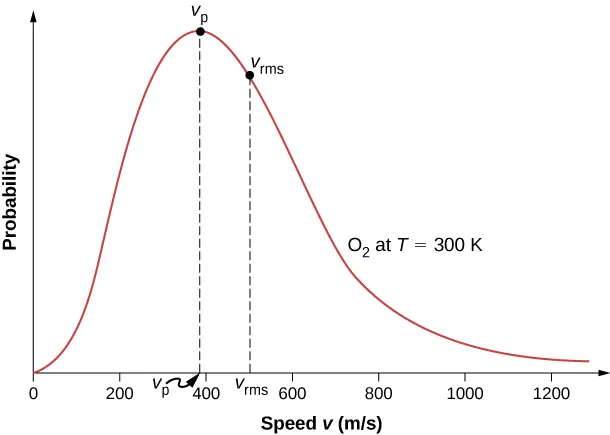
Maxwell–Boltzmann speed distribution for an ideal gas, with the most probable speed and the root-mean-square speed marked on the curve. The figure visually shows why lies to the right of the peak: squaring the speed weights the faster-moving tail more heavily, so the rms value is pulled toward higher speeds. Source
The squaring step matters because faster particles contribute much more strongly to the result than slower particles. That makes especially useful in thermal physics, where particle energy depends on the square of speed.
Why this average is useful
A simple arithmetic average of speeds does not connect as neatly to kinetic energy. Since translational kinetic energy depends on speed squared, the root-mean-square form gives a speed value that can stand in for the average kinetic energy of the gas particles.
Connection to Average Kinetic Energy
For an ideal gas, the random translational motion of the particles is the key microscopic source of thermal behavior. As temperature rises, the particles move more energetically, so their average kinetic energy increases.
= average translational kinetic energy per particle, in J
= mass of one gas particle, in kg
= root-mean-square speed, in m/s
= Boltzmann constant,
= absolute temperature, in K
This relationship is one of the clearest links between the microscopic model of matter and the macroscopic idea of temperature.
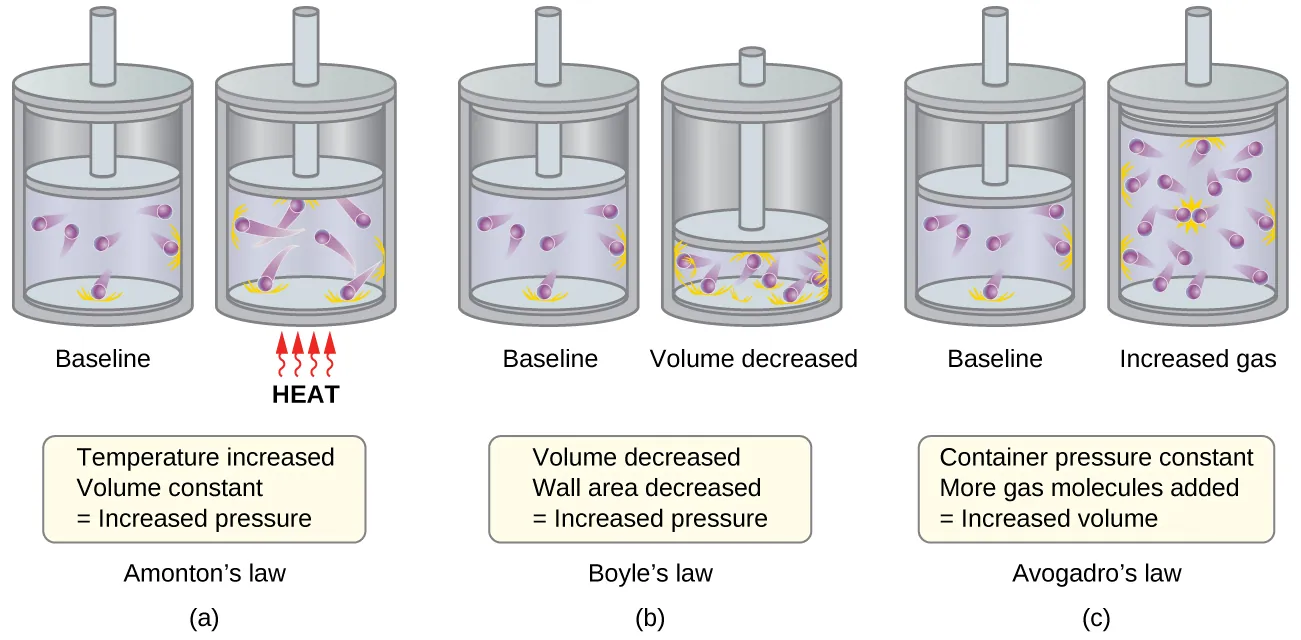
Particle-in-a-container diagram illustrating that heating a gas increases molecular speeds, leading to more frequent and more forceful wall collisions (and therefore higher pressure at constant volume). This supports the interpretation that temperature tracks the microscopic translational kinetic energy that drives macroscopic gas behavior. Source
It says that temperature is proportional to average translational kinetic energy per particle. A higher absolute temperature means a larger average kinetic energy, not necessarily that every particle has become faster by the same amount.
It is also important to notice what temperature does not describe. Temperature is linked to the average kinetic energy per particle, not the total kinetic energy of the entire sample. A larger sample can contain more total thermal energy, but if the particles have the same average kinetic energy, the temperature is the same.
What the equation tells you
Because the same equation includes both and , root-mean-square speed is not just a mathematical average. It is a physically meaningful quantity that describes the particle motion responsible for temperature in an ideal gas.
Temperature Dependence of
If the energy relation is rearranged, the direct dependence of root-mean-square speed on temperature becomes clear.
= root-mean-square speed, in m/s
= Boltzmann constant,
= absolute temperature, in K
= mass of one gas particle, in kg
This square-root dependence is essential for interpreting changes in temperature.
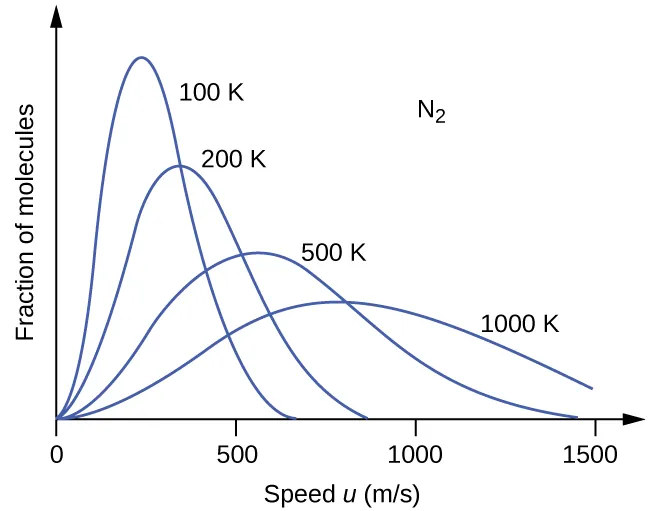
Maxwell–Boltzmann speed distributions at several temperatures, showing that higher produces a broader curve shifted to higher speeds. The graphic helps students connect “higher temperature” to “more high-speed particles,” while recognizing the distribution shape (not a single speed) is what changes as varies. Source
If temperature increases, increases.
If temperature decreases, decreases.
If temperature changes by a factor of 4, changes by a factor of 2.
If temperature changes by a factor of 9, changes by a factor of 3.
Factor reasoning is often faster than full substitution. Because root-mean-square speed depends on the square root of temperature, a modest change in speed corresponds to a larger change in temperature. Doubling requires a fourfold increase in absolute temperature, while tripling requires a ninefold increase.
A very common mistake is to think that speed and temperature are directly proportional. They are not. Average kinetic energy is directly proportional to absolute temperature, but root-mean-square speed is proportional to the square root of absolute temperature.
Using Absolute Temperature
The temperature in these relationships must be measured on the Kelvin scale. Zero on the Kelvin scale corresponds to zero thermal energy in the idealized model, so the equations only work correctly when temperature is treated as an absolute quantity.
Using Celsius differences can still describe temperature changes in some situations, but direct substitution into the rms-speed relationship must use Kelvin, not degrees Celsius. This is important on graphs, in proportional reasoning, and in any algebraic comparison of two states of a gas.
Interpreting particle motion
A larger does not mean every particle has that speed. It means the gas has a larger characteristic speed associated with its average kinetic energy. Some particles move slower than , and some move faster. The rms value is useful because it captures the overall energy scale of the random motion.
Common AP Physics 2 Reasoning
Questions on this topic often test qualitative reasoning as much as algebra. Useful ideas include:
Temperature compares directly with average kinetic energy per particle.
Root-mean-square speed compares with the square root of temperature.
A larger means particles have, on average, more kinetic energy.
When comparing two situations, focus on factors of change rather than many separate cases.
Keep the chain of reasoning clear: temperature, then average kinetic energy, then root-mean-square speed.
When reading a graph, statement, or experimental description, ask whether it is referring to energy or speed. If it refers to average kinetic energy, the relationship with temperature is linear. If it refers to rms speed, the relationship involves a square root. Recognizing that distinction helps prevent the most common interpretation errors.
Practice Questions
An ideal gas is heated from to . By what factor does the root-mean-square speed change?
States or uses that is proportional to (1 mark)
Correctly determines the factor as (1 mark)
A sample of ideal gas has its temperature increased from to .
(a) Describe how the average kinetic energy per particle changes. (2 marks)
(b) Determine the factor by which the root-mean-square speed changes. (2 marks)
(c) A student says, “Since the temperature increased by a factor of 4, the particle speed must also increase by a factor of 4.” Explain why this statement is incorrect. (1 mark)
(a) States that average kinetic energy is directly proportional to absolute temperature (1 mark)
(a) Correctly states that the average kinetic energy increases by a factor of 4 (1 mark)
(b) Uses or equivalent reasoning (1 mark)
(b) Correctly states that the root-mean-square speed increases by a factor of 2 (1 mark)
(c) Explains that speed depends on the square root of temperature, not temperature directly (1 mark)
FAQ
Gases do not have one single particle speed, so different averages emphasize different features of the motion.
Common choices are:
most probable speed: the speed occurring most often
mean speed: the ordinary arithmetic average
root-mean-square speed: the square-based average linked most directly to kinetic energy
For thermal physics, $v_{rms}$ is especially valuable because kinetic energy depends on speed squared, so this average connects naturally to temperature.
Yes.
Because the calculation uses squared speeds, faster particles have extra influence on the result. A relatively small number of very fast particles can pull $v_{rms}$ upward, even if most particles are moving more slowly than that value.
So $v_{rms}$ should not be interpreted as “the speed most particles have.” It is better understood as an energy-related characteristic speed.
They usually infer speeds indirectly from measurable effects.
Examples include:
pressure and temperature data interpreted with kinetic theory
time-of-flight methods in particle beams
spectral line broadening caused by particle motion
molecular beam experiments
These methods do not require watching every atom separately. Instead, they use large-scale observations and a model connecting those observations to typical particle speeds such as $v_{rms}$.
The ideal-gas expression assumes that particles behave like noninteracting points except during collisions.
Real gases can depart from that model when:
particle size is not negligible
intermolecular forces become important
the gas is very dense
the temperature is low enough for interactions to matter more strongly
In those situations, the simple link between temperature and motion is still useful, but the exact ideal-gas formula for $v_{rms}$ is only an approximation.
Individual particles constantly speed up and slow down during collisions, but the gas as a whole can remain in a stable statistical state.
At fixed temperature:
the overall distribution of particle speeds stays the same
gains and losses in kinetic energy balance out across many particles
the average kinetic energy per particle remains constant
So even though no single particle keeps one permanent speed, the collective quantity $v_{rms}$ can stay essentially unchanged.
