

AP Syllabus focus: 'Internal energy is the sum of the kinetic energy of a system’s objects and the potential energy of their configuration.'
Internal energy describes how energy is stored within a system itself. For AP Physics 2, the key idea is microscopic: energy belongs to the motions of the system’s parts and to how those parts are arranged.
What Internal Energy Means
The internal energy of a system is the energy associated with the objects that make up the system and with the interactions among those objects. It does not mean the motion of the entire system moving from one place to another.
Internal energy is the total energy stored within a system as the kinetic energy of its objects and the potential energy of their configuration.
Internal energy is a property of the chosen system.
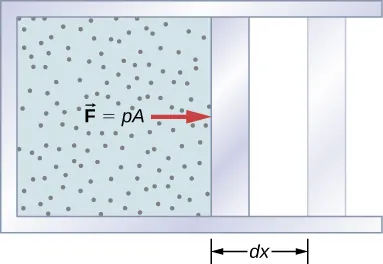
A gas confined in a cylinder with a movable piston illustrates a clear system boundary: the gas is the system, and the piston is part of the surroundings that the system can push on. This kind of diagram helps distinguish energy stored microscopically in the gas (internal energy) from energy transferred across the boundary as work during expansion or compression. Source
Its value depends on what has been included inside the system boundary, and it is measured in joules.
The Two Parts of Internal Energy
A useful way to organize internal energy is to separate it into a kinetic part and a potential part.
= internal energy of the system, J
= total kinetic energy of the system's objects due to internal motion, J
= total potential energy due to the configuration of the system's objects, J
This equation is mainly conceptual.
It shows that internal energy can change because the parts of the system move differently, because their arrangement changes, or because both happen at once.
Kinetic Energy Within the System
The kinetic part of internal energy comes from motion of the objects inside the system. What matters is internal motion, not the motion of the whole system as one unit.
This kinetic contribution can include:
atoms vibrating in a solid
molecules moving randomly in a fluid
parts of a system moving relative to one another
larger objects inside a chosen system gaining or losing speed
For example, a gas in a sealed container has internal kinetic energy because its particles move in many directions. A solid also has internal kinetic energy because its atoms vibrate about equilibrium positions. Even if a system appears motionless on the outside, its internal energy may still be large because its parts are moving internally.
A very important distinction is that center-of-mass motion is not internal energy. If a container of gas slides across a table, the translational kinetic energy of the container as a whole is not part of the gas’s internal energy. The random motion of the gas particles inside the container is part of the internal energy.
Potential Energy of Configuration
The potential part of internal energy depends on the configuration of the system, meaning the relative positions and interactions of the objects in it. If those positions change, the internal energy can change even when the system’s overall motion does not.
Configuration-based internal energy can include:
elastic potential energy in a stretched or compressed spring
electric potential energy between charged parts of the system
interaction energy between atoms or molecules in matter
This is why a system can store energy without obvious large-scale motion. A compressed spring contains internal energy because the spring’s shape creates elastic potential energy. Likewise, matter can store internal energy because its atoms and molecules interact depending on how they are arranged.
Why the System Boundary Matters
Whether an energy belongs to internal energy depends on the chosen system. Internal energy includes only energies connected to the objects and interactions that are inside that system.
If two carts and the spring between them are all included in the system, then the spring’s elastic potential energy is part of the system’s internal energy. If the spring is outside the system boundary, that same energy is not internal energy of the smaller system.
The same idea applies to interaction energies. Gravitational, electric, or elastic potential energy counts as internal only when the interacting parts responsible for that energy are included in the system you are analyzing.
Internal Energy in Different Systems
Different systems can store internal energy in different proportions. In some systems, the kinetic part is more noticeable; in others, the potential part is especially important.
Examples include:
a solid, where vibrating atoms contribute kinetic energy and atomic spacing contributes potential energy
a liquid, where molecules have both motion and interaction energy
a spring-object system, where elastic potential energy may be a major part of the internal energy
Because of this, internal energy is broader than just “motion” and broader than just “thermal energy.” It is the total microscopic energy stored in the system’s parts and arrangement.
Identifying Internal Energy in Problems
When a problem asks about internal energy, focus on the system’s contents and interactions. A good approach is to ask:
What objects are inside the system?
Are those objects moving relative to one another?
Is there stored energy due to their positions, spacing, or deformation?
Am I describing energy inside the system rather than motion of the whole system?
Thinking this way helps you recognize internal energy in many contexts, from gases and solids to springs and interacting particles.
Practice Questions
State what is meant by the internal energy of a system.
1 mark for stating that internal energy includes the kinetic energy of the system’s objects
1 mark for stating that internal energy includes the potential energy of the configuration or arrangement of those objects
A system consists of two carts connected by a compressed spring on a frictionless track. The system boundary includes both carts and the spring. The carts are initially at rest and are then released.
Explain, in terms of internal energy: (a) what energy is present in the system before release, (b) how the internal energy changes after release, and (c) whether the kinetic energy of the two-cart system’s center of mass is part of the internal energy.
1 mark for stating that before release the system has elastic potential energy because the spring is compressed
1 mark for recognizing that this elastic potential energy is part of the system’s internal energy
1 mark for stating that after release some spring potential energy is converted into kinetic energy of the carts, which is also part of the internal energy of the chosen system
1 mark for stating that the internal energy changes form from potential to kinetic energy within the system
1 mark for stating that center-of-mass kinetic energy is not part of internal energy because it is motion of the whole system, not internal motion or configuration
FAQ
Yes. The numerical value of internal energy depends on the reference level chosen for potential energy.
In physics, the absolute value is often less important than the change in internal energy. A system can have negative internal energy if the chosen zero level is above the system’s actual energy.
Yes. Chemical energy is part of internal energy because it comes from the arrangement and interactions of atoms and electrons within a system.
When chemical bonds change, the system’s internal potential energy changes. That is why chemical reactions can release or absorb energy.
During a phase change, the average kinetic energy may stay the same while the arrangement of particles changes.
That means the potential part of internal energy can change even without a temperature change. For example, particles may move farther apart or become less tightly bound.
A single macroscopic object can have internal energy because it is made of many internal parts, such as atoms and molecules.
What matters is that the object has internal structure. If there are internal motions or interaction energies inside it, then it has internal energy.
Internal energy depends on microscopic details that are not usually observed one by one, such as particle motions and interaction energies.
Also, the absolute value can depend on the chosen reference point. In practice, experiments more often determine how much the internal energy changes rather than its exact total value.
