

AP Syllabus focus: 'Changes in internal energy can change a system’s internal structure or behavior without changing its center-of-mass motion.'
Understanding this distinction helps separate what a system does as a whole from what happens inside it. A system may stay at rest or keep the same velocity while its particles, temperature, or shape change.
Whole-system motion and internal change
In AP Physics 2, a system is the collection of matter chosen for analysis.
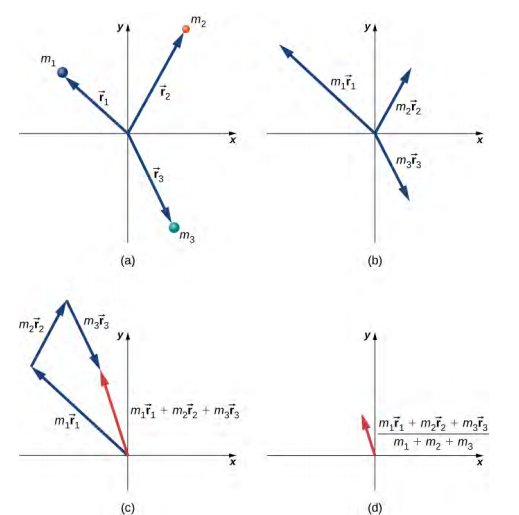
Diagram showing multiple particles with position vectors and the vector construction used to locate the system’s center of mass. It reinforces the idea that the center of mass is a single representative point for the system’s overall (translational) motion, even though the masses are spread out. This helps separate center-of-mass motion from any internal rearrangements of the particles. Source
When that system is treated as one object, its overall motion is described by its center of mass. However, the particles inside the system can still move relative to one another, vibrate, rearrange, or deform.
Center-of-mass motion: The motion of the system as a whole, treated as if all its mass were concentrated at a single point.
A system can therefore show clear physical changes even if its center of mass does not speed up, slow down, or change direction. A metal rod held fixed can warm up. A bell attached to a stand can vibrate strongly. A piece of clay pressed on a table can deform. In each case, the important change is inside the system.
What changes in internal energy mean
A change in internal energy is not about the system flying across the room. It is about changes in the system’s internal state. The particles may move differently, interact differently, or occupy a different arrangement. These changes can affect both internal behavior and internal structure.
Change in internal energy: A change within a system associated with the motion, interaction, or arrangement of its parts, rather than a change in the motion of the system as a whole.
A change in internal behavior often appears as faster or slower microscopic motion, stronger vibration, or more random particle motion.
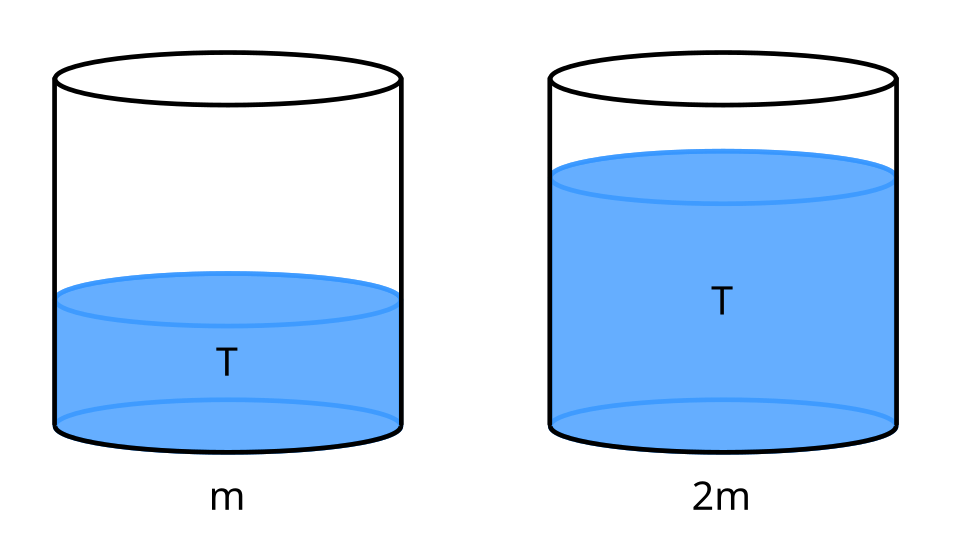
Two-beaker schematic comparing temperature and internal energy: adding more of the same liquid at the same temperature keeps the same while increasing total internal energy because there are more particles contributing microscopic energy. The visual helps students avoid conflating “temperature” with “how much internal energy the system has.” Source
A change in internal structure often appears as stretching, compression, bending, or permanent deformation. These are physical clues that the system itself has changed, even if its center of mass has not.
On AP problems, you should describe these changes using matter-based language: atoms moving more vigorously, particles vibrating differently, or parts of a material shifting relative to one another under stress.
To keep the ideas separate, physicists often track whole-system motion and internal energy as different parts of the energy description.
= total energy of the system, J
= kinetic energy associated with center-of-mass motion, J
= internal energy of the system, J
When stays the same, can still increase or decrease. That is the key idea for this subsubtopic. Saying that an object is “not moving” only describes one part of its energy picture.
Why the center of mass may not change
A change in internal energy does not require a change in the motion of the entire system. If energy transfer affects the particles inside the system instead of producing net motion of the whole object, the center-of-mass motion can remain unchanged.
This is especially clear when the system is constrained.
A clamped object can vibrate more, warm up, or change shape while remaining fixed in place. But the same principle also applies to an unconstrained system moving at constant velocity: its center of mass may continue with the same motion while internal processes occur inside it.
The reason is that internal changes involve motion or rearrangement relative to the center of mass, not motion of the center of mass itself. Internal forces between parts of the system can change how those parts move relative to one another, but they do not by themselves create a new overall motion of the entire system.
This is why a system can become hotter, more deformed, or more strongly vibrating without any visible change in how it travels through space. The internal state and the overall motion are related to different physical descriptions.
Recognizing internal changes in physical situations
A question about internal energy change often gives an object whose overall motion seems simple or unchanged. The challenge is to identify what is happening inside the system.
Look for signs such as:
a rise or drop in temperature
increased vibration or sound
bending, stretching, compressing, or cracking
a change in how parts of the system move relative to one another
a change in the material’s shape without a matching change in its translational motion
These observations point to a change in internal energy, not necessarily a change in center-of-mass motion.
It is also possible for internal energy to decrease while center-of-mass motion stays the same. A warm object cooling on a shelf, or a vibrating object settling down while remaining in place, shows that internal change can occur in either direction.
How to describe this on an AP Physics response
When explaining a situation, focus on the difference between macroscopic motion and internal change.
A strong response usually does the following:
identifies whether the center-of-mass velocity changes
describes what internal feature changes, such as vibration, temperature, or deformation
states that the system’s internal structure or behavior can change even when the whole system’s motion does not
avoids treating “no change in motion” as “no change in energy”
A common mistake is to focus only on visible motion. An object can look stationary and still be undergoing major internal changes that affect how it sounds, feels, or responds to forces.
Practice Questions
A metal bar is clamped to a wall so its center of mass cannot move. After being struck, the bar rings and later feels warmer. Identify one observation that shows a change in internal energy and state whether the center-of-mass motion changed. [2 marks]
States that ringing, vibration, or warming shows a change in internal energy. (1)
States that the center-of-mass motion did not change or remained at rest. (1)
A lump of putty rests on a table. A student presses down on it and the putty changes shape, but the lump does not slide across the table. Explain how this situation shows that a system’s internal energy can change without a change in center-of-mass motion. [5 marks]
States that the putty’s center of mass does not change its motion or remains at rest. (1)
Identifies that the putty’s shape changes, so its internal structure changes. (1)
States that parts of the putty move relative to one another during deformation. (1)
Explains that this relative motion or rearrangement is a change in internal energy. (1)
Clearly distinguishes internal change from motion of the whole object. (1)
FAQ
Yes. If both colliding objects are included in one system, the system’s center of mass can keep the same velocity while internal energy changes inside the system.
Possible internal changes include:
deformation
sound production
vibration
a temperature increase
This is one reason collisions can leave objects warmer or permanently reshaped even when the motion of the system’s center of mass follows the same overall pattern.
No. For a rigid object, pure rotation about its center of mass is organized macroscopic kinetic energy, not internal energy.
Internal energy involves changes such as:
particle vibration
deformation
changes in particle arrangement
If a rotating object also flexes, heats up, or develops internal vibrations, those added changes count as internal energy changes.
Yes. Zero center-of-mass velocity only means the mass-weighted average motion is zero.
The particles inside the system can still be moving rapidly in different directions, so their motions cancel in the center-of-mass calculation while remaining physically real.
This is why a hot object sitting still can still have substantial microscopic motion.
Usually, yes, if the system is the whole object. A sound wave involves parts of the object moving relative to one another, so it is not simply motion of the center of mass.
That means a ringing bell or vibrating bar can have changing internal energy even while the whole object stays fixed in place.
The exact classification depends on the chosen system, but in AP-level reasoning, vibrations within a material are typically treated as internal changes.
Yes. Real materials are not perfectly ideal.
For example:
a bent object may spring back
internal friction can still produce a slight temperature increase
some vibration may remain after the shape is restored
So the final visible shape can match the initial one while the internal energy is different. This is common in real materials that are elastic but not perfectly lossless.
