

AP Syllabus focus: 'For an isolated system, total energy is constant; for a closed system, internal energy changes through heating or work.'
To analyze thermodynamic systems, you must identify what can cross the system boundary. That choice determines whether energy stays fixed or whether the system’s internal energy can change.
Why system type matters
In thermodynamics, the system is the part of the universe you choose to study, and everything else is the surroundings. The boundary between them is crucial because it tells you whether matter or energy can cross.
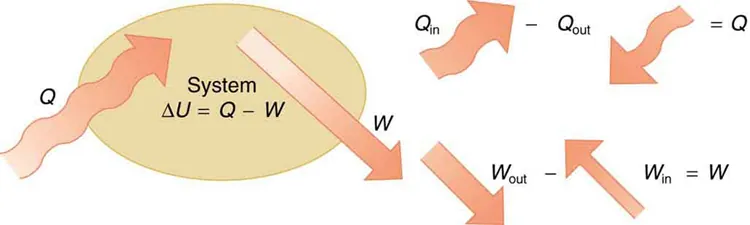
Schematic energy-flow diagram for a thermodynamic system, showing heat entering/leaving and work done by/on the system across the boundary. This visual supports the idea that the boundary choice determines which energy-transfer terms must appear in the first-law accounting. Source
For this subtopic, the key comparison is between isolated systems and closed systems. These categories are not about what the system is made of. They are about how the system interacts with its surroundings.
When answering AP Physics 2 questions, always ask:
Can matter cross the boundary?
Can energy cross the boundary?
If energy crosses, does it do so by heating, work, or both?
Isolated systems
An isolated system is the most restricted kind of system in this topic.
Isolated system: A system that exchanges neither matter nor energy with its surroundings.
Because nothing enters or leaves an isolated system, the total energy of the system remains constant. That does not mean every form of energy inside the system stays the same. Instead, energy may change form within the system while the total stays unchanged.
For example, energy inside an isolated system could shift between different parts of the system or between different energy stores. What matters is that there is no transfer of energy across the system boundary.
This idea is an application of conservation of energy. If the system is truly isolated, there is no external source adding energy and no external sink removing it. Therefore, the system’s total energy before a process equals its total energy after the process.
In AP Physics 2, an isolated system is often an idealized model. Real systems may be approximately isolated if any energy transfer to the surroundings is negligible during the time being studied.
Closed systems
A closed system is less restricted than an isolated system.
Closed system: A system that does not exchange matter with its surroundings, but whose energy can change through heating or work.
In a closed system, the amount of matter stays fixed, but energy may cross the boundary. That is the central idea of the specification: the system’s internal energy can change because of heating or work.
A closed system is therefore not required to have constant total energy for the system alone. Instead, energy can move between the system and its surroundings. The system gains or loses energy, while total energy is still conserved for the larger combined system of system plus surroundings.
This distinction is essential:
Isolated system: no matter transfer, no energy transfer
Closed system: no matter transfer, but energy transfer is possible
A common mistake is to think that a sealed system is automatically isolated. A sealed container prevents matter from entering or leaving, so it may be closed, but it can still be heated or have work done on it.
Internal energy changes in a closed system
For a closed system, the most important energy statement is the first law of thermodynamics in AP Physics 2 form.
= change in internal energy of the system, J
= energy transferred into the system by heating, J
= work done on the system by the surroundings, J
This equation shows exactly how a closed system’s internal energy can change:

Pressure–volume diagram for a gas in a closed system, illustrating how boundary work is tied to the integral of pressure over a volume change (graphically, the area under the curve). It helps students connect the abstract “work” term in the first law to a measurable geometric feature on a – plot. Source
If is positive, energy enters the system by heating.
If is negative, energy leaves the system by heating.
If is positive, the surroundings do work on the system.
If is negative, the system does work on the surroundings.
The important point for this subtopic is not the detailed mechanism of heating or work. It is the fact that closed systems allow these energy transfers, so their internal energy is not generally constant.
By contrast, an isolated system has no such transfers across the boundary. In many AP situations, that means the energy of the isolated system remains unchanged throughout the process.
Comparing isolated and closed systems
What remains constant
The phrase total energy is constant applies to an isolated system. The phrase internal energy changes through heating or work applies to a closed system.
This means you should be careful about what quantity the problem is asking about:
For an isolated system, focus on the constancy of total energy.
For a closed system, focus on how internal energy may increase or decrease because of interactions with the surroundings.
A closed system can even have no net internal energy change during a process if the effects of heating and work balance each other. Even then, it is still closed rather than isolated if energy crossed the boundary.
How to identify the system correctly
Many errors come from choosing the wrong boundary. In AP problems:
Read carefully to determine what is included in the system.
If energy transfer with the surroundings is excluded, treat the system as isolated.
If the system can be heated or have work done on it while matter remains inside, treat it as closed.
Do not confuse no matter transfer with no energy transfer.
A good habit is to state the system type before writing any energy equation. That makes the later reasoning much clearer and helps prevent sign or conservation mistakes.
Modeling and idealization
Real systems are often only approximately isolated or approximately closed. Physics uses these models because they capture the dominant behavior.
If outside interactions are so small that they do not significantly affect the process, an isolated-system model may be appropriate. If matter remains fixed but energy exchange cannot be ignored, a closed-system model is the better description.
Practice Questions
A gas is placed in a rigid, sealed container. During the time interval being studied, no energy enters or leaves the container.
State whether the gas should be modeled as an isolated system or a closed system, and justify your answer.
1 mark: Correctly identifies the system as an isolated system.
1 mark: Justification that neither matter nor energy crosses the boundary, so total energy remains constant.
A sample of gas in a cylinder is treated as a closed system. During a process, of energy enters the gas by heating. The gas does of work on the surroundings.
Using the AP Physics 2 sign convention, answer the following:
(a) Explain why the gas is not an isolated system. (1 mark)
(b) State the value of . (1 mark)
(c) Calculate the change in internal energy, . (2 marks)
(d) State whether the internal energy increases or decreases. (1 mark)
(a) 1 mark: Energy crosses the boundary, so the system is not isolated.
(b) 1 mark: because the system does work on the surroundings.
(c) 1 mark: Uses .
(c) 1 mark: Substitutes correctly to get .
(d) 1 mark: Internal energy increases because is positive.
FAQ
Real insulation only reduces energy transfer; it does not eliminate it completely.
Small amounts of energy can still cross the boundary through:
thermal radiation
tiny conductive paths
vibrations or sound
imperfect seals
Because of that, a thermos is usually an approximation to an isolated system, not a perfect one.
It depends on the model and the time scale.
If energy leakage is extremely small during the interval being studied, the setup may be treated as isolated for that problem. If the same leakage matters over a longer time or higher precision is required, the setup is better treated as closed.
Physics models are chosen for usefulness, not perfection.
The difference comes from the sign convention for work.
In AP Physics 2, $W$ is usually taken as work done on the system, so the equation is $ \Delta U=Q+W $. In some other courses, $W$ means work done by the system, which leads to $ \Delta U=Q-W $.
Both forms are valid if used consistently.
No. Closed only means matter does not cross the boundary.
A closed system can still have changing:
pressure
volume
temperature
internal energy
The classification tells you about exchange with the surroundings, not whether the state variables remain fixed.
Changing the boundary can change how you describe the energy transfer.
For example, an interaction that counted as external work in a smaller system may become an internal energy redistribution in a larger system. That is why system choice matters so much in thermodynamics.
A correct boundary does not change the physics, but it can make the analysis much simpler or much harder.
