

AP Syllabus focus: 'Electric fields may originate from charged objects. The electric field at a point is the electric force on a test charge divided by the test charge.'
Electric fields allow physicists to describe how charged objects affect the space around them. This idea connects an invisible influence in space to a measurable force on a charge placed at a chosen location.
Electric fields as effects of charge
An electric interaction does not require physical contact. A charged object changes the surrounding region so that another charge placed nearby can experience an electric force. The concept of an electric field gives a way to describe that influence at each location in space.
Electric field: A quantity that describes the electric force per unit charge at a point in space due to charged objects.
Thinking in terms of field is useful because it separates two ideas. First, there is the source that creates the effect, which is the charged object. Second, there is the response, which is the force experienced by some charge placed in that region. The field belongs to the arrangement of charged objects creating it, not to the object used to detect it.
This means the electric field is a property of the space around a charged object. It tells how strongly that object can influence other charges placed at different locations.
Charged objects create fields in space
Any object with a net charge can produce an electric field. The source might be a single charged particle, a small metal sphere, or a larger charged object. In every case, the important idea is the same: charge produces an electric field in the surrounding space.
The field is not something that appears only when a second object arrives. Instead, the charged object establishes a measurable influence around itself. If another charge is later placed somewhere in that region, the field at that location helps determine the force that will act on it.
The strength of the field is not necessarily the same everywhere.
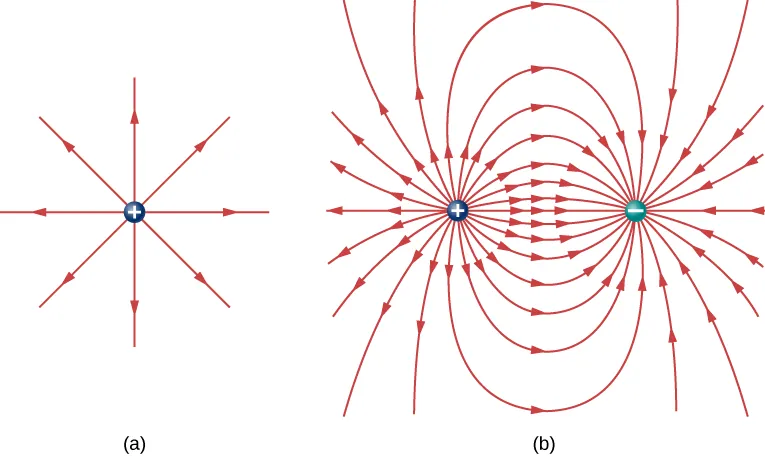
Electric field-line diagrams for (a) a single positive point charge and (b) an electric dipole. The arrowheads indicate the field direction (the direction a positive test charge would be pushed), and the line density visually represents larger field magnitude near the charges. This diagram reinforces that the electric field is defined locally and changes with position. Source
Near a charged object, the field may be stronger; at other points, it may be weaker. For that reason, electric field must always be discussed at a point.
Field value depends on location
When physicists say “the electric field at a point,” they mean one exact location in space. A field may have one value at one position and a different value somewhere else. For an extended charged object, different parts of the surrounding space can be affected by the source in different ways.
To define the field at a point, physicists imagine placing a test charge there and observing the electric force acting on it.
Test charge: A charge used to probe the electric effect of source charges at a chosen point in space.
Using a test charge makes the field measurable. Force can be observed directly or inferred from motion, while the field is determined from how much force the source produces on that probe charge. The test charge is part of the definition, but the field itself is created by the original charged object.
Defining electric field quantitatively
The key quantitative relationship for this subsubtopic connects electric field and electric force. The electric field at a point is defined as the force on a test charge divided by the value of that charge.
= electric field at the point, in
= electric force on the test charge, in
= test charge, in
This equation shows that electric field is not the same thing as electric force. The force depends on both the source of the field and the size of the charge being tested. The field removes the dependence on the test charge and describes only the effect of the source at that location.
A very important consequence follows from the ratio . If the test charge were doubled, the force would also double, so the value of would stay the same. If the test charge were halved, the force would also be halved, and again the field would be unchanged. This is why electric field is treated as a property of the point in space, not as a property of the specific probe used to measure it.
The phrase force per unit charge is the central meaning of electric field.
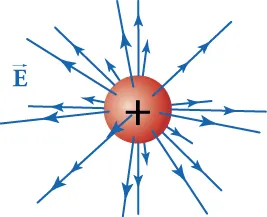
A vector-field representation of the electric field around a positive charge, with arrows pointing radially outward. The arrow direction shows the direction of the force a positive test charge would experience, while the arrow length indicates how the field magnitude decreases with distance. This visualization links the definition to the idea that is a position-dependent vector field. Source
It tells how much electric force would act for each coulomb of charge placed at the point. That makes the concept especially useful for comparing different locations around a charged object.
What field magnitude tells you
A larger field magnitude means a charge placed there would experience a larger electric force for each coulomb of charge it carries. A smaller field magnitude means the same charge would experience less force. The electric field therefore measures the strength of electric influence at a point.
The unit has a clear physical interpretation. It tells how many newtons of electric force act on each coulomb of test charge at that location. This connects the abstract idea of a field to measurable quantities used in experiments.
Electric field is also a local quantity. If you move from one point to another, the value of the field can change. For that reason, problems involving electric field must always specify the position where the field is being evaluated.
Common reasoning to remember
Charged objects are the sources of electric fields.
Electric field is defined at a point in space, not for an object as a whole.
Electric field is force per unit charge, found using .
The field does not depend on the size of the test charge used to measure it.
Field strength tells how strongly a source charge can affect other charges placed at that location.
Practice Questions
A test charge of placed at point experiences an electric force of magnitude .
Calculate the electric field magnitude at point . [2 marks]
1 mark for using
1 mark for correct answer:
A charged object creates an electric field around it.
At point , a test charge of experiences an electric force of magnitude .
At point , a test charge of experiences an electric force of magnitude .
(a) Calculate the electric field magnitude at point .
(b) Calculate the electric field magnitude at point .
(c) State which point has the stronger electric field.
(d) A student says, “Because the force is the same at both points, the electric field is the same.” Explain why this statement is incorrect. [5 marks]
1 mark for using at point
1 mark for correct answer at :
1 mark for using at point
1 mark for correct answer at :
1 mark for stating that point has the stronger field and explaining that electric field depends on force per unit charge, so equal force on different test charges does not mean equal field
FAQ
Electric field lets you describe the effect of a source charge on the space around it before choosing any particular object to place there.
That makes reasoning easier because you can:
find the field created by the source once
then predict the force on many different charges
compare different locations without redefining the interaction each time
It turns a two-object interaction into a description of how one object influences space.
No. The electric field at the point is set by the source charge or charges, not by the sign of the test charge.
What changes is the force on the test charge. Since the charge value changes sign, the force changes sign as well.
So:
same location
same source charges
same electric field
But the force on a negative test charge is opposite in sign to the force on a positive test charge.
There is no universal number. A test charge is “small enough” if placing it in the region does not noticeably change the original charge distribution that created the field.
In practice, physicists want the probe charge to:
produce only a tiny additional field
avoid moving charges around in the source object
disturb the system as little as possible
This is why the test charge is often treated as idealized in introductory physics.
Yes, if the object is very small compared with the distance from the point where the field is being evaluated, a point-source model can be a good approximation.
This works because, from far away, the size and shape of the object matter less than its overall charge.
However, close to the object, the actual shape and charge distribution can matter a lot, so the point approximation may become inaccurate.
A common method is to place a small known charge at a selected location and determine the electric force on it.
That force might be found from:
direct force measurement
the acceleration of the probe
the deflection of a suspended charged object
Once the force is known, the field is calculated from $E=\dfrac{F}{q}$.
So the field is usually measured indirectly through its effect on a carefully chosen probe charge.
