

AP Syllabus focus: 'A charged particle between oppositely charged parallel plates undergoes constant acceleration, so its motion shares characteristics with projectile motion near Earth's surface.'
When a charged particle moves through the space between oppositely charged parallel plates, it experiences a steady electric force. That makes its motion predictable and closely analogous to familiar two-dimensional projectile motion.
Motion Between Oppositely Charged Plates
A particle placed between oppositely charged parallel plates feels an electric force because of the electric field in the space between them. In the ideal AP Physics 2 model, the field in the central region is uniform, meaning its magnitude and direction stay the same from point to point.
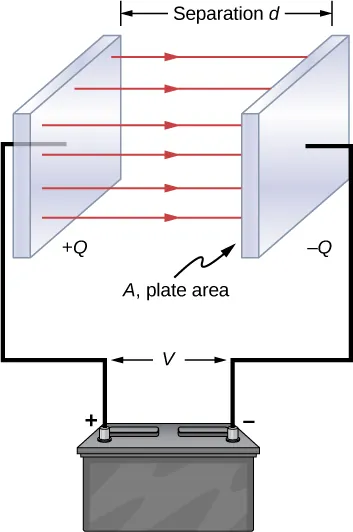
A parallel-plate capacitor produces an approximately uniform electric field in the region between the plates (away from edge effects), with field lines directed from the positive plate toward the negative plate. The diagram also highlights the geometric separation and the applied potential difference , which are commonly related by in the ideal model. Source
If the particle remains in that region, the force on it stays constant, so the particle's acceleration also stays constant.
The key motion idea is constant acceleration.
Constant acceleration: Acceleration that remains the same in magnitude and direction during the time interval being analyzed.
This does not mean the particle's velocity is constant. A constant acceleration changes the velocity steadily over time. If the particle enters the space between the plates with some initial velocity, its later motion depends on how that initial velocity compares with the field direction.
Why the Acceleration Is Constant
The electric force on the particle depends on the particle's charge and the electric field between the plates. For an ideal set of parallel plates, the field is the same everywhere between the plates except near the edges, so the force is the same throughout most of the region.
= electric force on the particle, N
= charge of the particle, C
= electric field strength between the plates, N/C
= acceleration of the particle, m/s^2
= mass of the particle, kg
Because , , and are constant for a given situation, the acceleration remains constant while the particle is between the plates. A positive particle accelerates in the same direction as the electric field. A negative particle accelerates in the opposite direction. This is a major difference from gravity, which always pulls downward regardless of the object's properties.
Connection to Projectile Motion
The closest analogy is a projectile launched near Earth's surface. In projectile motion, gravity provides a constant downward acceleration, while the horizontal motion continues independently. For a charged particle between plates, the electric force plays the role that gravity plays for a projectile.
If the particle enters moving parallel to the plates, then its initial velocity is perpendicular to the electric acceleration. In that common situation:
the velocity component parallel to the plates remains constant
the velocity component in the force direction changes steadily
the path curves toward one plate
That curved path is parabolic in the ideal model, just like the path of a projectile.
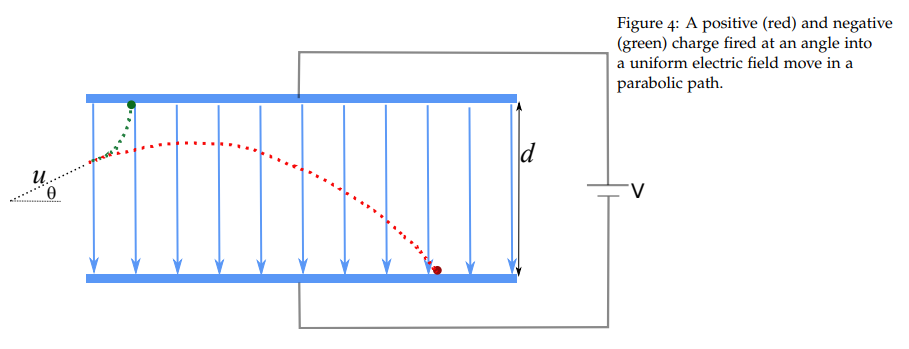
A charged particle entering the uniform field between parallel plates experiences a constant force , so its acceleration is constant while it remains between the plates. The resulting trajectory is parabolic when there is an initial velocity component perpendicular to the field, and the curvature reverses for opposite charge signs. Source
The similarity comes from the same underlying structure: constant acceleration in one direction and unchanged velocity in the perpendicular direction.
The important difference is that the electric acceleration is not universal. Its magnitude depends on the particle's charge-to-mass ratio and on the field strength. Its direction also depends on the sign of the charge.
Describing the Motion with Components
Component thinking is the simplest way to analyze motion between plates. Choose one axis parallel to the particle's initial direction and one axis along the field.
If there is no force along the first axis, the motion there is uniform. Along the second axis, the motion is uniformly accelerated. Those two component motions combine to produce the full trajectory.
= displacement parallel to the initial motion, m
= constant velocity component parallel to the plates, m/s
= time, s
= displacement in the acceleration direction, m
= initial velocity component in the acceleration direction, m/s
= constant acceleration caused by the electric force, m/s^2
= velocity component in the acceleration direction, m/s
These equations have the same form as the kinematics used for projectiles. That is why AP problems about charged particles between plates often reward the same style of reasoning used for two-dimensional motion under gravity.
What to Notice in Diagrams and Problems
In diagrams, begin by identifying the field direction and the sign of the particle.
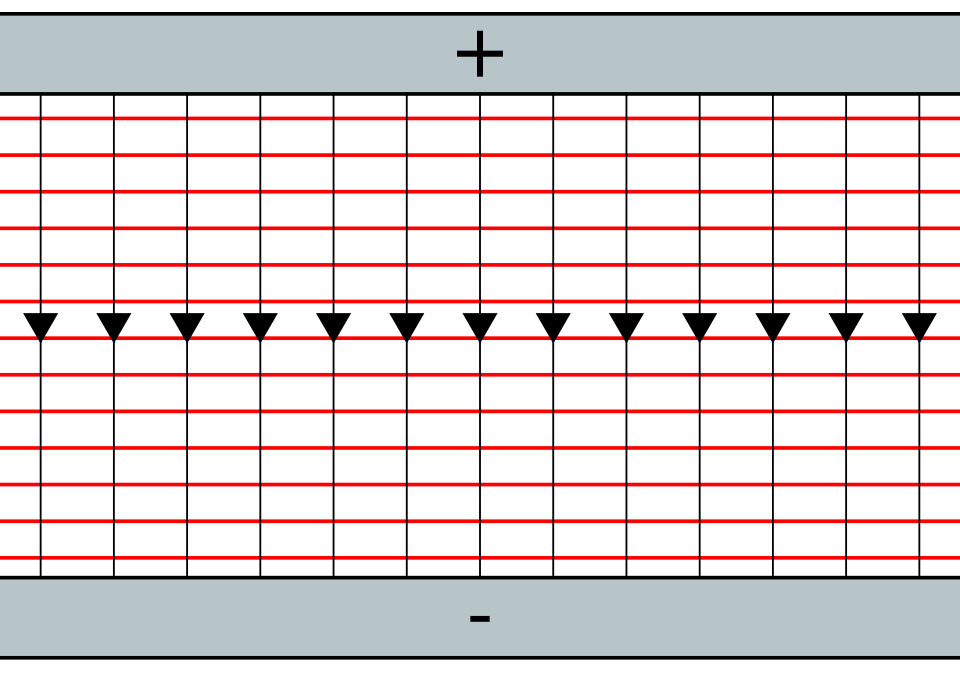
Field lines between oppositely charged parallel plates are straight, parallel, and evenly spaced in the central region, indicating a nearly uniform electric field. The equipotential lines are perpendicular to the field lines, emphasizing that the electric field points in the direction of decreasing electric potential. Source
Those two pieces determine the force direction immediately. Then decide whether the particle's initial velocity is parallel to the plates, perpendicular to them, or at an angle.
Useful reasoning habits include:
separate the motion into perpendicular components
treat the acceleration as constant only while the particle is within the uniform field region
remember that deflection depends on both the force direction and the time spent between the plates
distinguish carefully between force, acceleration, and velocity
A common mistake is to think the particle must move in the direction of the field at all times. That is not true if it already has a velocity component in another direction. The field changes the velocity by acceleration; it does not instantly replace the particle's original motion. Another common mistake is assuming all charged particles bend the same way. The sign of the charge matters, and so does the particle's mass.
Practice Questions
A positively charged particle enters the space between two oppositely charged parallel plates with an initial velocity to the right. The electric field between the plates points downward.
(a) State the direction of the electric force on the particle.
(b) Describe the particle's path while it is between the plates.
1 mark: Force is downward, in the same direction as the electric field.
1 mark: Path is curved or parabolic downward because the particle has constant downward acceleration and constant horizontal velocity.
A particle of charge and mass enters midway between oppositely charged parallel plates with initial speed parallel to the plates. The plates produce a uniform electric field of magnitude perpendicular to the initial motion.
(a) Write an expression for the magnitude of the particle's acceleration.
(b) Describe the motion parallel to the plates.
(c) Describe the motion perpendicular to the plates.
(d) Explain why the overall path is similar to projectile motion near Earth's surface, and state one difference.
1 mark: for magnitude, or with direction stated correctly.
1 mark: Parallel component has constant velocity or zero acceleration.
1 mark: Perpendicular component has constant acceleration due to the electric force.
1 mark: Path is parabolic or curved because constant acceleration acts in one direction while motion continues in the perpendicular direction.
1 mark: Valid difference, such as acceleration direction depends on charge sign, or magnitude depends on , , and rather than a universal .
FAQ
If the electric field outside the plates is negligible, the particle no longer experiences an electric force once it exits.
It then continues in a straight line at constant velocity, moving in the direction it had at the instant it left the plates. That exit direction is tangent to the curved path inside the field region.
Whether it hits a plate depends on more than just the existence of a force.
Important factors include:
the plate separation
the plate length
the particle's entry position
its initial speed
the value of $q/m$
the field strength
A particle may leave the region before it has enough time to move far enough toward a plate.
Usually, no.
One component of velocity may stay constant, but the component along the acceleration direction changes. As a result, the total speed usually changes while the particle is between the plates.
The only way the speed could remain constant is if the force stayed exactly perpendicular to the particle's instantaneous velocity at every moment, which is not the usual situation in this model.
Near the ends of the plates, the electric field is not perfectly uniform. The field lines begin to spread out, so the force is no longer exactly constant in magnitude and direction.
That means the path near the edges is not a perfect parabola.
In AP Physics 2, these edge effects are usually ignored unless a problem specifically mentions them.
They curve in opposite directions because their charges have opposite signs.
They also do not curve by the same amount because their masses are very different. An electron has a much smaller mass than a proton, so the same electric force produces a much larger acceleration for the electron.
That is why electrons often show much greater deflection than protons under the same conditions.
