

AP Syllabus focus: 'The electric potential energy stored in a capacitor equals the work done by an external force to separate that amount of charge on the capacitor.'
Charging a capacitor requires energy input. That energy becomes stored electric potential energy because an external force must separate opposite charges and keep them apart on the capacitor.
Why energy must be added
A capacitor stores energy only when charge has been separated.
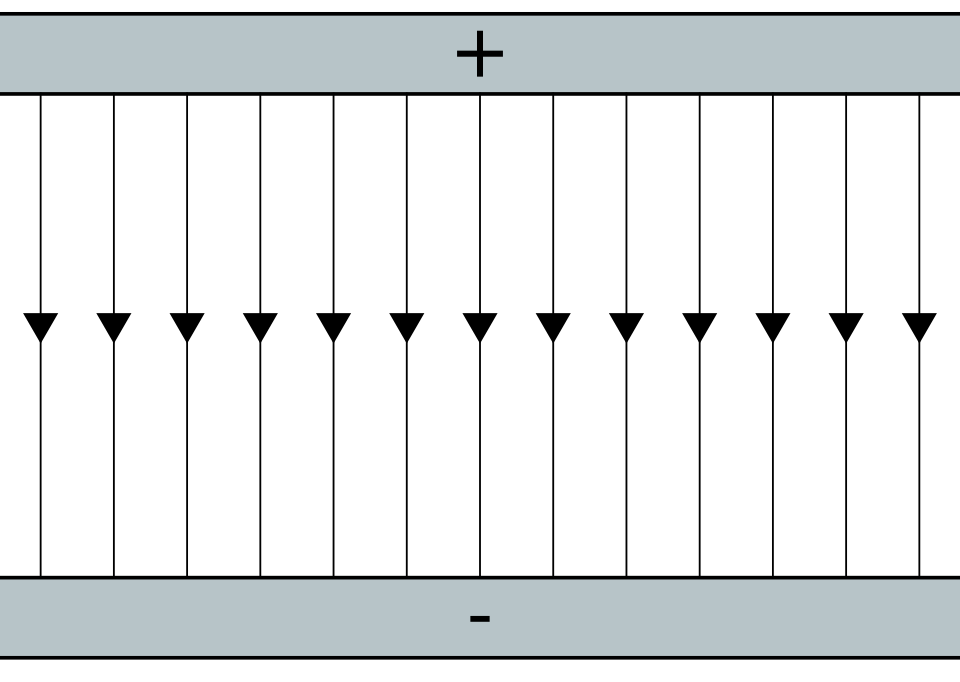
Electric field lines between oppositely charged parallel plates, illustrating how separating charge produces a strong, approximately uniform electric field in the region between the plates. This field is where the capacitor’s stored energy is associated in the ideal parallel-plate model (ignoring edge fringing). Source
One part of the capacitor becomes positively charged, and the other becomes negatively charged. Since opposite charges attract, this separation does not happen on its own. An external agent must move charge in a way that works against that attraction.
As charge separation increases, the capacitor system gains electric potential energy. The energy is not created by the capacitor itself. Instead, it is transferred into the capacitor by the external charging process.
Energy stored in a capacitor: The electric potential energy of the capacitor system, equal to the work done by an external force to separate charge onto the capacitor.
At AP Physics 2 level, the key idea is the connection between work and stored electric potential energy.
Role of the external force
The external force comes from whatever device is charging the capacitor. That device pushes charge into a less natural arrangement by increasing the amount of separated positive and negative charge. Because the separated charges attract each other, the charging device must do work to keep moving more charge.
Why charging becomes harder
At the beginning, very little charge has been separated, so the opposition to further charging is small. As more charge accumulates, the attraction between the opposite charges already on the capacitor becomes stronger. Because of that, continuing to separate additional charge requires more work from the external source.
This means the charging process is also an energy-transfer process. The external source does positive work, and the capacitor system gains electric potential energy.
For an ideal charging process in which other energy changes are negligible, the work done externally equals the increase in stored energy.
= change in electric potential energy of the capacitor system, in J
= work done by an external force to separate charge, in J
This relationship is an energy statement for the charging process.
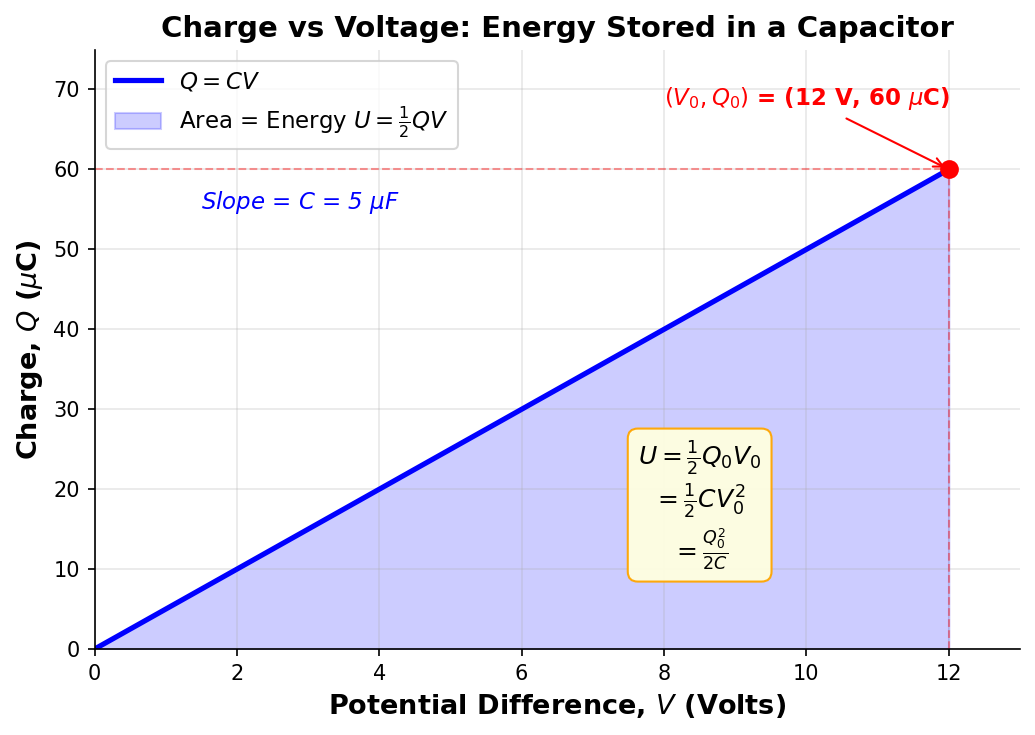
Charge–voltage graph for a charging capacitor, where the stored energy is the area under the line as charge accumulates. Because increases linearly with (for constant ), the area is triangular, giving . Source
What “stored” means
The word stored does not mean the energy is sitting inside one plate by itself. The energy belongs to the system of separated charges on the capacitor. When an external source has done work to create that separation, the capacitor now has the ability to transfer energy later.
That is why a charged capacitor can still be useful even after the charging source is removed. If the capacitor is connected so charge can move back toward a less separated arrangement, the stored electric potential energy decreases and energy is transferred to something else in the system.
A useful reference point is the uncharged capacitor, which is usually treated as having zero stored electric potential energy. Any work done during charging then measures how much energy has been added to the capacitor system.
Charging process in words
A good way to picture capacitor charging is to follow the energy transfer step by step.
An external source removes charge from one part of the capacitor and deposits equal-magnitude charge on the other part.
This creates a separation of positive and negative charge.
The attraction between the separated charges opposes further separation.
The external source must continue doing work to move additional charge.
The total work done by that external source becomes the energy stored in the capacitor.
Interpreting the idea in AP-style reasoning
Many questions on this topic are verbal rather than heavily mathematical. A strong explanation usually connects three ideas:
charge is being separated
an external force must do work
that work becomes electric potential energy stored in the capacitor
Reasoning pattern to use
If the external source is doing positive work to move charge against the electric attraction created by the already separated charges, then the capacitor’s stored energy is increasing. If the capacitor later loses that separation, then its stored energy decreases.
Sign language also matters. During charging, the external agent does positive work on the capacitor system. The electric interaction between the separated charges opposes that process. That opposition is exactly why energy must be supplied from outside.
Common misunderstandings
A common mistake is to say that the capacitor “makes” energy. It does not. The energy comes from the external charging process.
Another mistake is to think that simply having charge means energy is stored. The important feature is separated opposite charge. The stored energy is tied to the work required to create and maintain that separation.
It is also important not to confuse stored energy with energy being continuously used up. In an ideal model, a charged and disconnected capacitor keeps its stored electric potential energy until some process allows energy transfer.
Practice Questions
A capacitor is charged by an external source. What form of energy is stored in the capacitor, and how is that energy placed into the capacitor? [2 marks]
States that the capacitor stores electric potential energy. (1)
States that the energy comes from work done by an external force or charging source to separate charge on the capacitor. (1)
An initially uncharged capacitor is charged slowly by an external source and then disconnected.
(a) Explain why the external source must do work to continue charging the capacitor after some charge is already on it. [2 marks]
(b) State the relationship between the work done by the external source and the change in the capacitor’s stored energy. [1 mark]
(c) The capacitor is later connected in a circuit and discharges. Describe what happens to the separated charge and to the stored energy. [2 marks]
(a)
States that opposite charges on the capacitor attract, so the existing charge separation opposes further separation. (1)
States that the external source must do work to move additional charge against that opposition. (1)
(b)
States or gives an equivalent verbal statement that the work done by the external source equals the increase in stored electric potential energy. (1)
(c)
States that the separated charges move back toward a less separated arrangement. (1)
States that the capacitor’s stored electric potential energy decreases and is transferred to other forms in the circuit or device. (1)
FAQ
In a real circuit, not all of the source’s energy ends up as stored electric potential energy in the capacitor.
Some energy is usually transferred to wires and components as thermal energy while charge is moving. The capacitor stores only the part associated with the final separated-charge arrangement.
The main limit is usually breakdown of the insulating material inside the capacitor, along with heating of the plates or leads.
If the electrical stress becomes too large, the insulation can fail and charge can cross the gap suddenly. That can damage the capacitor or cause a dangerous discharge.
A charged capacitor already has separated charge ready to move as soon as a conducting path is available.
It does not depend on relatively slow chemical reactions during the release stage. That is why capacitors are useful in pulse applications such as camera flashes and defibrillators.
An ideal capacitor would. Real capacitors do not.
Small leakage currents through the material, across the surface, or through imperfect insulation slowly reduce the separated charge. As that happens, the stored electric potential energy gradually decreases over time.
This effect is called dielectric absorption.
After discharge, parts of the insulating material can relax slowly and cause a small redistribution of charge. A small voltage can then reappear across the capacitor terminals, even though it was previously discharged.
