

AP Syllabus focus: 'A system can interact with its environment and may transfer energy or mass. Changing external variables can also change the system's internal structure or substructure.'
In mechanics, the way you define a system determines what can cross its boundary and whether the model must change as the physical situation evolves.
System boundaries and interaction
When physicists choose a system, they draw an imagined boundary around the matter or objects they want to analyze. For this subsubtopic, the essential issue is whether the system exchanges mass, energy, or both with the surroundings. The boundary is a modeling choice, not a physical wall, so a good definition depends on what you want to track.
A system that exchanges material with its surroundings is treated differently from one that keeps the same matter throughout the motion. That difference affects what assumptions are valid later in a mechanics solution.
Open system: A system whose boundary allows mass to enter or leave, and which may also exchange energy with its surroundings.
Open systems appear whenever matter crosses the chosen boundary.
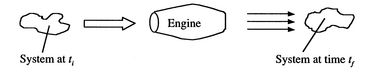
This schematic contrasts a ‘system’ (a fixed set of matter that moves and deforms with time) with a ‘control volume’ view (a fixed region in space that mass flows through). For AP Mechanics open-system problems (like rockets or situations with ejected/collected material), the control-volume viewpoint makes it explicit that the system membership changes with time. The picture highlights why open-system modeling often requires accounting for what the entering/leaving mass carries with it. Source
In mechanics, that can happen if material is added, removed, ejected, collected, or redistributed in a way that changes which matter belongs to the system. The key idea is that the system does not keep the same set of particles over time.
Because mass can cross the boundary, an open system often cannot be treated as having a fixed mass. Also, energy may cross the boundary in two ways: through interactions with the surroundings and through the incoming or outgoing matter itself.
Closed system: A system that keeps the same matter over time, even though it may still interact with its surroundings and exchange energy.
A closed system does not gain or lose mass. However, it is not necessarily isolated. External forces can still act on it, and energy can still be transferred across the boundary. For example, a sealed object being pushed or pulled remains a closed system even though the surroundings are clearly interacting with it.
This distinction is important: closed refers to whether mass crosses the boundary, not whether the environment has any influence at all.
Mass transfer and energy transfer
In AP Physics C mechanics, the phrase interact with its environment means the system is not automatically separated from everything outside it. The surroundings can affect the system in ways that matter for modeling.
Two common possibilities are:
Mass transfer: matter crosses the system boundary
Energy transfer: the surroundings add or remove energy from the system
Mass transfer changes the membership of the system itself. If matter enters, the system contains more material than before. If matter leaves, the system contains less. That means a statement like “the mass of the system is constant” must be justified, not assumed.
Energy transfer does not always require mass transfer. A system can be closed and still exchange energy through external interactions. For example:
an outside force can do work on the system
the system can do work on the surroundings
energy can be carried away by material that leaves an open system
The modeling consequence is straightforward: before applying any later mechanics ideas, identify what is crossing the boundary.
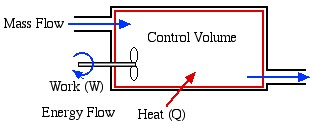
A control volume (system boundary) is drawn around the device being analyzed, and arrows indicate what can cross that boundary. In an open-system model, mass flow can enter/leave, and energy transfer can occur separately as heat and work . This kind of diagram is the visual counterpart of the “what crosses the boundary?” checklist you use before applying conservation laws. Source
If the boundary allows matter through, the system is open. If the matter stays fixed but outside influences still act, the system is closed but interacting.
Changing systems and external variables
Not every important system change comes from matter entering or leaving. The syllabus also emphasizes that changing external variables can alter a system’s internal structure or substructure.
Changing system: A system whose mass, composition, or internal arrangement changes over time because of interactions with the environment or changes in outside conditions.
A changing system may still be physically recognizable as the “same” object or collection of objects, but its internal makeup is no longer unchanged. In mechanics, that matters because a simple model that was valid at one moment may become incomplete later.
For example, outside conditions can change how matter is arranged within the boundary, how strongly different parts are connected, or whether the system can still be approximated as rigid. The term internal structure refers to the arrangement and relationships of the parts inside the system. Substructure refers to smaller-scale internal details that may begin to matter when external conditions change.
External variable: A quantity controlled by the surroundings or boundary conditions that can alter the state or internal arrangement of the system.
External variables can include things such as applied pressure, externally imposed constraints, contact conditions, or any outside influence that changes how the system is put together. A change in such a variable may:
deform the system
rearrange mass within the system
change which parts are tightly connected
make previously negligible internal details important
This means a system can be changing even if no mass crosses the boundary. In that case, the important issue is not open versus closed alone, but whether the internal model remains valid as conditions vary.
Modeling strategy for AP problems
When a problem involves open, closed, or changing systems, start by stating exactly what is inside the system boundary. Then ask:
Does any matter cross the boundary?
Can the surroundings transfer energy to or from the system?
Do outside conditions change the system’s internal arrangement?
Is the same model valid for the entire time interval?
If matter crosses the boundary, treat the system as open. If the same matter remains inside but outside interactions still occur, treat it as closed. If outside conditions alter the system’s composition or internal arrangement, recognize that it is a changing system, and be ready to update the model.
In AP-level analysis, many mistakes begin with an unclear system choice. A correct boundary makes it easier to decide whether mass stays fixed, whether energy enters or leaves, and whether the internal structure can still be ignored or must be included in the reasoning.
FAQ
Yes. In some models, the boundary is chosen so that it moves with the material being tracked.
That can be useful when you want to follow the same chunk of matter over time rather than a fixed region in space. In other cases, a fixed boundary is more convenient, especially when material flows through it.
The important point is consistency: once the boundary is chosen, you must be clear about what is allowed to cross it.
Yes. A mechanics model can still be affected by a variable that is not itself a force or motion quantity.
For example, temperature may change a material’s stiffness, shape, or internal state. If that change affects the motion model, then it is relevant even in a mechanics setting.
What matters is whether the outside variable changes the system’s structure enough to affect the analysis.
Because mass transfer may be significant over one interval and negligible over another.
Over a very short time, the amount of matter crossing the boundary might be so small that a simpler approximation works well. Over a longer interval, that same transfer can substantially change the system.
So an open system is often judged not only by what can cross the boundary, but by whether the transfer matters on the timescale being studied.
Yes, if the original choice stops being convenient or physically clear.
For instance:
parts may separate widely
new interactions may become important
the internal arrangement may no longer be negligible
Redefining the system is acceptable if you do it explicitly and keep track of what has changed. The new system must be stated clearly before continuing the analysis.
Not necessarily.
Once it leaves the chosen system, it is no longer counted as part of that system. However, it may still matter physically because it can interact with the surroundings or with the original object later.
Whether you continue to track it depends on the question being asked. If the expelled or lost mass affects later motion or forces of interest, a larger or different system may be the better choice.
Practice Questions
A sealed crate is pulled across a rough floor by a rope. The system is defined as the crate only. State whether this is an open or closed system, and justify your answer.
1 mark: Identifies the system as closed.
1 mark: Justifies that no mass crosses the boundary of the crate, even though the surroundings still interact with it.
A truck carries a pile of sand while moving along a road. Sand leaks steadily from a hole in the truck bed. The system is defined as the truck plus the sand still in the truck.
(a) State whether the system is open or closed.
(b) Explain why.
(c) The hole becomes larger during the motion. Explain how this change in an external variable can change the system’s internal structure or substructure.
(d) State one modeling consequence of this classification.
1 mark: Identifies the system as open.
1 mark: Explains that sand leaves the system boundary, so mass is transferred to the surroundings.
1 mark: States that making the hole larger is a change in an external condition or boundary condition.
1 mark: Explains that this can change how the sand is distributed inside the truck or how rapidly material leaves, so the internal arrangement of the system changes.
1 mark: States a valid modeling consequence, such as the system mass is not constant or the same internal model may not remain valid throughout.
