

AP Syllabus focus: 'For nonuniform solids, center of mass is found by integration. Linear or volume mass density can also be integrated to determine the total mass.'
Continuous objects cannot be treated as a few isolated masses, so the center of mass must be built from many tiny mass elements and combined using integration and mass-density functions.
Why Continuous Distributions Need Integration
When mass is spread through a rod, slab, or solid, the object cannot always be reduced to a few separate particles. The idea is to divide the object into tiny pieces, treat each piece as carrying a small mass, and then add all of their contributions in the limit with integration.
This is the key method for a continuous mass distribution, especially in nonuniform solids, where different regions may contain different amounts of mass.
Continuous mass distribution. A model in which mass is spread continuously through an object, so the center of mass is found by integrating over infinitesimal mass elements.
For a discrete system, center of mass is a weighted average of position. A continuous distribution uses the same idea, but the sum becomes an integral. The center of mass is pulled toward regions that contribute more mass, so a nonuniform density shifts the result away from the geometric middle.
One-Dimensional and Three-Dimensional Views
If the object is very thin, such as a wire or rod, a one-dimensional model is often enough. If the object occupies a genuine three-dimensional region, the same reasoning applies, but the mass element is built from a small volume. In both cases, the coordinate of the center of mass is a mass-weighted average of position.
= center-of-mass coordinate along the chosen axis, m
= total mass of the object, kg
= position of the mass element measured from the origin, m
= infinitesimal mass element, kg
The same pattern gives and when the full spatial location is needed. On many AP problems, only one coordinate must be found because the geometry fixes the others.
Mass Density and Differential Mass
To carry out the integral, the mass element must be written in terms of a geometric element such as a length or a volume. That step comes from mass density, which describes how mass is distributed through space.
Mass density. A function that relates mass to a small piece of an object. For thin objects, linear mass density is written as and gives mass per unit length. For solids, volume mass density is written as and gives mass per unit volume.
If density is constant, equal-sized pieces have equal mass. If density varies with position, then identical geometric pieces can have different masses, and that variation must appear in the integral.
= total mass of the object, kg
= infinitesimal mass element, kg
= linear mass density, kg per m
= infinitesimal length element, m
= volume mass density, kg per m
= infinitesimal volume element, m
Integrating density over the entire object gives the total mass. This is often required before calculating the center of mass, because the denominator must represent the mass of the whole distribution.
Choosing the Differential Element
The most effective differential element matches both the shape of the object and the way density is written.
A circular hoop is drawn with a small arc segment highlighted and treated as a differential element (often ) with corresponding . The diagram emphasizes that the geometry determines the differential element (e.g., arc length on a hoop), which then plugs into the same center-of-mass structure . Source
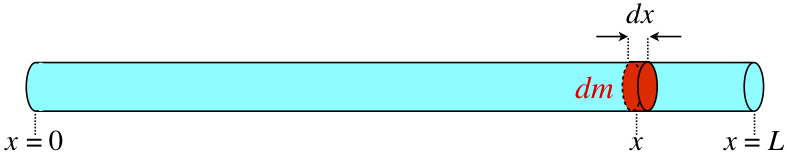
For a rod, a small segment is natural. For a solid, a thin slice, shell, or rectangular volume element can be chosen, provided it correctly represents a small volume . A good choice makes both and the integration limits simple.
Procedure for Nonuniform Solids
Choose a coordinate system and mark the origin clearly.
Describe the density as a function of position, such as or .
Write the infinitesimal mass element using geometry, for example or .
Find the total mass with if it is not already known.
Build the numerator of the center-of-mass expression, such as .
Divide by the total mass and check that the result lies in a physically reasonable location.
This procedure is especially important when the object is nonuniform. More mass concentrated on one side shifts the center of mass toward that side, even if the object’s shape is perfectly regular.
Physical Meaning of the Integral
The numerator in the center-of-mass formula is a mass moment about the chosen origin. Each small piece contributes its position multiplied by its mass. A mass element far from the origin can matter strongly because its position factor is larger. A dense region also matters strongly because its is larger. The center of mass is therefore the single coordinate that balances all of those weighted contributions.
In a three-dimensional solid, each coordinate is found separately. Even when the full density function is complicated, the principle remains the same: identify how much mass is in each tiny region and average its location using that mass.
Common AP Pitfalls
Using the geometric center automatically, even when density is not uniform.
Forgetting to compute from the density function before using the center-of-mass formula.
Writing incorrectly, such as using only instead of density times a geometric element.
Choosing integration limits that do not cover the entire object exactly once.
Omitting units: should have units of kg per m, should have units of kg per m, total mass should be in kg, and center-of-mass coordinates should be in m.
These checks help confirm that the integral setup matches the physics of the continuous mass distribution.
FAQ
Yes. The centre of mass is a weighted average of position, not a point that must sit inside the substance.
This can happen for shapes with empty space in the middle, such as a ring or a curved frame. The object’s mass can balance about a point where there is no material at all.
They change the form of the volume element.
For cylindrical coordinates, a common choice is $dV=r,dr,d\theta,dz$.
For spherical coordinates, a common choice is $dV=r^2\sin\theta,dr,d\theta,d\phi$.
The centre-of-mass idea stays the same, but the geometry is built into $dV$.
Use any extra condition given in the problem to determine it first.
Common possibilities include:
the total mass
the mass of part of the object
a density value at a particular location
Once that constant is known, substitute it back into $dm$ and then carry out the centre-of-mass integral.
Both can be correct. The best choice is the one that makes the integral simplest.
A useful differential element should:
match the shape of the object
fit naturally with the density function
give easy integration limits
If one choice produces awkward bounds or a complicated expression for $dm$, another choice is usually better.
It depends on whether the integral still converges.
If $\int dm$ remains finite, the total mass is still finite, and the centre of mass may also be finite. If the integral diverges, the model predicts infinite mass, which is not physically reasonable for an AP Mechanics problem.
So a sharply increasing density is not automatically invalid, but it must still produce a finite integral.
Practice Questions
A thin rod lies along the x-axis from to and has linear mass density . Write an integral expression for:
(a) the total mass
(b) the center-of-mass coordinate
1 mark for
1 mark for
A solid rod of length has constant cross-sectional area and lies along the x-axis from to . Its volume mass density is .
(a) Derive an expression for the total mass .
(b) Determine the center-of-mass coordinate .
1 mark for identifying
1 mark for correct setup of total mass:
1 mark for correct total mass:
1 mark for correct setup of center-of-mass numerator:
1 mark for correct result:
