

AP Syllabus focus: 'The center of mass along an axis can be found from the weighted average of the positions of the masses in the system.'
This subsubtopic explains how to locate the balance point of a collection of separate masses by combining position and mass into one physically meaningful average.
Core idea
For a system made of discrete objects, each object has its own mass and position. The center of mass is the single coordinate that represents how the system’s mass is distributed along a chosen axis. It is not just the midpoint of the positions unless the masses are equal. Instead, larger masses pull the center of mass closer to their own locations.
Center of mass: The mass-weighted average position of a system.
When AP Physics C asks for center of mass for discrete objects, the key idea is to treat each object’s contribution according to both where it is and how much mass it has. A light object far from the origin can matter less than a heavier object that is closer. The calculation therefore combines geometry and mass into one coordinate.
The weighted-average formula
Along one axis, usually the -axis, the center of mass is found by multiplying each mass by its coordinate, adding those products, and dividing by the total mass.

Two point masses ( and ) are placed at coordinates and along the -axis, emphasizing that positions are measured from a chosen origin (). This setup is the geometric picture behind the weighted-average formula for . Source
This is a weighted average because the masses act as the weights on the coordinates.
= position of the center of mass along the chosen axis, m
= mass of object , kg
= coordinate of object measured from the chosen origin, m
= total mass of the system, kg
This same structure works for any single axis.
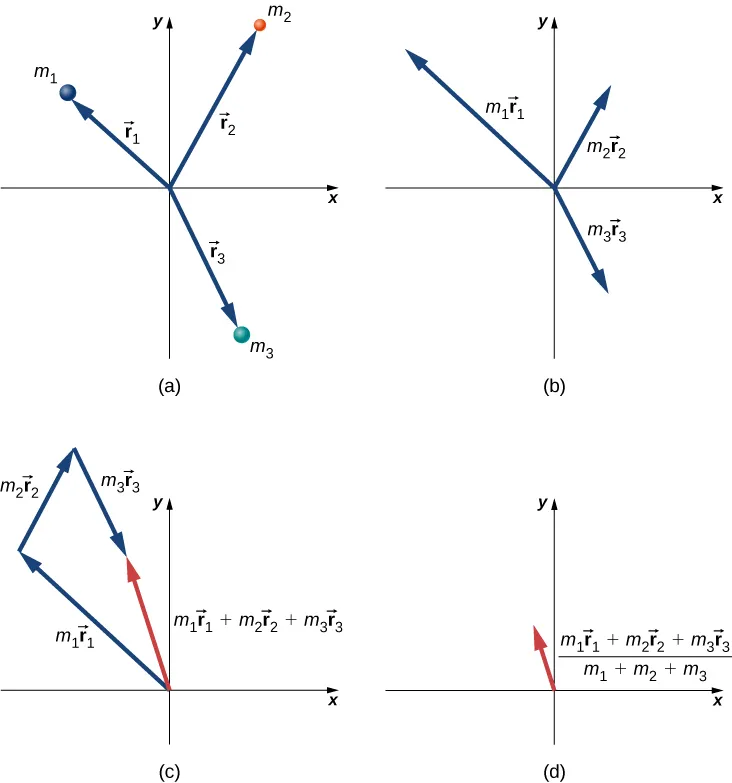
A four-panel construction shows how to find the center of mass by treating each particle’s position as a vector , scaling it by its mass to form , adding the scaled vectors, and then dividing by the total mass. This is the vector version of , and it clarifies why larger masses “pull” the average more strongly. Source
If a problem asks for center of mass along the -axis, the same weighted-average idea is applied to the -coordinates instead.
What the formula tells you
If all masses are equal, the center of mass becomes the ordinary average of the coordinates.
If one mass is much larger than the others, the center of mass lies closer to that object.
The result depends on coordinates, not merely on distances between objects.
For positive masses placed on a line, the center of mass must lie between the smallest and largest coordinate values.
How to calculate it correctly
A careful process helps avoid the most common algebra and sign errors.
Step 1: Define the system
Decide exactly which discrete objects are included. Every object in the chosen system contributes to the calculation. If an object is omitted, both the numerator and denominator become incorrect.
Step 2: Choose an axis and an origin
Pick a coordinate axis and set an origin. The origin can be placed anywhere convenient, but every position must be measured from the same origin and on the same axis. Consistency is more important than where zero is located.
Step 3: Assign signed coordinates
Each object must have a coordinate such as positive, negative, or zero. Negative coordinates are valid and important. A mass at m contributes a negative term to the numerator because it is located on the negative side of the origin.
Step 4: Form the numerator and denominator
Calculate each product , then add those products to form . Separately, add the masses to form . The numerator has units of kilogram-meters, and dividing by kilograms leaves meters, which is appropriate for a position.
Step 5: Interpret the result
The answer is the coordinate of the system’s center of mass on that axis. It is a property of the entire system, not the position of one special object. The center of mass may or may not match the coordinate of any actual mass.
Physical meaning
The center of mass is easiest to understand by comparing it with an ordinary average. An ordinary average treats all listed positions equally. A center-of-mass calculation does not. It gives greater influence to larger masses, so a heavy object can shift the result substantially even if several lighter objects are elsewhere.
This also explains why the center of mass can lie where no object is located.
It is a balance-point coordinate, not a requirement that matter physically exist at that exact point.
For AP problems, keep these interpretations in mind:
A center of mass closer to the positive side means more of the system’s mass is effectively concentrated there.
A negative value of means the mass distribution is overall shifted to the negative side of the chosen origin.
If two objects have equal mass, their combined effect places the center of mass halfway between their coordinates.
If masses are unequal, the center of mass is nearer the larger mass.
Special cases and useful checks
Several quick checks can tell you whether your result is reasonable.
If there is only one object in the system, the center of mass is just that object’s coordinate.
If two or more objects share the same coordinate, they can be treated as one combined mass at that coordinate.
If an object is located at the origin, its term in is zero, but its mass still contributes to .
If all coordinates are shifted by the same amount, the center-of-mass coordinate shifts by that same amount.
If your answer lies outside the range of coordinates for a line of positive masses, there is probably a sign or arithmetic mistake.
Common mistakes to avoid
Students often miss points not because they do not know the formula, but because they use it carelessly.
Using an ordinary average instead of a weighted average. The expression is not unless all masses are equal.
Forgetting signs. A mass at a negative coordinate must contribute a negative term to .
Mixing coordinate systems. Every position must be measured from one common origin.
Leaving out part of the system. If an object belongs to the defined system, its mass must appear in both the numerator and denominator.
Using distances instead of coordinates. Distance from one object is not the same as position on an axis.
Ignoring units. The final answer should have units of position, usually meters.
FAQ
Yes. The centre of mass is a weighted-average position, not the location of a required physical particle.
For discrete masses, it often falls between objects. That is especially common when masses are separated on a line and none of them sits exactly at the balance point.
You can combine them into a single equivalent mass at that coordinate before calculating.
For example, masses $m_1$ and $m_2$ both at $x=a$ contribute $m_1a+m_2a=(m_1+m_2)a$. This gives exactly the same centre of mass as treating them separately.
Yes. The centre-of-mass equation can be rearranged algebraically if one quantity is missing.
Typical unknowns include:
an added mass
the position of an added mass
the mass of one object when the final centre of mass is given
The key is to write the weighted-average equation first, substitute known values, and then solve for the unknown.
It changes the numerical value, but not the physical location.
If every coordinate is converted consistently, the result scales in the same way. For instance, a centre of mass at $2.3$ m is the same physical point as $230$ cm. Problems only arise when units are mixed.
Addition is commutative, so rearranging the terms does not change either $\sum m_i x_i$ or $\sum m_i$.
That means you may list masses from left to right, largest to smallest, or in any other order. The final centre of mass will be the same, provided every mass-coordinate pair is included correctly.
Practice Questions
Three particles lie on the -axis: a kg particle at m, a kg particle at m, and a kg particle at m. Find the center of mass of the system.
1 mark: Uses correctly.
1 mark: Calculates m.
Four small blocks can be treated as particles on the -axis. Their masses and positions are: kg at m, kg at m, kg at m, kg at m.
(a) Calculate the center of mass of the four-block system.
(b) A fifth block of mass kg is added at position . The new center of mass is at m. Determine .
Part (a), 1 mark: Correct setup of .
Part (a), 1 mark: Correct numerator and denominator, giving .
Part (a), 1 mark: Correct answer m.
Part (b), 1 mark: Sets up .
Part (b), 1 mark: Solves correctly to obtain m.
