

AP Syllabus focus: 'For symmetric mass distributions, the center of mass lies along the lines of symmetry. The whole system can often be modeled as a single object located at that point.'
Symmetry is one of the fastest tools in mechanics. It lets you locate a system’s center of mass qualitatively, often without algebra, and simplifies how an extended object is represented in translational motion.
Why symmetry matters
The center of mass is determined entirely by how mass is distributed. When that distribution is symmetric, the center of mass must respect the same symmetry. It cannot be shifted to one side if the mass on one side is a mirror image of the mass on the other. This gives a powerful shortcut: you can often narrow down the center-of-mass location before doing any detailed calculation.
A symmetry argument works because matching pieces of mass balance one another.
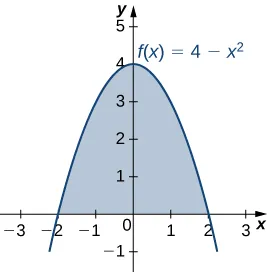
A symmetric shaded region under a parabola is graphed with the y-axis as the line of symmetry. Because equal-area (equal-mass, for uniform density) slices occur at and , the horizontal moments cancel, forcing the center of mass onto the symmetry line (here, ). Source
If equal amounts of mass lie at equal distances on opposite sides of a line, their sideways influences cancel. That forces the center of mass onto the symmetry line. Any point not on that line would favor one side over the other, which would contradict the mirror-image mass distribution. In three dimensions, the same reasoning applies to a plane of symmetry.
Lines and planes of symmetry
For a flat object, a line of symmetry divides the mass distribution into mirror-image parts. If an object has one symmetry line, the center of mass must lie somewhere on that line. Symmetry alone may not tell you the exact distance along it, but it gives a strong constraint that reduces the problem from a full two-dimensional search to a one-dimensional one.
If an object has two or more independent symmetry lines, the center of mass must lie at their intersection.
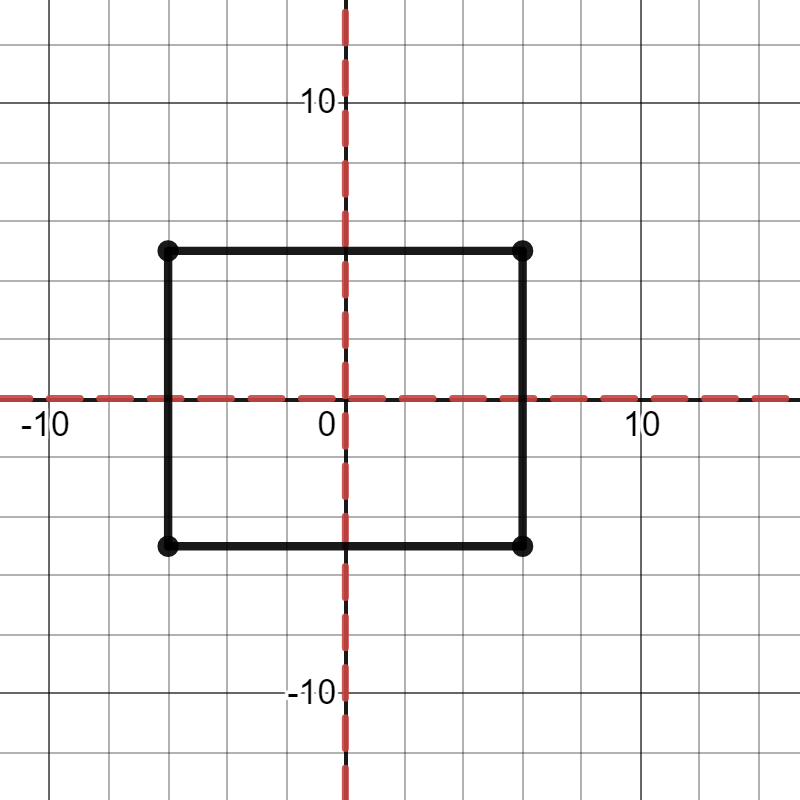
A rectangle is shown with its two mirror-symmetry lines (one horizontal and one vertical). The intersection of these symmetry lines marks the unique point that is unchanged by either reflection, which is why the center of mass of a uniform rectangle must be located there. Source
The same idea extends to solids: a plane of symmetry restricts the center of mass to that plane, and multiple symmetry planes locate it more precisely. You should think of the center of mass as satisfying all valid symmetry conditions at once.
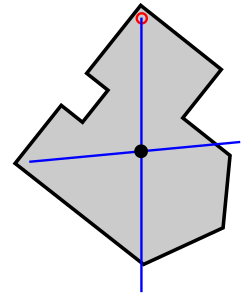
An irregular flat shape is shown with two vertical reference lines drawn from different suspension points (a plumb-line method). Each suspension produces a line that must pass through the center of mass; the intersection of the lines locates the center of mass as the single point consistent with both constraints. Source
For a uniform sphere, symmetry exists in every direction through the center, so the center of mass is exactly at the geometric center.
Common symmetry results
Many standard AP Physics shapes can be located by symmetry alone:
A uniform rod has mirror symmetry about its midpoint, so its center of mass is at the midpoint.
A uniform rectangle has horizontal and vertical symmetry lines, so its center of mass is at the geometric center.
A uniform disk or ring is symmetric about any diameter, so its center of mass is at the center.
A uniform sphere has full spherical symmetry, so its center of mass is at its center.
A uniform rectangular box has three perpendicular symmetry planes, so its center of mass is at the geometric center.
A uniform equilateral triangular plate has three symmetry lines, so its center of mass is at their intersection.
These statements depend on mass symmetry, not just visual symmetry. If density changes from one region to another, an object may still look symmetric while the mass distribution is not. In that case, the center of mass can shift away from the geometric center even though the outline of the object has not changed.
Modeling the whole system as a single object
The second key idea in the syllabus is that the whole system can often be modeled as a single object located at the center of mass. This is a translational model. Instead of tracking the motion of every small part of a bat, plate, or cart, you often analyze the motion of one point: the center of mass. This is why the motion of many extended bodies through space can be described compactly, even when the bodies themselves are large.
This simplification is useful when internal details do not matter to the question. If the goal is to describe how the object as a whole moves from place to place, the center of mass can represent that motion well. Symmetry is valuable because it often identifies that point immediately, without the need for coordinate calculations.
However, this model has limits. Replacing an extended object with a point does not describe how the object rotates, bends, or distributes its mass around that point. Symmetry helps you locate the center of mass, but it does not remove all physical structure from the problem.
How to use symmetry on AP problems
When reading a diagram, check for symmetry before choosing equations.
Ask whether the object or system has matching mass on opposite sides of a line or plane.
Include all parts of the system shown in the problem, not just the main shape.
Look for symmetry that survives after any attached masses, removed pieces, or unequal densities are considered.
If only one symmetry line remains, conclude that the center of mass lies somewhere on that line.
If two or more independent symmetry lines remain, place the center of mass at their intersection.
If the mass distribution is unchanged in every direction about one point, the center of mass is at that point.
Use the wording in the problem carefully; terms such as uniform, identical, and centered often signal symmetry you are expected to use.
A strong written justification often states that equal mass is distributed equally on both sides, so any sideways shift would contradict the symmetry.
Limits of symmetry arguments
Symmetry is a shortcut only when the symmetry is real.
A small attached object can shift the center of mass away from an otherwise obvious location.
A missing piece can remove one symmetry line and leave only another.
Looking balanced is not enough; the important idea is equal mass distribution, not just shape.
If only one symmetry line exists, symmetry gives a constraint, not a complete answer.
Some objects are symmetric enough to show where the center of mass must lie, but not symmetric enough to give the exact coordinate without further analysis.
A sketch may look symmetric even when the problem statement does not guarantee symmetry, so rely on stated physical information, not appearance alone.
FAQ
A useful trick is to treat the missing piece as if it were a piece of “negative mass” placed where the removed material used to be.
This helps you see which symmetries survive. If the hole is centred on a symmetry line, that line may remain valid. If the hole is off-centre, it usually destroys that symmetry and shifts the centre of mass away from the original position.
No. Rotational symmetry about a point can also be enough.
If the mass distribution is unchanged after a rotation through some angle less than $360^\circ$, the centre of mass must stay fixed under that rotation. The only point that remains fixed is the rotation centre, so the centre of mass must be there.
No. A single view or cross-section only tells you about part of the mass distribution.
A front view may look perfectly symmetric left-to-right, yet the object could have more mass towards the back than the front. In that case, the centre of mass still lies on the left-right symmetry plane, but not necessarily in the middle front-to-back.
The centroid is a geometric idea based only on shape. The centre of mass depends on how mass is actually distributed.
They coincide only when density is uniform throughout the object. If density varies, the centroid can stay at the geometric middle while the centre of mass shifts towards the denser region.
For a thin rigid lamina, suspend it from one point and let it hang freely. A plumb line from the suspension point gives a vertical line that must pass through the centre of mass.
Repeat from a second suspension point. The two lines intersect at the centre of mass. If the object is truly symmetric, that point should match the position predicted from symmetry.
Practice Questions
A thin uniform circular ring lies in the plane of the page. State the location of its center of mass and explain how symmetry determines that result.
Center of mass is at the geometric center of the ring. (1)
Valid explanation that every diameter is a line of symmetry, so the center of mass must lie on all of them; the only common point is the center. (1)
A composite object consists of a uniform square plate. Two identical small masses are attached, one at the midpoint of the left edge and one at the midpoint of the right edge.
(a) Identify the symmetry line or lines of the composite object. (2)
(b) State the location of the center of mass using symmetry alone. (1)
A third identical small mass is then attached at the midpoint of the top edge.
(c) After this change, identify the remaining symmetry line, if any. (1)
(d) Using symmetry only, state what can and cannot be concluded about the new center of mass. (1)
(a) Vertical centerline identified. (1)
(a) Horizontal centerline identified. (1)
(b) Center of mass is at the center of the square, where the two symmetry lines intersect. (1)
(c) Only the vertical centerline remains. (1)
(d) New center of mass must lie somewhere on the vertical centerline, but symmetry alone cannot determine its exact vertical position. (1)
