

AP Syllabus focus: 'Individual objects in a system may behave differently from one another and from the system as a whole. The system's internal structure affects how it should be analyzed.'
In mechanics, a good model depends on whether the parts of a system move together or relative to one another. Internal structure tells you when a simplified description is reliable and when it is not.
Why Internal Structure Matters
A system may contain several separate objects, or it may be one extended object made of many parts. In either case, the system can have an overall motion while its parts behave differently from one another. That difference is often the deciding factor in how you should model the situation.
Internal structure: The arrangement of parts within a system and the ways those parts can move, interact, or change relative to one another.
Internal structure includes whether parts are rigidly connected, loosely connected, free to shift, or able to deform. A solid metal block and a sealed container partly filled with liquid may have the same total mass and the same outside dimensions, but they do not respond in the same way if they are pushed, stopped, or shaken. The difference comes from what is happening inside the system.
Different motions inside one system
Objects within a single chosen system do not have to share the same position, velocity, or acceleration at every instant. If the system can flex, compress, spread out, or rearrange internally, then different parts can behave in different ways even while the system still counts as one unit for analysis.
For example, if you define the system as a bus plus its passengers, then the bus may slow down while some passengers continue moving forward relative to the floor. The chosen system is still the same, but its internal parts are clearly not behaving identically. The same idea applies to a box containing loose objects, a fluid in a container, or a deformable object.
This is why the phrase motion of the system is not automatically the same as motion of every object in the system. The system can have a clear overall behavior while internal parts shift or respond differently.
Same external motion, different internal behavior
Two systems can show nearly the same outside motion while having very different internal behavior. A rigid suitcase and a suitcase filled with loose items might travel along similar paths when carried. However, one keeps the same internal arrangement, while the other may have parts sliding, colliding, or settling inside. If the question only asks about the suitcase’s general motion across the room, that internal difference may not matter much. If the question asks about the motion of the contents or whether the internal arrangement changes, then the structure becomes essential.
Choosing an Appropriate Model
A useful mechanics model includes the details that matter and ignores the details that do not. Internal structure helps determine the correct level of detail. If the parts of a system stay in fixed relative positions, a simple model may be enough. If the parts move relative to one another, then a more detailed description is usually required.
One common simplification is the rigid model.
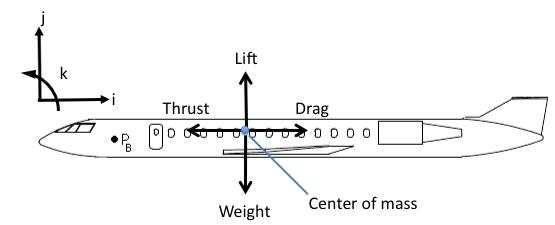
Free-body diagram of an aircraft showing the external forces (lift, weight, thrust, drag) applied to the isolated body, with the center of mass labeled. This is a concrete example of how a rigid-model/system-level analysis focuses on external interactions while suppressing internal structural details unless they matter to the question. Source
Rigid model: An idealized description in which the distances between parts of a system remain constant during the motion being analyzed.
When a rigid model is appropriate, the system can often be described by one overall motion without tracking each component separately.
This saves time and keeps the mathematics focused on the important behavior. However, that simplification is only valid if the internal structure does not significantly affect the result.
When a simplified model stops working
A single overall model becomes less useful when:
parts of the system move relative to one another
the shape of the system changes noticeably
different objects in the system respond differently to the same event
the problem asks about one component rather than the whole system
A collapsing stack of objects, a sloshing liquid, or a shifting group of particles cannot always be treated as one rigid package. In such cases, the internal behavior is part of the physics, not just extra detail. Ignoring it can lead to a model that describes the outside appearance of the system but misses what the parts are actually doing.
How Internal Structure Changes the Analysis
Internal structure affects what variables you need to track. If all parts move together, one position variable may be enough. If parts can separate, compress, or slide, then different parts may need separate descriptions. The system may still be one chosen system, but it cannot be treated as though every part shares the same motion.
It also affects what assumptions are valid. A system may behave approximately like a rigid object during slow, gentle motion, but not during a sudden stop or rapid change. That means the best model depends not only on the objects involved, but also on the time interval and the type of motion being studied.
Practical questions to ask
Before starting the analysis, ask:
Do the parts stay in fixed relative positions?
Can any part move differently from the rest?
Does the shape of the system change in a way that matters?
Is the question about the whole system or about a particular object within it?
Would a rigid model hide important behavior?
Making these checks first helps you choose between a whole-system description and a more detailed model of the individual parts. In AP Physics C Mechanics, that modeling choice is often the difference between a correct analysis and one that overlooks the role of internal structure.
FAQ
Internal structure usually refers to the parts of the chosen system and how they relate to one another.
Substructure goes one level deeper. It means finer detail inside those parts that may or may not matter for the model.
For example:
a vehicle made of wheels, frame, and cargo has internal structure
the material composition inside the frame is substructure
Whether you include substructure depends on the question. If it does not affect the motion you are studying, you usually leave it out.
Real materials always deform at least a little when forces act on them.
That happens because:
atomic bonds can stretch or compress
different regions of the object can respond at slightly different times
large forces can produce bending, twisting, or vibration
In many AP Physics C problems, those effects are small enough to ignore, so a rigid model works well.
However, “rigid” is an approximation, not a literal physical property of real matter.
They allow some parts of a system to move relative to others in specific ways.
A hinge may let parts rotate while keeping them connected. A slider may allow motion along one direction but not another.
These constraints matter because they limit the possible internal motion rather than eliminating it.
So a system with joints can still be one system, but it is usually not well described as a single rigid object.
A measuring device may only track the overall position of a large object, not the detailed motion inside it.
That can hide:
vibrations
shifting contents
short-lived internal rearrangements
If your sensor averages over time or space, internal differences may be smoothed out.
As a result, the recorded motion can appear clean and uniform even when the actual system has important internal activity.
It is a compromise between realism and simplicity.
A fully continuous description may be too complicated, but a single-object model may ignore essential internal motion. Using a few connected masses can capture the main features while keeping the maths manageable.
This kind of model is useful when:
different regions move differently
the exact material details are not needed
the goal is to represent the most important internal behaviour
It is still an approximation, but often a very practical one.
Practice Questions
A box contains several loose metal blocks. The box is pushed across a horizontal floor. Explain why the loose blocks and the box do not necessarily have the same acceleration at every instant. State one condition under which the entire box-plus-blocks system could still be approximated as a single object. [2 marks]
1 mark: States that objects within the same system can move relative to one another, so the blocks and box need not share the same acceleration.
1 mark: Gives a valid condition such as negligible internal shifting or that only the overall motion of the entire system is being considered.
A delivery cart carries a large container that is partly filled with liquid. The cart starts from rest and accelerates forward.
Describe how the internal structure of the chosen system affects the analysis. In your answer, you should: (a) compare the behavior of the cart and the liquid, (b) explain when the cart-plus-liquid system can be approximated as a single object, and (c) identify one limitation of that approximation. [5 marks]
1 mark: States that the liquid can move relative to the container, so different parts of the system may behave differently.
1 mark: Explains that the cart and the liquid do not necessarily have the same motion during the acceleration.
1 mark: States that a single-object model is acceptable if internal motion is negligible or unimportant for the quantity being asked.
1 mark: Explains that internal structure determines whether separate parts must be described individually.
1 mark: Gives one valid limitation, such as the single-object model cannot describe sloshing, redistribution of mass, or the motion of a specific part of the liquid.
