

AP Syllabus focus: 'Centripetal acceleration can be caused by one force, several forces, or force components. At the top of a vertical loop, minimum speed occurs when gravity alone provides centripetal force.'
Circular motion does not require a special new interaction. Instead, familiar forces such as gravity, tension, normal force, or friction combine so that their net effect continually points inward.
Circular motion and real forces
When an object moves in a circle, its velocity is constantly changing direction.
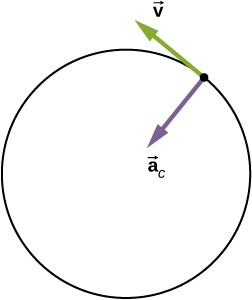
The velocity vector is tangent to the circular path, while the centripetal acceleration points radially inward toward the center. This geometry is the kinematic reason the net force must have an inward (radial) component during circular motion. Source
That change in direction requires an inward net force. In AP Physics C, the key idea is that the phrase centripetal force does not name a new physical force. It describes the role played by whatever real forces point toward the center.
Centripetal force: The net force directed toward the center of a circular path that produces circular motion.
A common mistake is to draw a separate force labeled “centripetal force” on a free-body diagram. Do not do this. A free-body diagram should contain only real interactions such as weight, tension, normal force, or friction. After those forces are identified, their inward sum is what provides the centripetal force.
The radial force condition
For motion along a circular path of radius and speed , the net force in the radial direction must match the force required to keep the object turning toward the center.
= net force toward the center, N
= mass, kg
= speed, m/s
= radius of the circular path, m
This equation is not an additional force law. It is Newton’s second law applied specifically in the direction toward the center. The left side must come from actual forces or actual force components.
Only the part of a force that points toward the center contributes to circular motion. If a force is angled, it must be resolved into components, and only its radial component belongs in the centripetal-force equation.
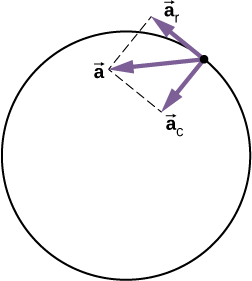
The acceleration of circular motion can be decomposed into a radial component (centripetal) and a tangential component that changes the speed. This decomposition clarifies why only the radial components of real forces appear in , while tangential components govern speeding up or slowing down. Source
How forces produce circular motion
One force can provide all of it
Sometimes a single real force supplies the entire inward force. For example, tension may be the only force directed toward the center for an object moving in a horizontal circle on a string. In that case, the tension itself is the centripetal force.
This means the analysis is simple: identify the one inward force and set it equal to .
Several forces can work together
In other situations, more than one force points inward. Then the inward forces add to produce the required net radial force. If one inward force is large and another is smaller, both still matter because the motion depends on their vector sum.
For AP problems, always ask: which forces have components toward the center at that instant?
A component of a force may matter
A force does not need to point exactly at the center to help produce circular motion. A force at an angle can still contribute through one of its components. This is why choosing axes carefully is so useful. If one axis is taken along the radial direction, the part of the force responsible for circular motion becomes easier to isolate.
Setting up circular-motion force equations
A reliable method is:
Draw a free-body diagram with only real forces.
Mark the direction toward the center.
Choose that direction as the radial axis.
Resolve angled forces into components if needed.
Add all radial components algebraically.
Set the radial net force equal to .
The sign of each term depends on your coordinate choice. If inward is positive, inward force components are positive and outward ones are negative. The physics stays the same as long as the signs are used consistently.
The top of a vertical loop
At the top of a vertical loop, the center of the circle is directly below the object, so the inward direction is downward. That makes this position especially important, because gravity already points toward the center there.
Minimum speed at the top of a vertical loop: The smallest speed for which an object just maintains contact with the track or just keeps a string taut at the top.
If the object is on the inside of a track at the top, the radial forces are typically weight and normal force, both downward when contact exists. The radial equation is therefore based on the sum of those downward forces. If the object is attached to a string, the forces at the top may be weight and tension, again both directed toward the center when the string is taut.
The important limiting case is the instant when the object is just about to lose contact with the track, or the string is just about to go slack. At that threshold, the contact force or tension becomes zero. The only remaining inward force is gravity.
= mass, kg
= gravitational field strength,
= minimum speed at the top, m/s
= loop radius, m
From this condition, . This result shows that the minimum top speed depends only on the loop radius and gravitational field strength.
If the object’s speed at the top is smaller than this value, gravity alone would be too much to match the required circular-motion condition without a force in the opposite direction. Since a track cannot pull the object toward itself from the inside and a loose string cannot push, contact is lost. The object then stops following the circular path.
This is why the phrase “gravity alone provides centripetal force” identifies the exact boundary between maintaining circular motion at the top and losing contact there.
FAQ
In AP Physics C, free-body diagrams are usually drawn in an inertial frame.
In an inertial frame, only real interactions are included:
gravity
tension
normal force
friction
“Centrifugal force” appears only when analysing motion from a rotating, non-inertial frame. For standard mechanics problems in an inertial frame, the correct approach is to add the real forces and set their radial sum equal to $mv^2/r$.
The biggest change is the direction of the contact force.
For an object on the inside of a loop, the normal force usually points towards the centre. For an object on the outside, the normal force often points away from the centre.
That means the radial equation may involve subtraction rather than addition, depending on the sign convention. The required inward net force is still $mv^2/r$, but the real forces that contribute to it can be arranged quite differently.
Yes.
Because centripetal force is a net radial force, it can:
equal one real force
be the sum of several real forces
be the difference between opposing radial components
For instance, if one force points inward and another points outward, the centripetal force is their algebraic combination in the radial direction. So it is not tied to the size of any single force by itself.
It does not continue around the circle.
At the instant contact is lost, the object’s velocity is tangent to the circular path. After that moment, its motion is determined by whatever forces still act on it, usually gravity alone.
So the object begins moving along a projectile path that starts tangent to the loop at the release point. The circular path ends immediately once the contact force disappears.
You may choose inward as positive or outward as positive. Either choice works.
What matters is consistency:
assign a positive radial direction
give each radial force component the correct sign
keep $a_r$ in the same chosen direction
Many students prefer inward as positive because then the required centripetal acceleration is $+v^2/r$. If outward is positive, the radial acceleration becomes $-v^2/r$. Both methods give the same final physical result when used carefully.
Practice Questions
A ball moves at constant speed in a horizontal circle while attached to a string. What single force provides the ball’s centripetal acceleration, and in what direction does that force act? [2 marks]
1 mark for identifying the force as tension.
1 mark for stating that the force acts toward the center of the circle.
A cart of mass moves on the inside of a vertical circular track of radius . At the top of the loop, the cart has speed .
(a) Describe the free-body diagram for the cart at the top and write the radial force equation. [2 marks]
(b) Determine the minimum speed needed for the cart to remain in contact with the track at the top. [2 marks]
(c) Explain what happens if . [1 mark]
(a) 1 mark for identifying the forces as weight downward and normal force downward.
(a) 1 mark for a correct equation: .
(b) 1 mark for stating that at the minimum speed, .
(b) 1 mark for obtaining and .
(c) 1 mark for explaining that the cart loses contact with the track because a negative normal force would be required.
