

AP Syllabus focus: 'On a banked surface, components of the normal force and static friction can provide centripetal force. In a conical pendulum, a component of tension does so.'
A banked curve lets surface forces contribute to the inward net force, while a conical pendulum uses angled tension in the same way. In both cases, force components create the required circular motion.
Banked Curves
On a flat curve, friction alone must supply the inward force needed for circular motion. On a banked curve, the surface is tilted, so the normal force is not purely vertical. Because of this tilt, the normal force has a horizontal component directed toward the center of the circular path. That inward component can help produce the centripetal force, which is the net inward force required for circular motion.
Banked curve: A curved path tilted at an angle so that forces from the surface have components that can contribute to the inward net force.
For AP problems, the most useful axes are usually:
vertical, because the object often has no vertical acceleration
horizontal toward the center, because circular motion requires inward acceleration
Frictionless banked surface
In the simplest model, a car moves around the banked curve without any friction. Only two forces act:
weight , downward
normal force , perpendicular to the surface
The vertical component of the normal force balances the weight, while the horizontal component of the normal force supplies the entire centripetal force.
= normal force, N
= mass, kg
= speed, m/s
= radius of the circular path, m
= bank angle measured from the horizontal
= gravitational field strength, m/s
Dividing the two equations gives . This relation shows the design speed for a frictionless banked turn: at one particular speed, the banking alone provides exactly the required inward force.
Role of static friction
Real banked curves often involve static friction as well as the normal force. Static friction acts parallel to the surface and can change direction depending on whether the object would otherwise slide up or down the bank.
If the object moves faster than the no-friction speed, it tends to slide up the slope, so static friction acts down the slope. In that case:
friction adds an inward component
friction also adds a downward component
If the object moves slower than the no-friction speed, it tends to slide down the slope, so static friction acts up the slope. In that case:
friction reduces the inward component from the surface forces
friction adds an upward component
A major AP point is that centripetal force is not an extra force to draw on a free-body diagram. Instead, it is the name for the net inward component of the actual forces. On a banked curve, that inward net force can come from:
the horizontal component of the normal force alone, or
a combination of normal-force and static-friction components
When solving, always decide the likely direction of slipping first. That determines the direction of static friction and therefore the signs of its components.
Conical Pendulums
A conical pendulum is a mass attached to a string that moves in a horizontal circle while the string makes a constant angle with the vertical.
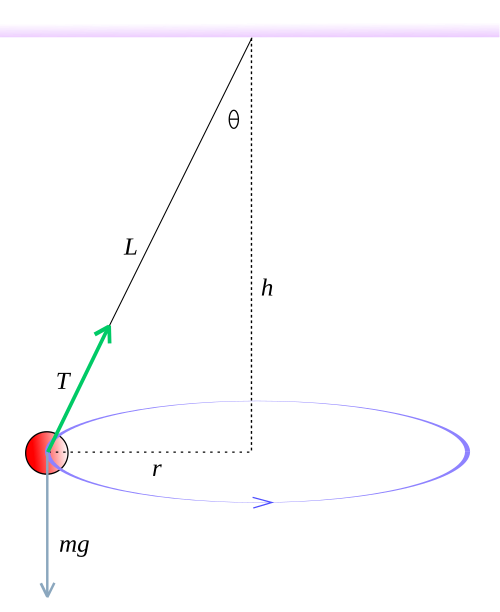
Labeled conical-pendulum diagram showing the bob’s horizontal circular path (radius ) and the string of length making angle with the vertical. The force vectors (along the string) and (downward) are drawn so it is visually clear why the horizontal component of tension supplies centripetal acceleration while the vertical component balances weight. Source
The string sweeps out a cone, which gives the motion its name.
Conical pendulum: A system in which a mass moves in a horizontal circle while suspended by a string that stays at a constant angle to the vertical.
Only two forces act on the mass in the ideal model:
weight , downward
tension , along the string
Because the string is angled, the tension has two components. The vertical component balances the weight, and the horizontal component points toward the center of the circle and provides the centripetal force.
If is measured from the vertical, the force equations are:
= tension, N
= mass, kg
= speed, m/s
= radius of the horizontal circle, m
= angle between the string and the vertical
= gravitational field strength, m/s
Dividing these equations gives . The structure is very similar to the frictionless banked-curve result because both situations involve one force component balancing weight and another producing inward acceleration.
As the speed increases, the required inward force increases, so the string must tilt farther from the vertical. That means:
the angle increases
the horizontal component of tension increases
the total tension also increases
Common AP Reasoning
These problems are usually straightforward if the force analysis is clean.
Draw only real forces on the free-body diagram.
Label the direction of the center of the circular path before resolving forces.
Treat the vertical acceleration as zero when the motion stays at a constant height.
Use the horizontal inward direction for the centripetal-force equation.
State clearly whether the angle is measured from the horizontal or the vertical.
Remember that the radius in a conical pendulum is the radius of the horizontal circle, not automatically the string length.
FAQ
Look at the wording or diagram first.
If the surface is said to make an angle with the horizontal, then the usual bank angle is that angle.
If the angle is given from the vertical, the sine and cosine roles swap compared with the usual setup.
A safe method is to sketch the force components directly from the diagram rather than memorising one formula.
If the string were horizontal, the tension would have no upward component.
But the mass still has weight acting downward, so there would be no force to balance gravity. To keep the mass at constant height, the string must always have some vertical component of tension.
That means the angle to the vertical must stay less than $90^\circ$.
The string length is the full slanted distance from the pivot to the mass.
The circular path is horizontal, so its radius is only the horizontal part of that length. If the string length is $L$ and the angle from the vertical is $\theta$, then
$r = L\sin\theta$
This is why the path radius is always less than $L$ unless the string could become horizontal, which it cannot in the ideal model.
In many ideal banked-curve and conical-pendulum relations, the mass cancels.
For example, in $\tan\theta = \dfrac{v^2}{rg}$, the mass does not appear. That means the required angle depends on the speed, radius, and gravitational field, not on how heavy the object is.
Mass still matters for quantities such as:
the actual tension
the actual normal force
the actual friction force
So mass often cancels in the motion condition, but not in the force magnitudes.
Real turns are more complicated than the idealised model.
Possible differences include:
changing bank angle across the width of the road or track
tyre deformation
suspension effects
aerodynamic forces
uneven surfaces
changing available friction in rain or ice
The AP model ignores these so that the key idea is clear: surface-force components can provide the inward net force. The simplified model is still very useful for understanding how banking helps vehicles turn.
Practice Questions
A car moves around a frictionless banked curve of radius and bank angle . Derive an expression for the speed at which no friction is required.
Uses force components correctly: and (1 mark)
Combines the equations to obtain (1 mark)
A small mass is attached to a string and moves as a conical pendulum. The string makes an angle with the vertical, and the mass moves in a horizontal circle of radius with speed .
(a) State the two forces acting on the mass. (1 mark)
(b) Write an equation for the vertical direction. (1 mark)
(c) Write an equation for the horizontal inward direction. (1 mark)
(d) Show that . (1 mark)
(e) Write an expression for the tension in the string in terms of , , and . (1 mark)
(a) Identifies tension and weight (1 mark)
(b) (1 mark)
(c) (1 mark)
(d) Divides the equations correctly to get (1 mark)
(e) (1 mark)
