

AP Syllabus focus: 'Centripetal acceleration is the component of acceleration directed toward the center of a circular path. Its magnitude equals speed squared divided by radius.'
Circular motion can look steady, but its velocity is constantly changing direction. That directional change produces a special inward acceleration that is central to analyzing motion along curved paths.
Understanding centripetal acceleration
In physics, acceleration means the rate at which velocity changes. Because velocity includes both speed and direction, an object can accelerate even when its speed stays constant. This is exactly what happens in circular motion.
When an object moves along a circle, its instantaneous velocity is always tangent to the path.
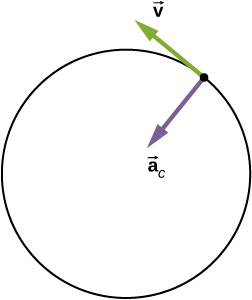
The velocity vector is tangent to the circular path at the object’s position, while the centripetal acceleration points radially inward toward the center. This perpendicular relationship is the geometric reason an object can have nonzero acceleration even when its speed is constant. Source
As the object continues around the circle, that tangent direction changes from moment to moment. Since the velocity vector changes, the object must have an acceleration.
Centripetal acceleration: The component of an object's acceleration that points toward the center of a circular path.
The word component matters. The total acceleration of an object in circular motion is not always purely centripetal, but the centripetal part is always the inward part associated with following the curved path. It is a geometric requirement of circular motion.
Why circular motion requires inward acceleration
A useful way to think about this is to compare the velocity vector at two nearby points on the circle. Even if the speeds at those two instants are the same, the directions differ slightly. The difference between those velocity vectors points inward, toward the center of the circle.
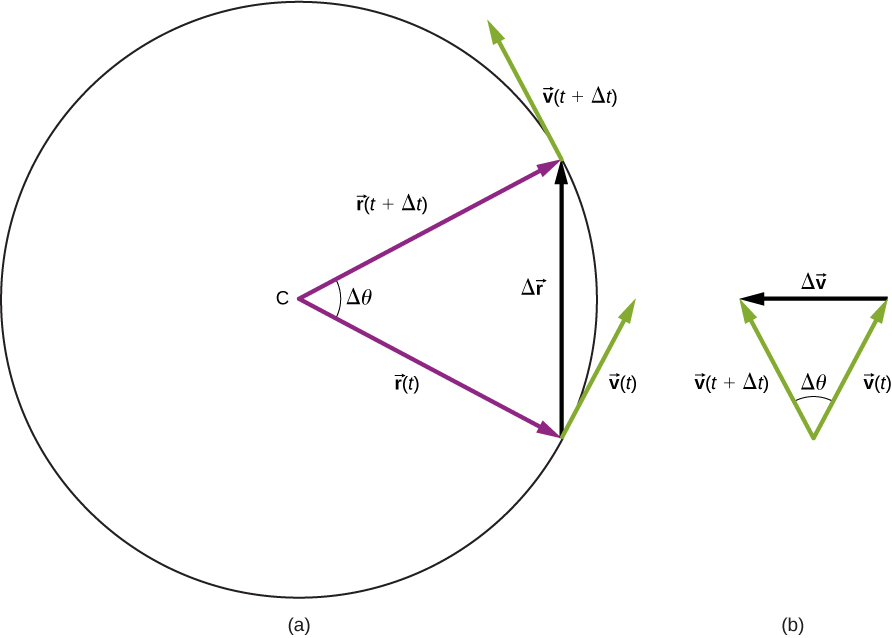
Two tangential velocity vectors at nearby points on the circle have the same magnitude but different directions, so their difference points inward. In the limit of small time steps, becomes the centripetal acceleration directed toward the center. Source
That inward change in velocity means the acceleration is inward as well.
This explains an important AP Physics idea: constant speed does not mean zero acceleration. In straight-line motion, constant speed can go with zero acceleration. In circular motion, constant speed still involves acceleration because the direction of motion is continuously turning.
The inward direction is always measured from the object's position toward the center of the path. It does not point in the direction of travel, and it does not point opposite the velocity.
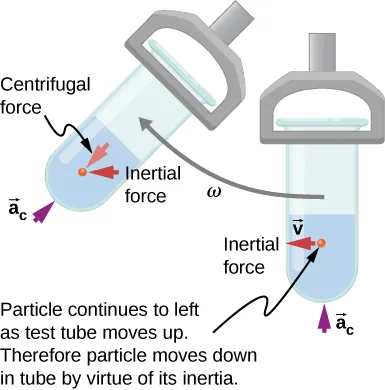
This centrifuge diagram labels the inward centripetal acceleration and the tangential velocity at specific positions on the circular path. The picture emphasizes that the inward acceleration is not along the direction of motion, but perpendicular to the instantaneous velocity. Source
Instead, it points perpendicular to the instantaneous velocity for uniform circular motion.
Magnitude of centripetal acceleration
The magnitude of centripetal acceleration depends on two quantities: the object's speed and the radius of the circular path. Faster motion or a tighter curve requires a larger inward acceleration.
= magnitude of the centripetal acceleration, in
= speed of the object, in
= radius of the circular path, in
This equation gives only the magnitude. The direction must always be stated separately as toward the center of the circle.
Several important relationships follow immediately from the formula:
If the speed doubles, the centripetal acceleration becomes four times larger because of the square on .
If the radius doubles while speed stays the same, the centripetal acceleration becomes half as large.
A smaller radius means a sharper turn, so the velocity direction must change more rapidly.
The units are correct because .
These relationships are often more useful than memorizing the formula alone. They help you predict how circular motion changes when the speed or path size changes.
Vector features to remember
Centripetal acceleration is a vector, so direction is essential. At every point on the path, the vector points along the radius from the object to the center. As the object moves around the circle, this direction changes continuously. That means the centripetal acceleration can have constant magnitude while still being a changing vector.
It is also important to distinguish motion around the center from motion toward the center. An object in circular motion is not traveling inward along the radius. Its velocity is tangent to the circle, while its centripetal acceleration points radially inward. The acceleration changes the direction of the velocity so that the object keeps following the curve.
In AP Physics C, students often need to identify centripetal acceleration from a diagram. The safest method is:
locate the center of the circular path,
draw the radius from the object to that center,
point the acceleration vector inward along that radius.
Common misunderstandings
A few misconceptions appear repeatedly:
“If speed is constant, acceleration must be zero.”
This is false for circular motion because direction is changing.“Centripetal acceleration points in the direction of motion.”
It does not. The velocity is tangent to the circle, while centripetal acceleration points inward.“The object is moving toward the center.”
Not necessarily. The acceleration points toward the center, but the motion is around the center.“Centripetal acceleration is a separate kind of force.”
It is not a force at all. It is an acceleration component.“The formula alone is enough.”
On free-response questions, you usually need both the correct magnitude and the correct inward direction.
Careful attention to vectors, especially the difference between tangent and inward directions, is what makes centripetal acceleration clear and usable in mechanics problems.
Practice Questions
A particle moves in a circle of radius at a constant speed of .
(a) State the direction of its centripetal acceleration.
(b) Calculate the magnitude of its centripetal acceleration.
1 mark for stating that the acceleration is directed toward the center of the circle.
1 mark for using and obtaining .
A small object moves at constant speed around a circular path of radius .
(a) Explain why the object has a nonzero acceleration even though its speed is constant. (2 marks)
(b) State the magnitude of the centripetal acceleration in terms of and . (2 marks)
(c) The speed is doubled and the radius is halved. By what factor does the centripetal acceleration change? (1 mark)
(a)
1 mark for stating that velocity changes because its direction changes.
1 mark for stating that acceleration is the rate of change of velocity, so it is nonzero.
(b)
1 mark for the correct expression .
1 mark for identifying it as the centripetal acceleration magnitude.
(c)
1 mark for the correct factor of .
FAQ
The formula $a_c=\dfrac{v^2}{r}$ gives only the magnitude of the centripetal acceleration.
The direction is supplied separately: it is always toward the centre of the circular path. Using speed keeps the magnitude expression simple, while the vector direction is handled in words or with a diagram.
Yes. The centre is a geometric feature of the path, not necessarily a physical object.
For example, an object can move around a point in space with nothing located there. What matters is that the path is circular and that the inward acceleration is directed toward that point.
If the interaction that was keeping the object on the circle is removed, the centripetal acceleration disappears immediately.
At that instant, the object continues with the velocity it already had, which is tangent to the circle at the release point. After that, its motion depends on whatever accelerations remain.
No. It is most exact for circular motion, but the idea also helps with curves that are only locally circular.
At any point on a smooth curved path, one can often describe the bend using a local radius of curvature. The inward acceleration associated with that local bend behaves like a centripetal component.
That sensation comes from your body's tendency to continue in its current state of motion while the vehicle or ride turns beneath you.
In an inertial frame, the actual acceleration needed for the turn is inward, toward the centre. The “outward” feeling is an effect of being in a turning frame, not evidence that the real centripetal acceleration points outward.
