

AP Syllabus focus: 'Tangential acceleration changes the speed of an object and points tangent to the path. The total acceleration is the vector sum of tangential and centripetal accelerations.'
In circular motion, acceleration is not always purely inward. If an object's speed changes while it follows a curved path, its acceleration has two perpendicular components that must be interpreted together.
Separating the Two Components
In curved motion, velocity can change in two different ways: its magnitude can change, and its direction can change. AP Physics C describes these effects using two perpendicular components of acceleration. Identifying the correct component helps explain whether an object is speeding up, slowing down, or simply turning.
Tangential acceleration: The component of acceleration tangent to the path that changes the object's speed.
The tangential acceleration lies along the tangent line to the path. If it points in the same direction as the velocity, the object speeds up. If it points opposite the velocity, the object slows down. This component does not point toward the center of the circle; its purpose is to change how fast the object moves along the path.
= tangential acceleration, meters per second squared
= speed, meters per second
= time, seconds
This equation shows that tangential acceleration is determined by how quickly the speed changes with time, not by the curvature of the path.
Centripetal acceleration: The component of acceleration directed toward the center of the circular path that changes the direction of the velocity.
The centripetal acceleration is required whenever an object follows a circular path, even if its speed stays constant. Its role is to rotate the velocity vector so the object keeps moving around the circle instead of continuing in a straight line.
= centripetal acceleration, meters per second squared
= speed, meters per second
= radius of the circular path, meters
A larger speed or a smaller radius gives a larger centripetal acceleration. In uniform circular motion, this component is perpendicular to the velocity, so it changes direction without directly changing speed.
Net Acceleration as a Vector Sum
When both components are present, the object is in nonuniform circular motion. The total acceleration is neither purely inward nor purely tangent to the path. Instead, the true acceleration vector is the sum .
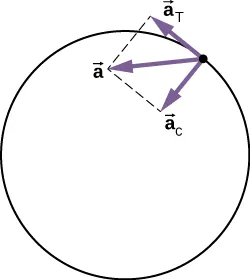
Tangential acceleration points along the direction of motion (tangent to the path), while centripetal acceleration points radially inward toward the center of curvature. The net acceleration is the vector sum of these perpendicular components, so its direction lies between the tangent and the inward radial direction. Source
Because these two components are perpendicular at each instant, they must be added as vectors rather than as ordinary numbers.
= magnitude of the total acceleration, meters per second squared
= tangential acceleration, meters per second squared
= centripetal acceleration, meters per second squared
The direction of the net acceleration depends on the relative sizes of the two components. If is small compared with , the net acceleration points mostly inward. If is larger, the net acceleration tilts more strongly along the tangent. The acceleration points exactly inward only when the tangential component is zero.
Important cases to recognize:
If , the motion is constant-speed circular motion, so the total acceleration is purely centripetal.
If , there is no turning at that instant, so the acceleration is purely tangential.
If both are nonzero, the object’s speed and direction change at the same time.
The direction of each component must come from the geometry of the motion, not from memorizing a single picture.
Interpreting Direction and Motion
Each component has a different physical meaning. Tangential acceleration tells you how rapidly the speedometer reading changes. Centripetal acceleration tells you how rapidly the velocity vector turns.
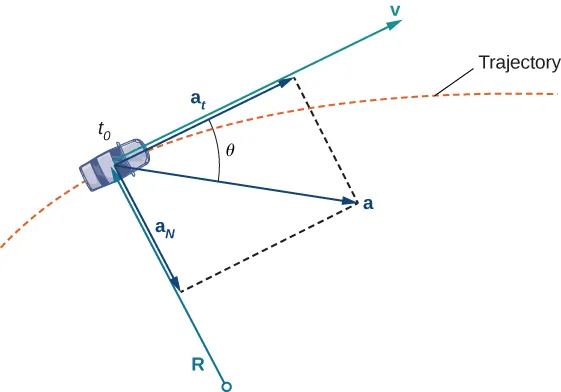
The velocity vector is tangent to the path, while the normal (centripetal) component of acceleration points toward the inside of the turn. The figure also shows the total acceleration vector decomposed into tangential and normal components, emphasizing that changes in speed and changes in direction can occur simultaneously. Source
The total acceleration describes both effects at once, so it is the full rate of change of velocity.
For an object moving around a circle while speeding up, the net acceleration points inward and forward along the motion. For an object slowing down, it points inward and backward relative to the motion. These ideas are especially useful when drawing acceleration vectors on motion diagrams or interpreting the direction of an object's change in motion.
Qualitative checks
Speed increasing: the tangential component points in the same direction as the instantaneous velocity, while the centripetal component still points inward.
Speed decreasing: the tangential component points opposite the instantaneous velocity, but the centripetal component remains inward.
Constant speed: only the centripetal component remains, so the acceleration is perpendicular to the velocity.
Common Reasoning Errors
Several mistakes appear often in circular motion problems:
Confusing inward with total acceleration: inward direction describes the centripetal part, not necessarily the whole acceleration.
Adding magnitudes directly: is not the net magnitude unless the two components happen to be parallel, which they are not here.
Thinking centripetal acceleration changes speed: it changes the direction of velocity; the tangential part changes the speed.
Assuming zero tangential acceleration means zero acceleration: in constant-speed circular motion, acceleration is still nonzero because the velocity direction is changing.
FAQ
For motion on a circle of fixed radius, the relationship is $a_t = r\alpha$.
This comes from differentiating $v = r\omega$ with respect to time. It is useful when a problem gives angular acceleration rather than the rate of change of speed directly.
Yes.
If the object is on a circular path and starts from rest, it can have a nonzero tangential acceleration that begins to increase its speed. At that instant, $a_c = \dfrac{v^2}{r} = 0$, so the acceleration is entirely tangential.
No. A similar idea works for any curved path.
At each instant, a smooth curve can be approximated by a local circle. The inward component then depends on the local radius of curvature rather than a single fixed radius for the whole motion.
A speed-time graph is useful for tangential acceleration because its slope gives the rate of change of speed.
Centripetal acceleration cannot usually be found from a speed-time graph alone. You also need information about the curvature of the path, such as the radius at that instant.
Choose a clear convention first and keep it throughout the problem.
If positive is chosen along the direction of motion, positive $a_t$ means speeding up.
If positive is chosen opposite the motion, the same physical situation would give negative $a_t$.
The sign comes from the coordinate choice; the physics comes from the direction relative to the velocity.
Practice Questions
A particle moves clockwise around a circular path and is slowing down. State the direction of its tangential acceleration relative to (a) its velocity and (b) the circular path. [2 marks]
1 mark: States that the tangential acceleration is opposite the direction of the velocity.
1 mark: States that the tangential acceleration is tangent to the path, not directed toward the center.
A object moves in a circle of radius . At one instant, its speed is and its tangential acceleration has magnitude . (a) Calculate the centripetal acceleration. (b) Calculate the magnitude of the total acceleration. (c) Determine the angle of the total acceleration relative to the inward radial direction. (d) State whether the object's speed, direction, or both are changing at that instant. [5 marks]
(a) 1 mark: Uses and gets .
(b) 1 mark: Uses .
(b) 1 mark: Gets .
(c) 1 mark: Uses and gets from the inward radial direction toward the tangent.
(d) 1 mark: States that both speed and direction are changing.
