

AP Syllabus focus: 'For a satellite in circular orbit, gravity alone provides centripetal acceleration. The orbital period and radius are related to the mass of the central body by Kepler’s third law.'
Circular orbital motion is one of the clearest applications of Newtonian mechanics. By combining gravity with uniform circular motion, you can predict satellite speed, orbital period, and the mathematical form of Kepler’s third law.
Gravity as the centripetal force
A satellite in a circular orbit moves with constant speed, but its velocity is still changing because its direction changes continuously. That change in velocity requires an inward acceleration toward the center of the orbit. In orbital motion, the force that provides this inward acceleration is the gravitational force from the central body, such as a planet or star. There is no separate physical force called “centripetal force”; rather, gravity is the force acting as the centripetal force.
One key quantity in orbital motion is the orbital period.
Orbital period: The time required for a satellite to complete one full orbit.
For a circular orbit, the gravitational force must exactly equal the force required to keep the satellite moving in a circle.
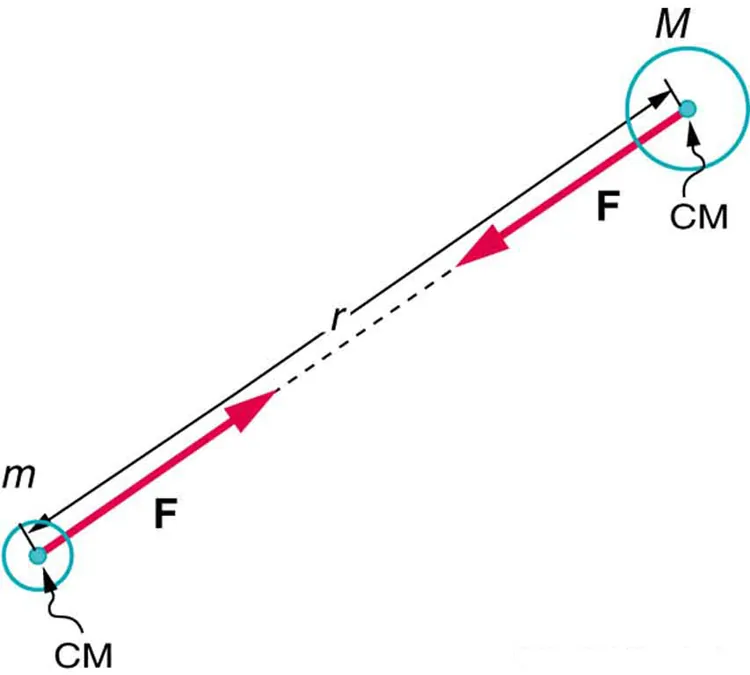
This force diagram shows two masses separated by a center-to-center distance , with gravitational forces of equal magnitude acting along the line joining their centers of mass. It supports the orbital-force setup by emphasizing that the relevant distance in is measured from center to center, matching how is defined in circular-orbit problems. Source
= gravitational constant,
= mass of the central body, kg
= mass of the satellite, kg
= orbital radius measured from the center of the central body, m
= orbital speed,
This equation is extremely important because it connects gravity and circular motion in a single step. The satellite mass appears on both sides and cancels, so the orbital motion does not depend on the satellite’s mass. For a given central body, the orbit is determined by the orbital radius rather than by whether the satellite is large or small.
Orbital speed
Rearranging the force relation gives the speed needed for a circular orbit.
= orbital speed,
= gravitational constant
= mass of the central body, kg
= orbital radius, m
This result shows that a satellite farther from the central body moves more slowly in a circular orbit. It also shows that a more massive central body produces higher orbital speeds at the same radius. The orbit is therefore a balance between the satellite’s forward motion and gravity’s inward pull.
Kepler’s third law for circular orbits
The force equation can be rewritten in terms of the orbital period, which leads directly to Kepler’s third law for circular motion.
Kepler’s third law: For objects in circular orbit around the same central body, the square of the orbital period is proportional to the cube of the orbital radius.
Since one full orbit has circumference , the orbital speed can also be written as . Substituting this into the circular-orbit speed relation gives the standard AP Physics C form of Kepler’s third law.
= orbital period, s
= orbital radius, m
= mass of the central body, kg
= gravitational constant
This equation says that for satellites orbiting the same central mass, the ratio is constant. That is the practical meaning of Kepler’s third law in circular-orbit problems. If the orbital radius increases, the period increases even more strongly because the period depends on the cube of the radius under the square root. If the central mass increases, the period becomes shorter for the same orbital radius.
What the relationship tells you
If two satellites orbit the same planet at different radii, the one with the larger radius has the longer period.
If the orbital radius doubles, the period does not merely double; it scales according to .
If two objects orbit different central bodies, the constant of proportionality changes because changes.
The radius used in the equation is the distance from the center of the central body, not just the height above its surface. If a satellite is at altitude above a planet of radius , then .
Assumptions and common AP interpretations
AP Physics C circular-orbit problems rely on a few standard assumptions.
The orbit is circular, so the radius is constant and the speed is constant.
Gravity alone provides the centripetal acceleration. No thrust, drag, or other force is included.
The central body is treated as the source of the gravitational force acting toward its center.
The satellite’s mass cancels from the derivation, so it does not affect the orbital period or orbital speed at a given radius.
The important mass in Kepler’s third law is the mass of the central body, not the combined mass of every nearby object in the system.
A common error is to say that gravity and centripetal force are separate forces that balance each other. In a circular orbit, gravity is the centripetal force. Another common mistake is using altitude instead of center-to-center distance for . On AP questions, that detail often determines whether the algebra is correct.
FAQ
A geostationary satellite must have the same orbital period as Earth’s rotation, which is about 24 hours.
For a given central mass, Kepler’s third law fixes a unique radius for that period. If the radius were smaller, the satellite would orbit too quickly. If it were larger, it would orbit too slowly.
It must also orbit above the equator and in the same direction as Earth’s rotation.
Yes. The same mathematical form works for any object whose motion is dominated by the gravity of one central body.
What changes from system to system is the value of $M$. A moon orbiting Jupiter and a planet orbiting the Sun both follow the same law, but with different central masses.
So the constant in $T^2/r^3$ is different for different central bodies.
For an elliptical orbit, the simple circular-orbit radius is replaced by the semi-major axis $a$.
The more general form is $ T^2=\dfrac{4\pi^2}{GM}a^3 $. The period still depends on the size of the orbit, but the speed is no longer constant.
That is why the circular formulas for a single speed at one radius cannot be used unchanged for an elliptical path.
Gravity depends on the separation between the centres of mass of the two objects.
For a spherically symmetric central body, the gravitational effect is the same as if all its mass were concentrated at its centre. That is why the correct distance is centre-to-centre distance.
In practice, if a satellite is at altitude $h$ above a planet of radius $R$, you must use $r=R+h$.
The circular-orbit equations assume gravity is the only force acting.
Very low satellites may still encounter a thin atmosphere. That produces drag, which removes mechanical energy and reduces the orbit’s size over time.
As the orbit shrinks, the satellite moves into denser air, causing even more drag. Eventually, re-entry can occur unless the satellite is boosted back to a higher orbit.
Practice Questions
A satellite of mass moves in a circular orbit of radius around a planet of mass . Write an expression for the satellite’s orbital speed.
1 mark for using
1 mark for obtaining
A satellite orbits a planet of mass in a circular orbit of radius .
(a) Starting from Newton’s law of gravitation and the expression for centripetal force, derive an expression for the orbital period .
(b) A second satellite orbits the same planet in a circular orbit of radius . Determine its period in terms of .
1 mark for writing
1 mark for using
1 mark for substituting to obtain
1 mark for rearranging to or
1 mark for part (b):
