

AP Syllabus focus: 'Uniform circular motion can be described with period and frequency. Period is the time for one revolution, frequency is revolutions per second, and for constant speed T = 2pi r / v.'
These notes explain how period, frequency, and uniform circular motion describe repeating circular motion, and how radius and speed determine the time needed for each complete revolution.
Describing uniform circular motion
In AP Physics C Mechanics, uniform circular motion is a way to describe motion that repeats regularly along a circular path. The word uniform is important: it tells you that the speed stays constant as the object moves around the circle.
Uniform circular motion: Motion along a circular path at constant speed.
A full trip around the circle is called one revolution. Because the motion repeats, it is natural to describe it using a time for each cycle and a number of cycles completed each second. These two quantities are period and frequency.
The period tells you how long one full revolution takes.
Period: The time required for one complete revolution.
A motion with a small period repeats quickly, while a motion with a large period repeats more slowly. If a rotating object completes one revolution every 2 seconds, then its period is 2 seconds, regardless of where on the circle you start measuring.
The frequency describes how many revolutions happen each second.
Frequency: The number of revolutions completed per second.
Frequency is measured in hertz, where means one cycle, or one revolution here, each second. A larger frequency means the motion repeats more rapidly. If an object goes around the circle 5 times every second, then its frequency is .
Period and frequency describe the same repeating motion in two different ways. One gives time per revolution, and the other gives revolutions per time.
= frequency in hertz,
= period in seconds,
This reciprocal relationship is essential. If the period gets smaller, the frequency gets larger. If the period doubles, the frequency is cut in half. Students often understand the formulas more easily by remembering the meanings first: period answers “how long for one revolution?” while frequency answers “how many revolutions each second?”
Relating circular motion to distance traveled
In one complete revolution, an object moving on a circle travels exactly one circumference.
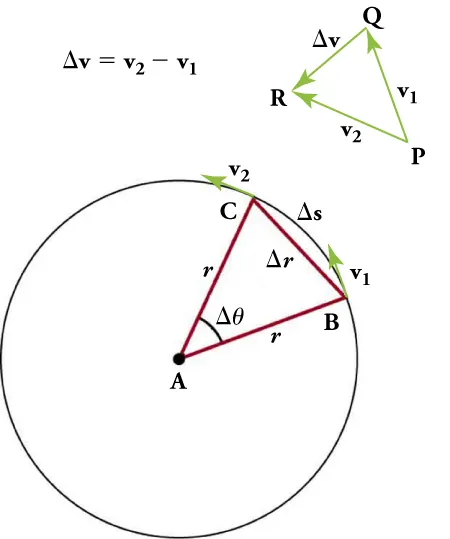
Textbook figure illustrating motion along a circular path with tangential velocity vectors at two points and the corresponding change in velocity directed inward. It visually supports the idea that one revolution corresponds to traveling one full circumference, which underlies computing the period via . Source
For a circle of radius , that distance is . In uniform circular motion, the speed remains constant, so the time for one revolution can be found from the basic idea that time equals distance divided by speed.
= period in seconds,
= radius of the circular path in meters,
= constant speed in meters per second,
This equation applies only when the object moves with constant speed around a circle. It connects geometry and motion very directly:
A larger radius means a larger circumference, so one revolution takes more time if speed stays the same.
A larger speed means the circumference is covered more quickly, so the period becomes smaller if radius stays the same.
From the same relationship, you can rewrite the motion in other useful forms, such as and . These are not new ideas; they are just different ways of expressing the same circular motion.
How to interpret period and frequency physically
It is helpful to connect the symbols to real motion. If a wheel spins once every , then the wheel has a short period and therefore a high frequency. If a satellite model on a string makes only one revolution every 4 seconds, then the period is long and the frequency is low.
When comparing two cases of uniform circular motion, keep the following patterns in mind:
If radius increases while speed stays constant, then period increases and frequency decreases.
If speed increases while radius stays constant, then period decreases and frequency increases.
If two objects have the same period, they have the same frequency, even if their radii are different.
If two objects have the same speed but different radii, the one with the smaller radius completes each revolution faster.
These comparisons matter because many AP questions test whether you understand the physical meaning of the quantities, not just the algebra.
Common mistakes to avoid
Students often lose points on simple ideas in this topic, especially when moving too quickly between words and equations.
Do not confuse period with total elapsed time. Period means the time for one revolution.
Do not confuse frequency with total number of revolutions. Frequency means revolutions per second.
Use the radius, not the diameter, in the circumference .
Keep units consistent. Period should come out in seconds, and frequency in hertz.
Apply only when the motion is uniform, meaning the speed is constant.
A strong understanding of this subtopic comes from recognizing that every formula is tied to one simple picture: an object repeatedly traveling one circumference in a fixed amount of time.
FAQ
In practical settings, especially for motors and wheels, people often use revolutions per minute or rpm because it gives a more convenient-sized number.
To convert:
from rpm to hertz, divide by 60
from hertz to rpm, multiply by 60
For example, $120\ rpm = \dfrac{120}{60} = 2\ Hz$.
In physics problems, hertz is usually easier because it matches SI units and works directly with seconds.
Speed depends only on magnitude, but velocity depends on both magnitude and direction.
In circular motion, the object’s direction changes continuously as it moves around the circle. That means the velocity changes even if the speed stays the same.
So uniform circular motion means:
constant speed
changing direction
therefore changing velocity
This is why circular motion is still accelerated motion, even when the speed does not change.
Start with the period for one full revolution, then scale by the fraction of the circle covered.
Examples:
half a revolution takes $\dfrac{T}{2}$
a quarter revolution takes $\dfrac{T}{4}$
$n$ revolutions take $nT$
You can do the same with distance:
one full revolution is $2\pi r$
a fraction of a revolution gives the same fraction of the circumference
This is useful when the question asks for time or distance over only part of the circular path.
Yes. If two objects have the same frequency, they complete the same number of revolutions each second, but their speeds can still differ if their radii are different.
Since $v=2\pi rf$:
same $f$
different $r$
therefore different $v$
The object on the larger circle travels a greater circumference each revolution, so it must move faster to keep the same frequency.
This idea often appears in rotating rigid bodies, where points farther from the axis move faster even though they go around together.
Look at how the information is stated.
Use period if the question gives:
time for one revolution
time for one cycle
Use frequency if the question gives:
revolutions per second
cycles per second
hertz
Then convert if needed using $f=\dfrac{1}{T}$.
A good habit is to ask:
“Am I given time per revolution?”
or “Am I given revolutions per time?”
That usually tells you immediately which quantity should come first in your solution.
Practice Questions
A particle moves in uniform circular motion with radius and period .
(a) Find its frequency. (b) Find its speed.
1 mark for using and obtaining
1 mark for using and obtaining (or )
A point on the rim of a rotating platform is from the center. The platform makes 90 revolutions in 30 seconds and rotates at constant speed.
(a) Determine the frequency of the motion. (b) Determine the period. (c) Determine the speed of the point. (d) How much time does the point take to complete 15 revolutions? (e) What total distance does the point travel in those 15 revolutions?
1 mark for
1 mark for
1 mark for
1 mark for time for 15 revolutions:
1 mark for distance in 15 revolutions:
