AP Syllabus focus:
‘The peripheral nervous system carries messages between the central nervous system and the rest of the body.’
The peripheral nervous system (PNS) is the body’s communication network linking the brain and spinal cord to organs, muscles, and skin. Understanding its wiring and message flow clarifies how the CNS receives sensory input and sends commands outward.
What the Peripheral Nervous System Is
The PNS includes all neural tissue outside the brain and spinal cord. It enables information to travel between the central nervous system (CNS) and the rest of the body, supporting sensation, movement, and reflexive responding.
Peripheral nervous system (PNS): All nerves and ganglia outside the brain and spinal cord that carry messages between the CNS and the rest of the body.
A practical way to remember the syllabus emphasis is that the PNS is a two-way route: signals go to the CNS and from the CNS.
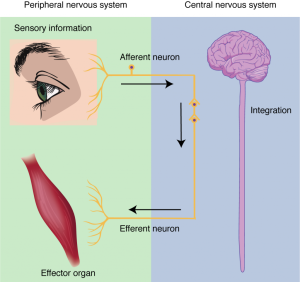
This diagram summarizes the PNS as a bidirectional communication link: sensory (afferent) neurons carry information from peripheral receptors into the CNS, while motor (efferent) neurons carry commands out to effector organs. The arrows visually reinforce that “afferent = toward the CNS” and “efferent = away from the CNS,” which is the core directional logic behind PNS signaling. Source
Core Structures of the PNS
Nerves (the “cables”)
A nerve is a bundle of many neuron axons traveling together in the PNS. Nerves vary in size and function, but their shared role is efficient long-distance transmission.
Nerve: A bundle of axons in the PNS that transmits information to and from the CNS.
Key features that support fast, reliable signalling:
Connective tissue coverings protect axons and supply blood flow.
Myelin on many peripheral axons increases conduction speed (myelin in the PNS is produced by Schwann cells, though cell types are usually addressed in neuron-focused units).
Mixed nerves can carry both incoming and outgoing traffic in different fibres within the same nerve.
Ganglia (the “relay hubs”)
Ganglia are clusters of neuron cell bodies located in the PNS.
They commonly serve as waypoints where information can be routed or modulated before reaching the CNS or peripheral targets.
Ganglion: A cluster of neuron cell bodies in the PNS.
Message Direction: To the CNS vs From the CNS
Although many nerves contain a mixture of fibres, the flow of information is often described by direction relative to the CNS.
Afferent pathways: sensory input to the CNS
Afferent fibres carry information from receptors to the CNS. Receptors transduce physical energy (e.g., pressure on skin) into neural signals that enter the spinal cord or brainstem.
Afferent (sensory) fibres: Nerve fibres that carry information from the body’s sensory receptors toward the CNS.
Common sources of afferent input include:
Skin (touch, temperature, pain)
Muscles and joints (position and movement feedback)
Internal organs (stretch, chemical changes)
Efferent pathways: motor output from the CNS
Efferent fibres carry information from the CNS to effectors, such as muscles and glands, producing action or physiological change.
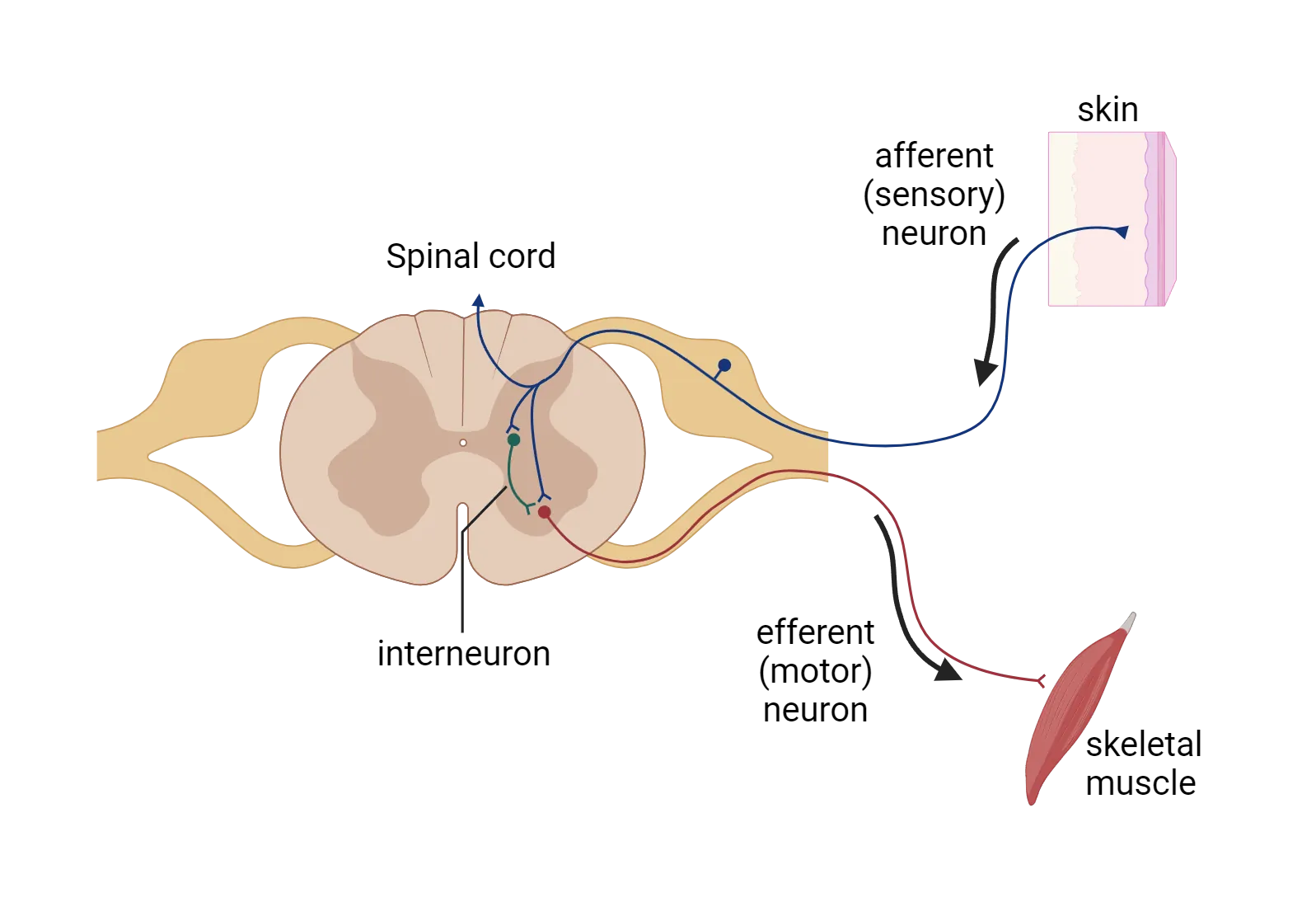
This figure diagrams a simple sensorimotor pathway: sensory (afferent) input from the periphery enters the spinal cord, is integrated within the CNS, and motor (efferent) output exits to drive a skeletal muscle response. It helps you see how “to the CNS” and “from the CNS” pathways are physically organized around the spinal cord, making the abstract afferent/efferent distinction concrete. Source
Efferent (motor) fibres: Nerve fibres that carry commands from the CNS to muscles and glands.
Efferent output typically involves:
Activating muscle fibres to contract
Signalling glands to release secretions
Coordinating multi-muscle actions by distributing CNS commands across many peripheral branches
How the PNS Connects the Body to the CNS
The PNS interfaces with the CNS primarily through two major entry/exit routes:
Spinal nerves, which connect with the spinal cord and serve much of the body below the head
Cranial nerves, which connect with the brain and serve much of the head and neck (and some internal organs)
The key AP-level idea is not memorising every nerve, but understanding that these pathways allow the PNS to carry messages between the CNS and the rest of the body, integrating sensation and action.
What “Carrying Messages” Means in Practice
The PNS supports communication by:
Linking receptors to processing centres: sensory information reaches the CNS for interpretation and decision-making.
Linking processing centres to effectors: CNS instructions reach muscles and glands to generate behaviour.
Maintaining signal fidelity over distance: bundling axons into nerves and insulating many fibres helps messages travel efficiently.
Enabling rapid responses: peripheral wiring provides the physical routes that make quick, coordinated responding possible.
Practice Questions
Define the peripheral nervous system and state its main function. (3 marks)
Identifies that the PNS consists of nerves (and/or ganglia) outside the brain and spinal cord. (1)
States that it connects the CNS with the rest of the body. (1)
States that it carries messages to and from the CNS (e.g., sensory to CNS and motor from CNS). (1)
Explain how the peripheral nervous system carries information between the central nervous system and the rest of the body. In your answer, refer to afferent and efferent pathways and at least one PNS structure. (6 marks)
Describes afferent pathways carrying sensory information from receptors towards the CNS. (1)
Describes efferent pathways carrying motor commands from the CNS to effectors (muscles/glands). (1)
Correctly refers to nerves as bundles of axons that transmit signals in the PNS. (1)
Correctly refers to ganglia as clusters of cell bodies in the PNS and links them to routing/relay. (1)
Explains that these pathways allow two-way communication between CNS and body. (1)
Includes accurate additional detail (e.g., mixed nerves can contain both fibre types; cranial/spinal nerves as main routes). (1)
FAQ
A nerve is a bundle of axons in the PNS.
A tract is a bundle of axons within the CNS (brain/spinal cord), often with different supporting cells and organisation.
Peripheral axons may regrow under some conditions because local support cells can guide regrowth.
Recovery depends on factors like the gap size, alignment, and whether the neuron’s cell body survives.
Pressure can disrupt normal signalling in sensory fibres, leading to abnormal firing patterns interpreted as tingling.
When pressure is removed, signalling gradually normalises as blood flow and conduction recover.
A dermatome is an area of skin mainly supplied by sensory fibres from a single spinal nerve root.
Patterns of numbness or pain across dermatomes can help localise where a peripheral or root-level problem may be.
Many local anaesthetics reduce action potential transmission by blocking voltage-gated sodium channels in peripheral axons.
This prevents sensory signals from reaching the CNS, reducing pain perception from the affected area.