AP Syllabus focus:
‘The autonomic nervous system regulates involuntary processes and includes the sympathetic and parasympathetic divisions.’
The autonomic nervous system (ANS) is a major control system for involuntary body functions. AP Psychology emphasizes how its two divisions coordinate arousal and recovery to support stable, adaptive functioning in everyday life.
Core idea: involuntary regulation
The ANS continuously adjusts internal conditions without conscious effort, helping maintain homeostasis (stable internal balance) while responding flexibly to changing demands (e.g., stress, rest, digestion).
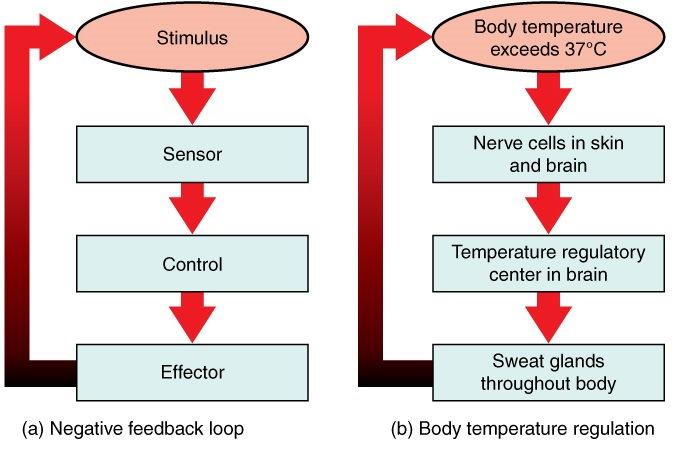
This figure summarizes the logic of homeostasis as a negative feedback loop: a change in a variable is detected by a sensor, evaluated by a control center, and corrected by an effector. It provides a visual model for how autonomic adjustments (like heart rate or sweating) can stabilize internal conditions while still allowing rapid responses to challenges. Source
Autonomic nervous system (ANS): A division of the nervous system that automatically regulates involuntary bodily processes such as heart rate, breathing, and digestion.
This regulation is typically fast, coordinated, and organ-specific, meaning different body systems can be adjusted independently (e.g., increasing heart rate while slowing digestion).
The two divisions of the ANS
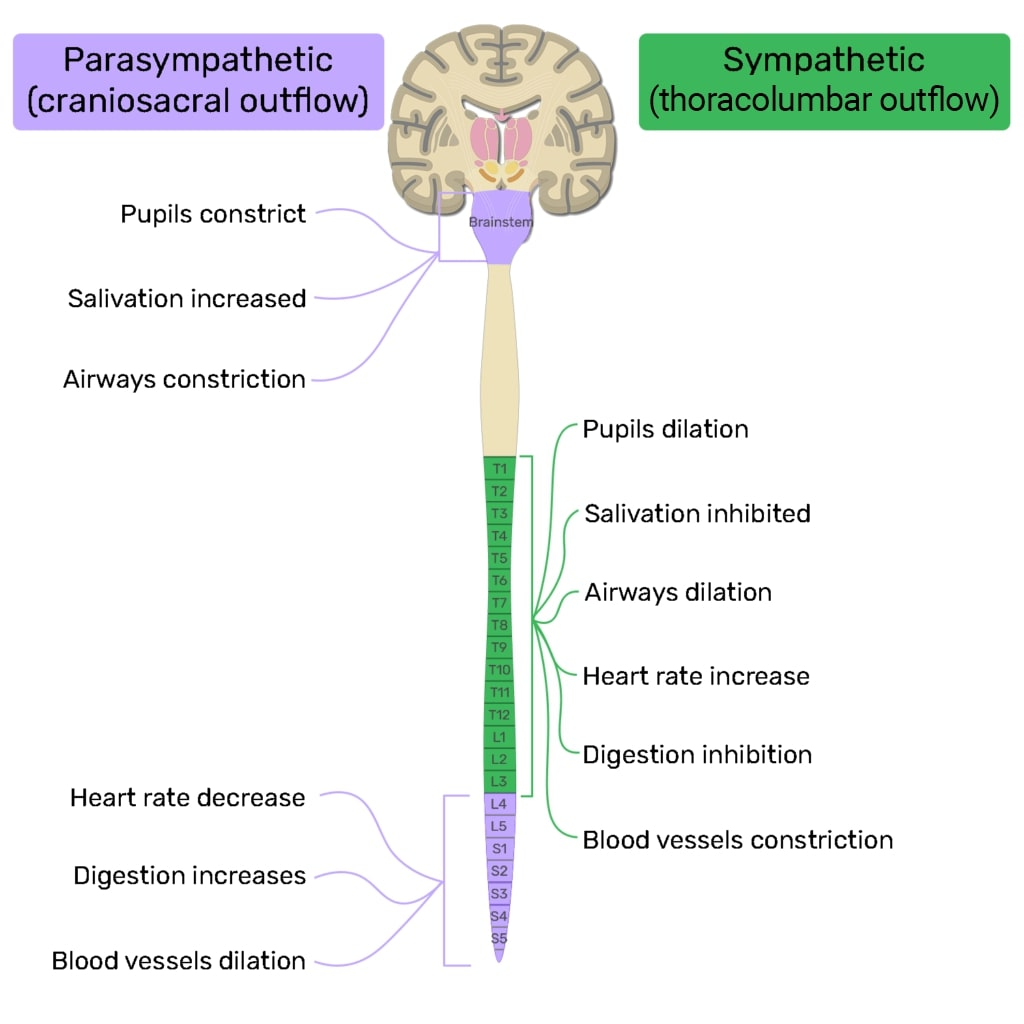
This diagram maps the two autonomic pathways from the central nervous system to key organs, with sympathetic outflow contrasted against parasympathetic outflow. The color-coding makes it easier to see how many organs receive input from both divisions, supporting the idea of flexible, organ-specific regulation rather than a single global “on/off” state. Source
A central AP idea is that the ANS includes the sympathetic and parasympathetic divisions, which often have opposing effects on the same organs.
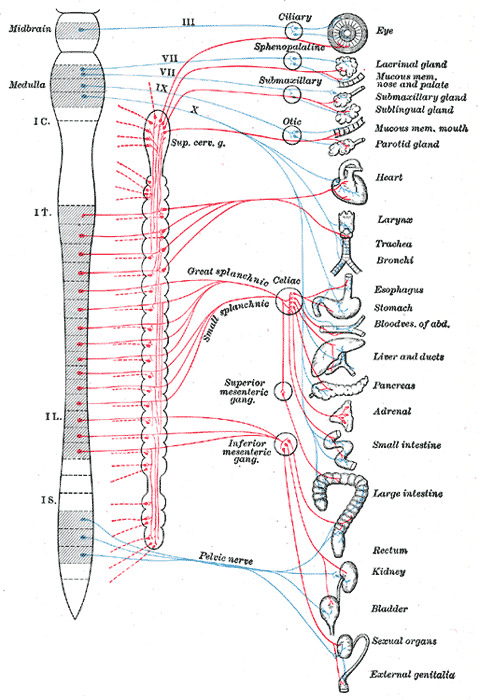
This anatomy figure illustrates where sympathetic and parasympathetic fibers originate and how they project to different regions of the body. Seeing the pathways alongside target organs helps explain why the divisions can produce coordinated, sometimes opposing effects on the same organ systems. Source
Sympathetic division: mobilisation (arousal)
The sympathetic nervous system supports “fight-or-flight” responding by preparing the body for action when a threat or challenge is perceived.
Sympathetic division: The ANS division that increases physiological arousal and mobilises energy for action, especially under stress.
Common sympathetic effects (you should be able to link each to “readiness for action”):
Heart: increases heart rate and force of contraction
Lungs: opens airways to increase oxygen intake
Eyes: pupil dilation to improve visual intake
Energy use: releases stored energy for quick access
Digestion: slows digestive activity (resources shift away from “maintenance”)
Skin: increases sweating for cooling during exertion
Parasympathetic division: restoration (calming)
The parasympathetic nervous system supports “rest-and-digest” functioning by conserving energy and promoting recovery, growth, and routine maintenance.
Key parasympathetic effects (connect each to “recovery and conservation”):
Heart: slows heart rate
Lungs: narrows airways back toward baseline
Eyes: constricts pupils under normal lighting
Digestion: increases digestive activity and nutrient absorption
Energy use: supports storage and efficient long-term regulation
How the divisions work together
The sympathetic and parasympathetic divisions are best understood as a coordinated system rather than a simple on/off switch.
Dual influence: Many organs receive signals that can push activity up (sympathetic) or down (parasympathetic), allowing precise control.
Dynamic balance: Everyday functioning depends on shifting dominance—sympathetic activity rises with stress or urgency; parasympathetic activity rises during relaxation and recovery.
Adaptive responding: The same environment can produce different ANS patterns depending on interpretation (e.g., excitement vs fear can share arousal but differ in context and regulation).
Psychological relevance for AP Psychology
In AP Psychology, the ANS matters because it connects mental processes (perception, appraisal, emotion) to bodily states that shape behaviour.
Emotion and arousal: ANS activation contributes to the physical component of emotion (e.g., racing heart, “butterflies”).
Stress responding: Sympathetic activation supports immediate coping, while parasympathetic activation supports recovery after the stressor ends.
Performance and attention: Moderate arousal can support alertness; excessive arousal can disrupt focus, decision-making, and fine motor control.
Practice Questions
Explain one way the sympathetic division affects the body during a stressful situation. (2 marks)
1 mark for identifying a correct sympathetic effect (e.g., increased heart rate, dilated pupils, reduced digestion).
1 mark for linking it to stress readiness/action (e.g., “prepares the body for fight-or-flight”).
Describe how the autonomic nervous system regulates involuntary processes and compare the roles of the sympathetic and parasympathetic divisions. Use examples of bodily changes in your answer. (6 marks)
1 mark for stating the ANS regulates involuntary processes (e.g., heart rate, breathing, digestion).
1 mark for identifying the sympathetic division as increasing arousal/mobilising action.
1 mark for identifying the parasympathetic division as calming/restoring maintenance.
Up to 3 marks for accurate paired examples (any three, 1 mark each):
Sympathetic increases heart rate vs parasympathetic decreases it
Sympathetic dilates pupils vs parasympathetic constricts pupils
Sympathetic inhibits digestion vs parasympathetic stimulates digestion
Sympathetic opens airways vs parasympathetic returns airways towards baseline
FAQ
Most pathways use a two-step relay: one neurone from the CNS to an autonomic ganglion, then a second neurone to the target organ.
No. Some targets are mostly sympathetic-controlled (e.g., many sweat glands), meaning regulation relies more on changing sympathetic output than balancing two opposing inputs.
Vagal tone refers to parasympathetic influence via the vagus nerve on the heart. Higher vagal tone is often associated with calmer baseline physiology and better recovery after stress.
Partly. Techniques like paced breathing and biofeedback can increase awareness and indirect control (often by enhancing parasympathetic activity), even though the ANS is primarily involuntary.
Both can involve sympathetic arousal (e.g., faster heart rate). Differences often come from cognitive appraisal and how quickly parasympathetic processes restore balance afterwards.