AP Syllabus focus:
‘The central nervous system includes the brain and spinal cord and interacts with all processes in the body.’
The central nervous system (CNS) is the body’s command and integration network. It receives information, processes it, and coordinates responses that support thought, emotion, movement, and internal regulation across all organ systems.
Core idea: what the CNS is
The central nervous system is the portion of the nervous system responsible for central control and integration of information.
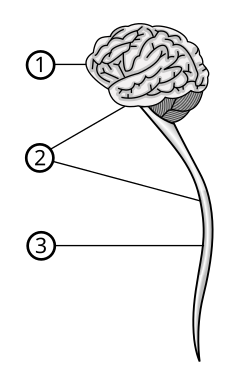
Labeled schematic of the human central nervous system highlighting the brain and spinal cord as a single integrated control network. Use it to connect the definition of the CNS to the idea that the spinal cord is both a communication highway and a site of rapid, organized responses. Source
Central nervous system (CNS): The brain and spinal cord, which together receive, integrate, and generate neural signals that coordinate behavior and bodily functions.
Because the CNS “interacts with all processes in the body,” it continuously links perception, cognition, and action to internal states like temperature, energy balance, and arousal.
The two main structures
Brain: primary site for information processing, interpretation, planning, and regulation of many automatic and voluntary functions.
Spinal cord: major signal pathway connecting the brain with the rest of the body; also supports fast, organized responses to incoming information at the level of the cord.
Spinal cord: A column of neural tissue within the vertebral canal that transmits information between the brain and the body and helps coordinate some immediate responses without requiring full brain processing.
How the CNS interacts with the whole body
CNS interaction with “all processes” can be understood as a continuous loop of input, integration, and output.
Input to the CNS (incoming information)
Incoming signals convey sensory information (e.g., touch, pain, body position, internal organ status).
The CNS uses these inputs to maintain homeostasis (stable internal conditions) and to guide behavior.
Integration within the CNS (processing and coordination)
Networks of neurons in the brain and spinal cord combine signals, compare them to stored information, and prioritise responses.
Integration supports:
Perception (making sense of sensory input)
Cognition (attention, memory, decision-making)
Emotion and motivation (coordinating feelings with actions)
Motor planning (organizing voluntary movement)
Output from the CNS (outgoing commands)
Outgoing signals coordinate:
Skeletal muscle activity (movement, speech, posture)
Organ function (heart rate, digestion, breathing patterns) through CNS control centers that influence bodily systems
Stress and arousal responses, aligning behavior with internal needs and environmental demands
Protective features of the CNS
Because the CNS is essential for survival and behavior, it is heavily protected.
Physical protection: bone and membranes
Skull protects the brain; vertebrae protect the spinal cord.
Meninges are protective membranes surrounding both brain and spinal cord.
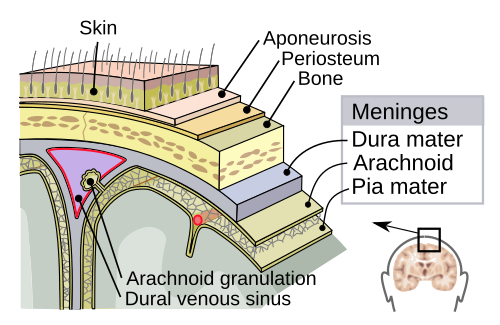
Cross-sectional diagram showing the meninges as layered protective membranes around the brain: dura mater (outer), arachnoid mater (middle), and pia mater (inner). This visual makes it easier to remember that the meninges are not one sheet, but a multi-layer barrier system that physically protects CNS tissue. Source
Meninges: Three layers of protective tissue (dura mater, arachnoid mater, pia mater) that surround the brain and spinal cord.
Fluid cushioning and chemical stability
Cerebrospinal fluid (CSF) helps cushion neural tissue and stabilise the CNS environment.
Cerebrospinal fluid (CSF): Clear fluid that circulates around the brain and spinal cord, providing cushioning, buoyancy, and waste clearance support.
The CNS also relies on the blood-brain barrier to help regulate what substances move from blood into brain tissue.
Blood-brain barrier (BBB): A selective barrier that limits many substances in the bloodstream from entering brain tissue, helping maintain a stable chemical environment for neural functioning.
Organization inside the CNS (high-yield structure-function links)
A useful way to describe CNS organization is by distinguishing tissue types and pathways that support rapid communication.
Gray matter vs. white matter (functional shorthand)
Gray matter: dense with cell bodies and synapses; often associated with processing and integration.
White matter: rich in myelinated axons; supports fast communication between CNS regions and between brain and spinal cord.
Why this matters for behavior and mental processes
The CNS is not just “where the brain is”; it is the central system that enables:
coordinated behavior (from simple movements to complex planning)
mental processes (thought, emotion, memory)
continuous regulation of bodily states, allowing the organism to adapt to changing demands
Practice Questions
Identify the two main structures of the central nervous system and state one function of the CNS. (2 marks)
Brain and spinal cord identified (1 mark).
Any accurate CNS function stated (e.g., integrates information; coordinates responses; interacts with bodily processes) (1 mark).
Explain how the central nervous system interacts with processes in the body. In your answer, refer to the roles of the brain and spinal cord and at least two protective features of the CNS. (6 marks)
CNS defined as brain + spinal cord.
Brain described as central processing/integration/coordination.
Spinal cord described as transmission pathway between brain and body (and/or coordinating rapid responses).
Interaction described as input–integration–output (sensory information in; commands out).
One protective feature explained (e.g., skull/vertebrae; meninges).
Another protective feature explained (e.g., CSF cushioning; BBB selective chemical protection).
FAQ
It relies on tight junctions between capillary cells and selective transport proteins.
Small lipid-soluble molecules pass more easily; many large or water-soluble substances require specific carriers.
Most CSF is produced by the choroid plexus within brain ventricles.
It flows through the ventricular system and around the brain and spinal cord, then is reabsorbed into the bloodstream via specialised structures.
Ascending pathways carry sensory signals towards the brain, and descending pathways carry motor commands from the brain.
Damage can disrupt one or both directions, producing characteristic patterns of loss depending on the level and completeness of injury.
They are potential/actual spaces relative to the meninges layers.
Their clinical importance is that bleeding in different spaces places pressure on the brain/spinal cord in different ways and can require different urgent interventions.
Some limited recovery can occur through changes in surviving circuits, but regeneration of many CNS axons is restricted.
Outcomes depend on location, extent of damage, and timing/quality of medical and rehabilitative care.