AP Syllabus focus:
‘The somatic nervous system governs voluntary processes.’
The somatic nervous system (SNS) is the part of the nervous system most directly tied to deliberate, controllable behavior. It links the brain and spinal cord to sensory input and to the skeletal muscles that produce voluntary movement.
What the Somatic Nervous System Is
The somatic nervous system is typically described as a functional subdivision of the peripheral nervous system that supports voluntary control and conscious awareness of many bodily sensations.
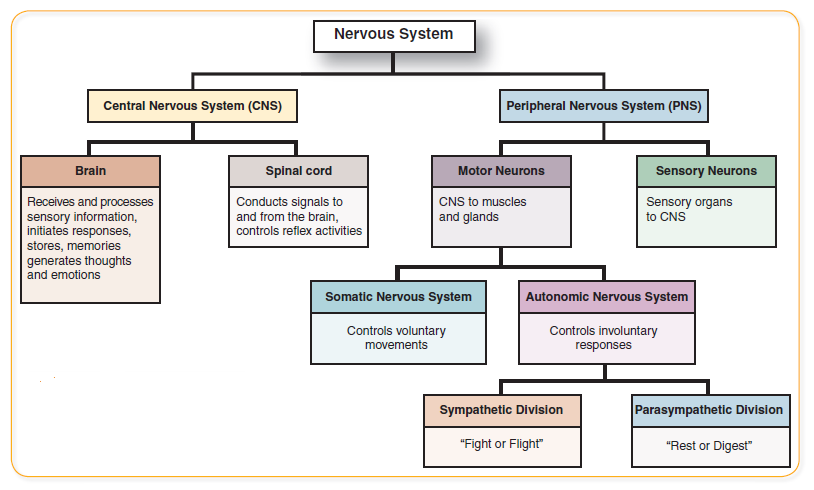
Flowchart of nervous system organization showing how the peripheral nervous system divides into sensory and motor components, and how the motor division includes the somatic (voluntary) and autonomic (involuntary) systems. This is a helpful “big picture” map for quickly locating the somatic nervous system in the AP Psych nervous-system hierarchy. Source
Somatic nervous system: The division of the peripheral nervous system that carries sensory information to the central nervous system and sends motor commands from the central nervous system to skeletal muscles to control voluntary movement.
Because the syllabus emphasises that the SNS “governs voluntary processes,” focus on how it enables intentional action: choosing to speak, write, walk, or lift an object, and adjusting movement based on ongoing sensory feedback.
Core Roles in Voluntary Processes
Voluntary motor control (skeletal muscles)
The SNS is responsible for activating skeletal muscles to carry out voluntary actions. Key ideas for AP Psychology:
Voluntary actions begin with motor planning and motor commands generated in the central nervous system.
Commands travel through peripheral motor pathways to specific muscles.
Fine motor skills (e.g., handwriting) rely on rapid, precise SNS signalling.
Sensory input that supports voluntary action
The SNS also conveys sensory information that helps guide controlled movement and conscious experience, such as:
Touch and pressure from the skin
Muscle and joint feedback that helps you monitor limb position and movement
Signals that help you correct actions mid-movement (e.g., tightening your grip if an object starts slipping)
Information Flow: Sensory In, Motor Out
Afferent (sensory) direction: body to CNS
Sensory receptors detect stimulation and send signals toward the spinal cord and brain. This incoming stream supports:
Conscious perception (noticing a stimulus)
Continuous updating of movement (adjusting posture, grip, and direction)
Efferent (motor) direction: CNS to body
Outgoing motor signals travel from the brain/spinal cord to skeletal muscle fibers, producing contraction and movement.
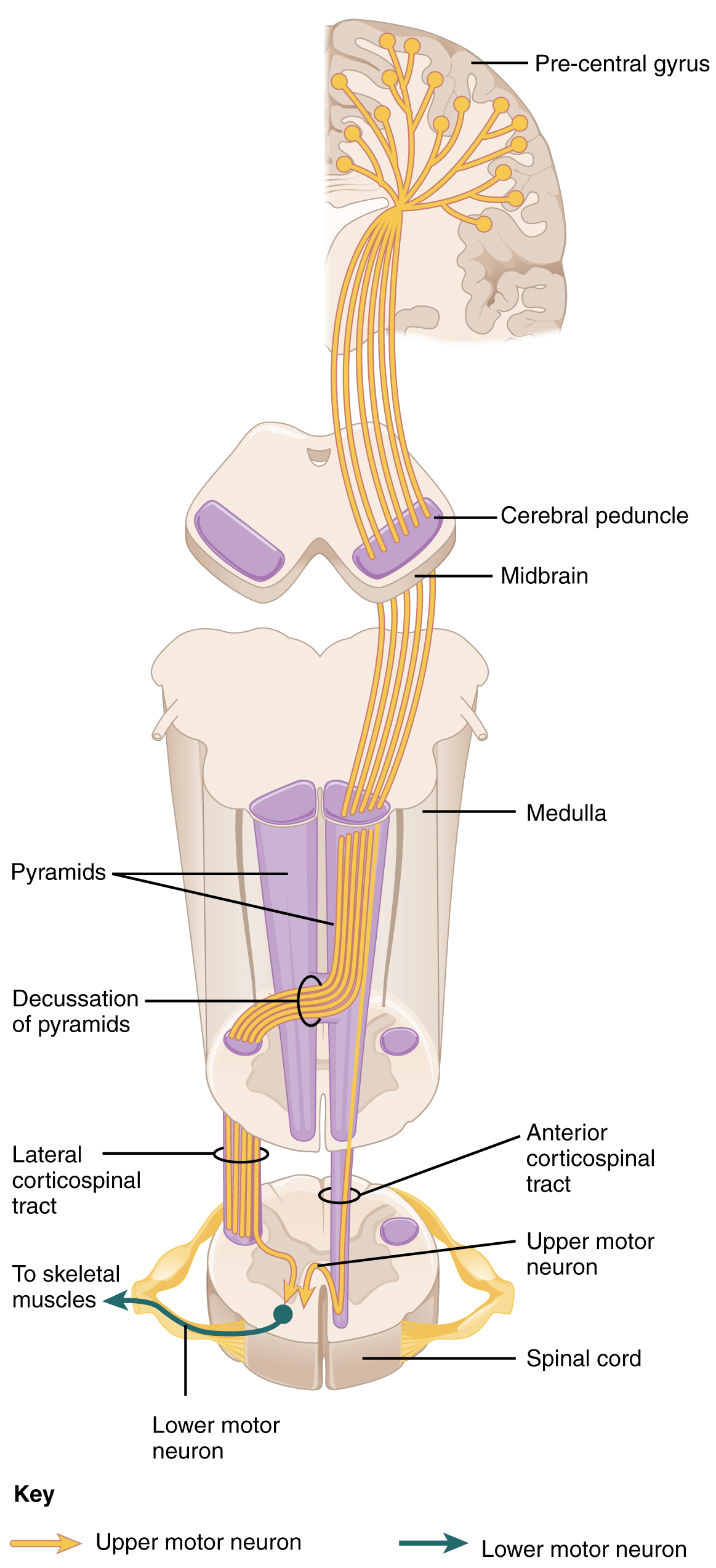
Diagram of the corticospinal (pyramidal) pathway, illustrating how voluntary motor commands descend from the precentral gyrus to the spinal cord and ultimately activate lower motor neurons that innervate skeletal muscle. It visually distinguishes upper vs. lower motor neurons and highlights the decussation (crossing) that helps explain contralateral control of movement. Source
This pathway supports:
Initiation of voluntary movement (deciding to act)
Scaling force and timing (gentle vs. strong, slow vs. fast)
Coordinating multiple muscles into a single intended action
Afferent: Carrying sensory information toward the central nervous system.
Efferent: Carrying motor commands away from the central nervous system to effectors such as skeletal muscles.
A practical way to remember the SNS is that it supports both the “input” you can often report (what you feel) and the “output” you can often choose (what you do), aligning with the syllabus focus on voluntary processes.
What “Voluntary” Means in Practice
“Voluntary” does not mean effortless. Many voluntary skills become smoother with practice, but they still rely on somatic pathways to:
Execute learned motor programs (e.g., typing) under intentional control
Pause, stop, or change an action when goals change
Translate decisions into observable behaviour via muscle movement
Common AP Psychology Applications
Understanding the SNS helps explain everyday psychological phenomena tied to voluntary action:
Reaction time differences when tasks require deliberate responding
Performance changes when attention is divided (voluntary control is limited)
Behavioural effects of fatigue or stress when controlling precise movements becomes harder
Practice Questions
Describe one function of the somatic nervous system. (2 marks)
1 mark: Identifies that it controls voluntary movement of skeletal muscles.
1 mark: Adds an accurate detail, e.g., carries motor commands from CNS to muscles or carries sensory information to CNS to guide movement.
Explain how the somatic nervous system supports voluntary behaviour, referring to both sensory input and motor output. (6 marks)
1 mark: States SNS governs voluntary processes/voluntary behaviour.
1 mark: Explains motor (efferent) commands travel from CNS to skeletal muscles.
1 mark: Links motor output to initiation/execution of chosen movement.
1 mark: Explains sensory (afferent) signals travel from body to CNS.
1 mark: Links sensory input to guiding/correcting voluntary movement.
1 mark: Uses accurate terminology (e.g., “afferent/efferent”, “skeletal muscles”, “CNS”) in context.
FAQ
It helps fine-tune timing and force by integrating rapid sensory feedback (touch, muscle/joint signals) with precise motor output.
Training strengthens coordination patterns, reducing unnecessary muscle activation and improving accuracy under voluntary control.
Yes, some movements can continue with reduced feedback, but accuracy typically worsens.
When sensory input is limited (e.g., numb fingertips), the CNS has less information for error correction, so voluntary actions become clumsier.
Motor neurons activate muscle fibres at specialised junctions, triggering contraction.
The strength of movement depends on which motor units are recruited and how frequently they are activated.
Practice can make control more efficient, so actions require less attention while remaining under voluntary control.
You can usually stop or alter the behaviour intentionally, which distinguishes it from truly involuntary processes.
Damage can disrupt sensory input (reduced touch/position sense) and/or motor output (weakness or paralysis) in the affected area.
Recovery depends on factors such as severity, location, and whether nerve fibres can regenerate effectively.